Stamp Duty in West Bengal 2026: Rates, Women, Fees and the End of the Rebate
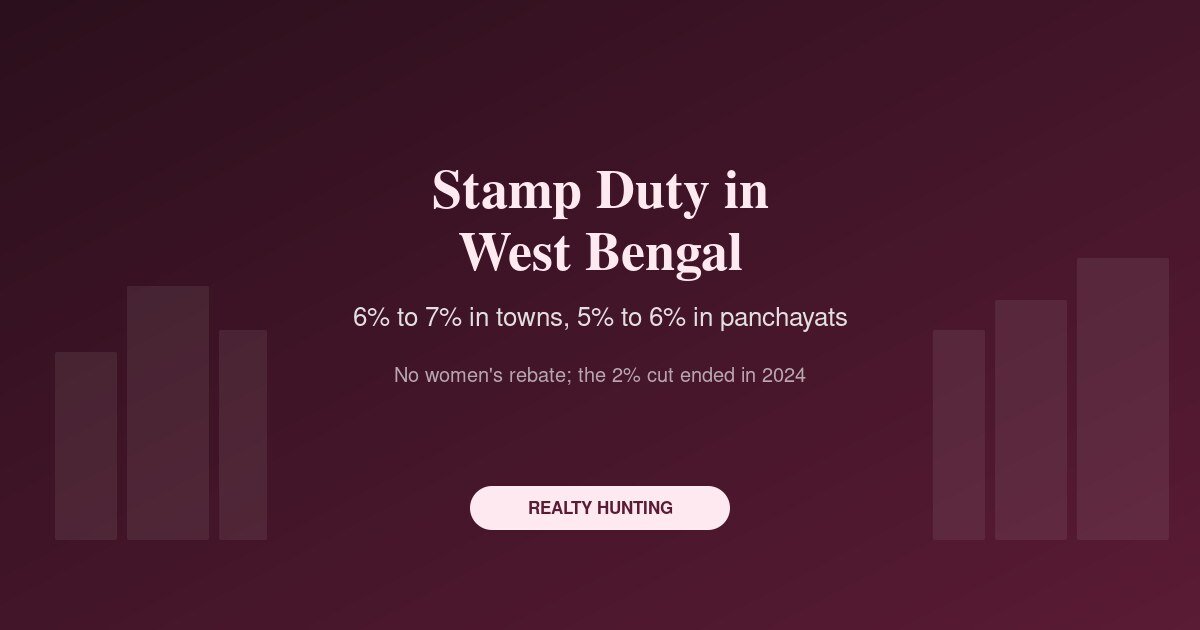
Stamp duty in West Bengal is 6% on property worth up to Rs 1 crore in a municipal or corporation area such as Kolkata or Howrah, and 7% above that. In panchayat areas it is 5% and 6%. Add a registration fee of about 1% of the market value. Men and women pay the same, and the Covid-era 2% rebate ended on 30 June 2024.
Key takeaways
- Four rates, set by where the property is and what it's worth: 6% or 7% in municipal areas, 5% or 6% in panchayat areas, with the step at Rs 1 crore.
- The registration fee is 1% of the market value on most guides; some put it at 1.1%. Either way it applies statewide.
- The 2% stamp duty cut and 10% market value cut, running since October 2021, were not renewed after 30 June 2024.
- West Bengal has no stamp duty concession for women buyers.
- Gifts to close family pay 0.5% stamp duty; a partition deed pays 0.5% on the separated shares. The 1% registration fee still applies to both.
- Mutation in most municipalities now starts automatically from the registration record through e-Nathikaran.
The four rates, and which one is yours
West Bengal decides the rate on two questions: is the property inside a municipal corporation or municipality, and is its value above Rs 1 crore? The value tested is the higher of the price in the deed and the market value set by the registration department.
| Location | Up to Rs 1 crore | Above Rs 1 crore | Registration fee |
|---|---|---|---|
| Kolkata, Howrah and other corporation or municipal areas | 6% | 7% | About 1% |
| Panchayat (rural) areas | 5% | 6% | About 1% |
The same rates apply to a flat, a house and a plot. Suburbs matter here: a plot on the fringe of Kolkata may still sit in a gram panchayat rather than a municipality, which saves a full percentage point. Check the jurisdiction the registration portal shows for the mouza, not the postal address. For how West Bengal compares with other states, see our national stamp duty guide.
The Rs 1 crore step
Most calculators apply the higher rate to the whole value once you cross Rs 1 crore, not just to the part above it. If that's how your deed is assessed, the step is steep:
| Market value (municipal area) | Rate | Stamp duty |
|---|---|---|
| Rs 1,00,00,000 | 6% | Rs 6,00,000 |
| Rs 1,01,00,000 | 7% | Rs 7,07,000 |
Rs 1 lakh more on the value means Rs 1.07 lakh more in duty. Splitting parking or fit-outs into a separate agreement to stay under the line only helps if the market value the department assigns is also below Rs 1 crore, because duty is charged on the higher figure, and a registrar who sees an artificial split can reassess the whole deal. Confirm on the e-Assessment slip (below) before you plan around it.
The rebate that ended in July 2024
In July 2021 the state cut stamp duty by 2 percentage points and market values by 10% to revive sales after the pandemic. From October 2021 a Kolkata flat under Rs 1 crore paid 4% instead of 6%, and a panchayat property 3% instead of 5%. The relief was extended several times, the last time until 30 June 2024, and the state announced it would end from 1 July 2024. It has not come back.
That matters because a lot of what you'll read online, including builder brochures and older bank pages, still quotes 4% or 5%. CREDAI West Bengal's response at the time was to ask the government to revise circle rates instead, which tells you where the industry thought the pressure lay. Our Kolkata real estate market study gives the 5% to 7% band in brief; the full rate grid is above.
What the end of the rebate did to a typical flat
Take an Rs 80 lakh flat in the Kolkata Municipal Corporation area, with the price above the market value.
| Item | Before 1 July 2024 | Now |
|---|---|---|
| Stamp duty | Rs 3,20,000 (4%) | Rs 4,80,000 (6%) |
| Registration fee (1%) | Rs 80,000 | Rs 80,000 |
| Total | Rs 4,00,000 | Rs 5,60,000 |
That's Rs 1.6 lakh more, all of it payable in cash on the day of registration. If your office charges the fee at 1.1%, add Rs 8,000.
Market value and the e-Assessment slip
West Bengal calls its floor rate the market value; buyers and portals call it the circle rate. The portal computes it for your property from the details you enter, such as district, mouza, road and use, rather than giving you a single printed rate. The gap between that figure and real prices is explained in our circle rate vs market rate post.
The practical sequence on wbregistration.gov.in:
- Use the portal's calculator for stamp duty, registration fee and market value to get an early figure.
- Complete the e-Requisition, the public data entry form with the property and the parties.
- The system generates an e-Assessment slip with a 14-digit query number and query year, showing the duty and fee payable.
- Pay through GRIPS, the state's payment gateway, by net banking, SBI ePay, debit card or UPI. Online payment is allowed once duty exceeds Rs 5,000 and compulsory at Rs 5 lakh or more.
- Book the registration and appear at the registry office with the documents on our registration checklist.
Treat the slip as your real number. If the assessed value is higher than your price, the duty follows it.
After registration: e-Nathikaran and mutation
Registering the deed does not change the municipal record. You still need mutation so the property tax bill comes in your name, and West Bengal has joined the two steps. e-Nathikaran, the registration department's system, passes your deed data to the urban development department's online mutation portal at wburbanservices. When you log in there, you'll find a row already filled in, marked "eNathikaran". You check it, upload what's asked, pay the demand notice online and download the mutation certificate. Each municipality sets its own mutation fee from the property's annual value.
Agricultural land and rural plots follow the land records route instead. Our guide to mutation after purchase covers what to do when a mutation is refused or stalls. If the land is described in bigha and katha, our sibling bigha to square feet table has the Bengal figures.
Gifts and partitions within the family
Close family transfers get a much lower rate, and that makes the registration fee the bigger number. A gift to a parent, child, spouse, sibling or lineal ascendant or descendant pays 0.5% stamp duty. A gift to anyone else pays the full conveyance rate for the area.
Take a mother gifting a Rs 60 lakh flat to her son. Stamp duty at 0.5% is Rs 30,000. The registration fee at 1% is Rs 60,000. Total: Rs 90,000. The same flat gifted to a nephew or a friend would cost Rs 3,60,000 in duty plus the Rs 60,000 fee. One source puts the fee on family gifts at 1.2%, which would make it Rs 72,000; the e-Assessment slip settles it. Other states' family rates are compared in our sibling post on gift deed stamp duty.
A partition deed pays 0.5% stamp duty on the market value of the separated share or shares, plus the 1% fee on the same value. Drafting and valuation are covered in our partition deed guide.
Where the West Bengal system costs buyers more
- No break for women. A few calculators show 5% for women or a 1% rebate. The weight of current sources says there is none; don't plan a purchase around one.
- The Rs 1 crore step. Just over the line costs more than the extra value, and you don't control the market value the department assigns.
- Old quotes. Any cost sheet from before July 2024 is 2 percentage points light.
- A heavy fee on family transfers. At 0.5% duty and 1% fee, the fee is two-thirds of the bill.
- Location mistakes. Assume municipal rates until the portal confirms a panchayat jurisdiction; underpaying delays the deed.
Frequently asked questions
What is the stamp duty for women in West Bengal?
The same as for men. West Bengal has no gender concession, so a woman buying a flat worth up to Rs 1 crore in Kolkata pays 6% stamp duty and about 1% registration fee, exactly as a man would. Some calculators still show a lower rate for women, but current bank and portal guides agree there is none.
What is the stamp duty in a panchayat area of West Bengal?
5% of the higher of the price and market value for property up to Rs 1 crore, and 6% above that, plus the registration fee of about 1%. So a Rs 40 lakh plot in a gram panchayat costs Rs 2,00,000 in duty and about Rs 40,000 in fee, Rs 40,000 less than the same deal inside a municipality.
Is the 2% stamp duty rebate still available in West Bengal?
No. The 2% cut in stamp duty and 10% cut in market value began in October 2021, were extended several times and ended on 30 June 2024. From 1 July 2024 the full rates apply: 6% or 7% in municipal areas and 5% or 6% in panchayat areas, depending on whether the value is above Rs 1 crore.
What does a gift deed cost in West Bengal between family members?
Stamp duty is 0.5% of the market value when the gift is to a parent, child, spouse, sibling or other lineal relative, plus a registration fee of about 1%. On a Rs 60 lakh flat that is Rs 30,000 duty and Rs 60,000 fee. A gift to anyone outside that circle is charged at the full conveyance rate.
How do I find the market value of a property in West Bengal?
Use the market value calculator on wbregistration.gov.in with the district, mouza, road and property details, then complete the e-Requisition to get an e-Assessment slip. The slip carries a 14-digit query number and the exact duty and fee, charged on the higher of that value and your price.
If you're buying in Kolkata or anywhere else in Bengal and want the market value and full cost checked before you sign, Realty Hunting can help you work it out.