Office Leasing Rises 9% to 18.7 Million Sq Ft in the September Quarter: Bengaluru Leads, NCR Doubles
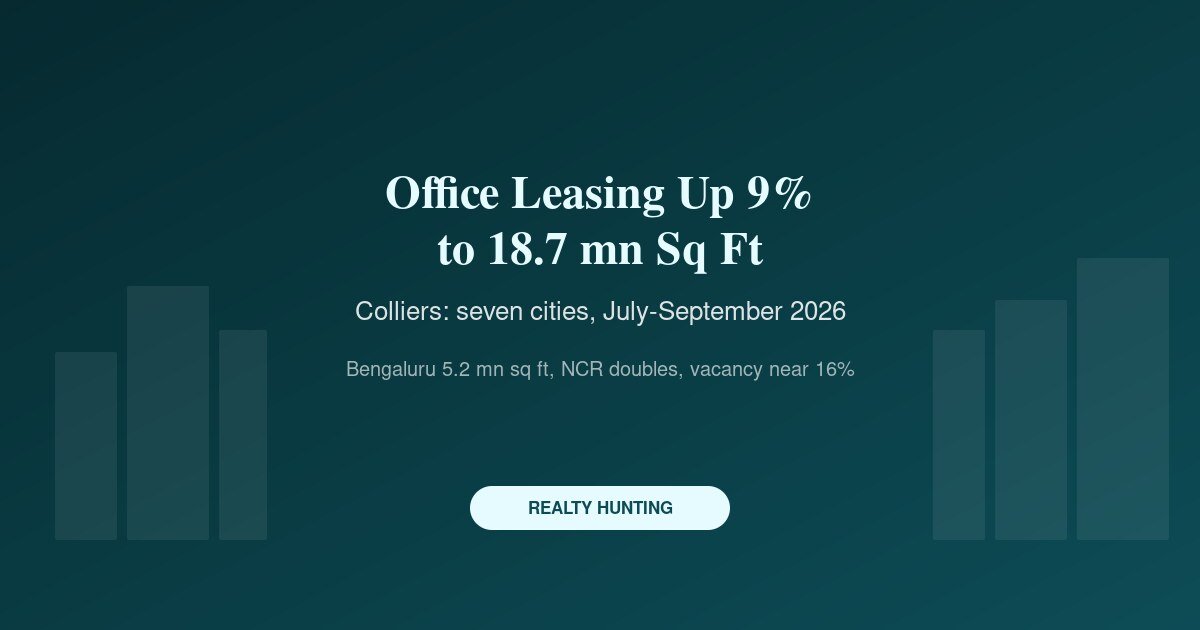
Office leasing in India's seven biggest cities rose 9% in July-September 2026, to 18.7 million sq ft from 17.2 million a year earlier, according to Colliers. Bengaluru led with 5.2 million sq ft, Delhi-NCR more than doubled to 3.3 million, and Hyderabad grew 47%. Mumbai, Pune and Chennai slipped. New supply of 19.2 million sq ft ran slightly ahead of demand.
Colliers released the numbers on 28 September. For anyone who owns, or is thinking of buying, a pre-leased office unit or a REIT, the detail matters more than the headline. Here is what the data says, city by city.
Key takeaways
- Gross leasing of Grade A offices: 18.7 million sq ft in July-September 2026, up 9% on the year and 7% on April-June's 17.4 million. Colliers calls it a record for a third quarter in recent years.
- January-September leasing reached 54.4 million sq ft, up 7%. Bengaluru took 15.7 million of it, a 29% share.
- Delhi-NCR leasing jumped 106% to 3.3 million sq ft; Hyderabad rose 47% to 2.2 million. Mumbai fell 20%, Chennai 23% and Pune 14%.
- Flex operators leased about 4 million sq ft in the quarter, up 49%, and 12.6 million in nine months, up 37%.
- New supply rose 16% to 19.2 million sq ft, led by Hyderabad (6.7 million). Vacancy was around 16%, a little lower than a year ago but up on the quarter.
The numbers at a glance
| City | Leasing, Jul-Sep 2025 (mn sq ft) | Leasing, Jul-Sep 2026 (mn sq ft) | Change |
|---|---|---|---|
| Bengaluru | about 4.7 | 5.2 | +11% |
| Delhi-NCR | about 1.6 | 3.3 | +106% |
| Pune | about 3.7 | 3.2 | -14% |
| Mumbai | 3.0 | 2.4 | -20% |
| Hyderabad | 1.5 | 2.2 | +47% |
| Chennai | 2.6 | 2.0 | -23% |
| Kolkata | 0.1 | 0.4 | about four times |
| Total | 17.2 | 18.7 | +9% |
Colliers published the 2026 figures and the percentage changes; where the year-ago figure is marked "about", we have worked it back from those two numbers and rounded. The city figures add up to the 18.7 million and 17.2 million totals.
Background: what gross leasing measures
Gross leasing counts every Grade A lease signed in the quarter, including companies moving from one building to another and renewals that come with expansion. It is a measure of deal activity, not of net new demand. That is why supply, vacancy and rents are needed alongside it to judge whether landlords or tenants have the upper hand.
On that score, the quarter was balanced rather than tight. Colliers put new completions at 19.2 million sq ft, up 16%, with Hyderabad adding 6.7 million and Bengaluru 5.4 million. Supply edged past leasing, and vacancy rose on the quarter to around 16%, while staying a little below its level a year earlier. Colliers says average rents in the busiest micro-markets of most cities kept rising, driven by demand for newer, green-certified buildings.
The cities in detail
Bengaluru: still the biggest office market
At 5.2 million sq ft, Bengaluru leased more than any other city for another quarter, and its 15.7 million sq ft over nine months is 29% of the national total. It also added 5.4 million sq ft of new space, so its market stayed roughly in balance.
Delhi-NCR: the sharpest turnaround
NCR leasing more than doubled, from about 1.6 million sq ft to 3.3 million. A jump that size off a weak base partly reflects how soft the same quarter was last year, but it also puts NCR back in second place. Gurugram is the bulk of NCR's office market. For how Grade A buildings compare with older stock there, see our guide to Grade A vs Grade B office space.
Hyderabad: demand up, supply up more
Hyderabad leased 2.2 million sq ft, up 47%, but completed 6.7 million sq ft of new space in the same quarter, three times what it leased. That is the one city where an owner of a new, unlet floor faces real competition for tenants.
Mumbai, Pune and Chennai: a softer quarter
Mumbai fell 20% to 2.4 million sq ft, Chennai 23% to 2 million and Pune 14% to 3.2 million. One quarter's fall in a lumpy series, where a single large deal can swing the total, is not yet a trend.
Who is taking the space
Flex operators, the coworking and managed-office firms, were the fastest-growing tenants: about 4 million sq ft in the quarter, up 49%, and 12.6 million over nine months, up 37%. Conventional leasing was flat at 41.8 million sq ft for January-September. In other words, almost all of this year's growth came from flex operators.
Among conventional tenants, technology firms led, followed by banking and financial services and then engineering and manufacturing; together they took nearly three-quarters of conventional space in the nine months. Colliers expects global capability centres to lease 30-35 million sq ft in 2026, 40-50% of the year's demand.
Why it matters to a small investor
You don't need to own a tower to be exposed to these numbers. If you hold an office REIT, own a pre-leased unit or are weighing one, occupancy and rent growth drive your income.
A worked example on a pre-leased unit
Take a hypothetical 1,000 sq ft unit bought for Rs 1.5 crore and let at Rs 110 per sq ft a month. These are illustrative figures, not quoted market rates. Annual rent is Rs 13.2 lakh (1,000 x 110 x 12), a gross yield of 8.8%. If the tenant leaves and the unit sits empty for six months before re-letting, you lose Rs 6.6 lakh, and the year's yield falls to 4.4%. In a market with 16% vacancy and rising supply, a vacancy gap is the main risk to price in, not a small change in the rent.
Before buying, browse our pre-leased property listings to see what leases and yields look like, and compare it with the REIT route in our REIT investment guide.
An honest view
The headline is strong, but read it carefully. First, the growth is narrow: conventional leasing was flat over nine months, and flex operators supplied the increase. Flex firms re-let space to others on shorter terms, so their demand can reverse faster than a bank's or a tech firm's. Second, supply is keeping pace, and vacancy rose on the quarter. Third, three of the seven cities shrank.
None of that makes offices a bad bet. It means the gains are going to the best buildings in the best locations, and older or poorly located stock has to compete on rent.
Who this is for
- Buyers of pre-leased units: favour Grade A buildings with long leases and established tenants in Bengaluru or NCR; be careful with unlet floors in Hyderabad's new supply.
- REIT investors: leasing momentum supports occupancy, but check each REIT's city mix and lease-expiry schedule.
- Businesses looking for space: with vacancy at about 16%, you can still negotiate rent-free periods and fit-out support, especially in newer supply.
For a wider look at the sector, see our guide to commercial office real estate in India.
Frequently asked questions
How much office space was leased in India in July-September 2026?
Colliers put gross Grade A leasing across seven cities at 18.7 million sq ft in July-September 2026, up 9% from 17.2 million a year earlier and 7% above April-June. Over January-September the total was 54.4 million sq ft, up 7%, with Bengaluru taking about 29% of it.
Which city leased the most office space in the September quarter?
Bengaluru, with 5.2 million sq ft, up 11% on the year. Delhi-NCR was second at 3.3 million sq ft, more than double its level a year earlier, and Pune third at 3.2 million sq ft despite a 14% fall. Hyderabad rose 47% to 2.2 million sq ft.
Is office vacancy in India rising or falling?
Both, depending on the comparison. Colliers put vacancy at about 16% at the end of September 2026, slightly lower than a year earlier but higher than in June, because 19.2 million sq ft of new space was completed in the quarter. Hyderabad, which added 6.7 million sq ft, is where supply is heaviest.
What is driving office demand in 2026?
Flex operators and global capability centres. Flex leasing rose 37% to 12.6 million sq ft in January-September, while conventional leasing stayed flat at 41.8 million sq ft. Technology, financial services and engineering firms took nearly three-quarters of conventional space, and Colliers expects capability centres to account for 40-50% of 2026 demand.
Is a pre-leased office a good investment right now?
It can be, if you buy a Grade A unit with a creditworthy tenant and a long lock-in. The risk is vacancy: with 16% of stock empty and supply rising, a tenant who leaves can cost you months of rent. Check the lease terms, the building's occupancy and the supply coming up nearby before you commit.
If you are looking at a pre-leased office or commercial unit, the Realty Hunting team can check the lease, the tenant and the local supply pipeline with you before you decide.