Commercial Real Estate India: Can You Really Earn 6–9% Yield from Office Spaces?
Most of the conversation about Indian real estate is about residential property. But tthis is a parallel market, commercial real estate, specifically office space, that has been quietly outperforming in 2026 on every metric that matters to investors: leasing volumes, rents, vacancy compression, and rental yields.
If you've been wondering whether commercial property is worth the extra complexity (bigger ticket size, different loan structure, longer lock-in leases), the 2026 data gives a clear answer for the right buyer profile. This piece goes through the numbers, the yield math, the risks, and where the opportunity actually lies.
Key Takeaways
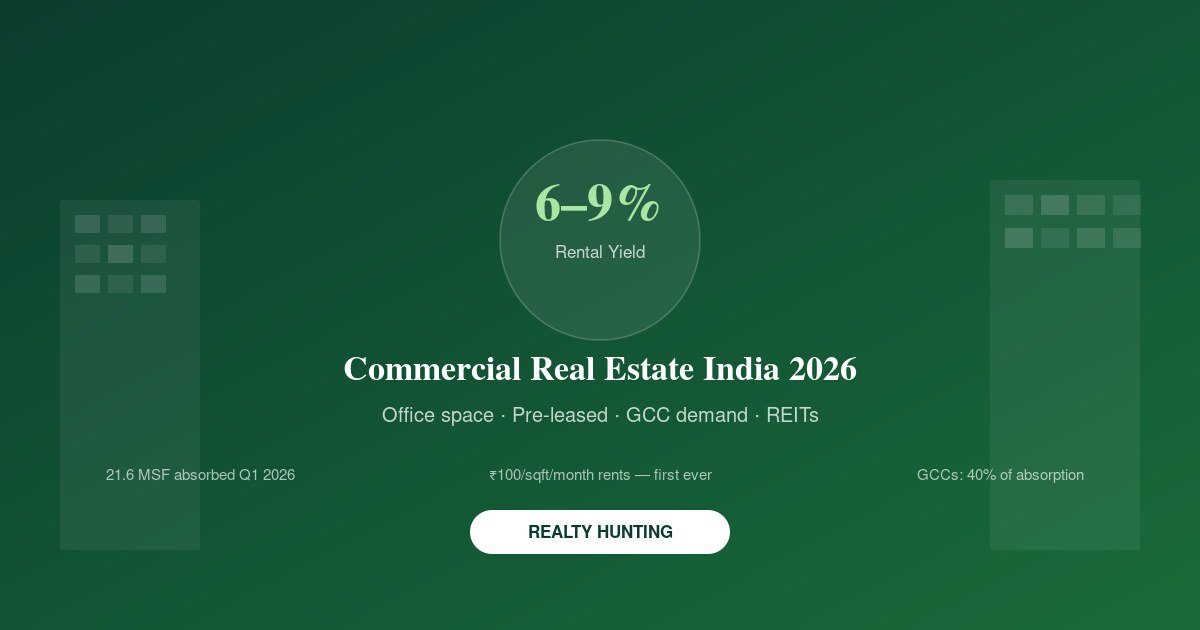
- Q1 2026 office absorption: 21.6 million sqft, the strongest in five years, up 10% year-on-year.
- Pan-India average rents crossed ₹100/sqft/month for the first time in Q1 2026.
- Vacancy tightened to approximately 9.5% pan-India; Bengaluru and Delhi NCR at multi-year lows.
- Hyderabad office rents grew 12% year-on-year; Delhi NCR up 10%.
- Gross rental yield on commercial property: 6–9% depending on city and grade.
- Global Capability Centres (GCCs) drove 40% of total office absorption in Q1 2026.
The Market by Numbers
India's office market has defied the global narrative of remote work hollowing out office demand. In Q1 2026:
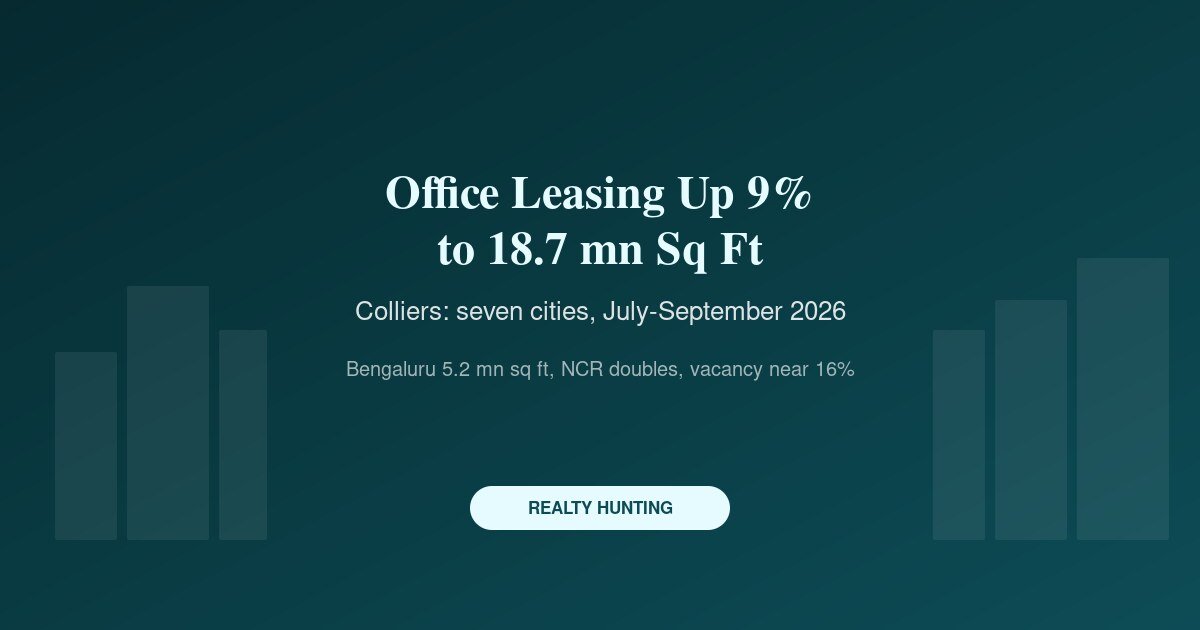
- Gross leasing volume: ~22 million sqft, up 13% over Q1 2025.
- Net absorption (actual space occupied): 21.6 million sqft, strongest since pre-pandemic benchmarks.
- Full-year 2026 forecast: 75 million sqft demand against 86.6 million sqft expected supply.
- Vacancy: Tightened sharply. Pan-India at ~9.5%; Bengaluru at a four-year low; Delhi NCR and Mumbai at 15-year lows in Grade-A stock.
The driver behind this isn't only domestic companies. Global Capability Centres, the captive India offices of MNCs like HSBC, Goldman Sachs, JPMorgan, Boeing, and hundreds more, accounted for 40% of all office space taken up in Q1 2026. These are long-term, high-creditworthy tenants signing 5–9 year leases. That's the backbone of commercial real estate returns.
Rent Growth by City (2026)
| City | Avg Rent (₹/sqft/month) | YoY Growth |
|---|---|---|
| Mumbai (BKC / Lower Parel) | ₹200–310 | ~6% |
| Bengaluru (Whitefield / Outer Ring Rd) | ₹85–130 | ~10% |
| Delhi NCR (Aerocity / Cyber City) | ₹140–200 | ~10% |
| Hyderabad (Hi-Tech City / Gachibowli) | ₹70–110 | ~12% |
| Pune (Hinjewadi / Kharadi) | ₹75–105 | ~7% |
| Chennai (OMR / Old Mahabalipuram Rd) | ₹65–95 | ~6% |
Hyderabad is the standout for rent growth in 2026. Its Hi-Tech City and Gachibowli corridor have absorbed enormous GCC demand, and supply hasn't kept up. Rent growth of 12% in one year is exceptional for commercial property. The catch: it's also the market where developers are adding supply fastest, which could moderate growth by 2027.
What You Actually Earn: Yield Calculation
Commercial property in India can generate gross rental yields of 6–9%. Let's run the math on a realistic investment:
Scenario: A 2,000 sqft pre-leased office unit in Bengaluru's Outer Ring Road
| Item | Amount |
|---|---|
| Purchase price | ₹1.5 Crore (₹7,500/sqft) |
| Monthly rent (₹90/sqft) | ₹1,80,000/month |
| Annual rental income | ₹21.6 Lakh |
| Gross rental yield | 14.4% |
Wait, 14.4%? That's the number you'll see in marketing brochures. But it's not what you'll actually earn.
Actual net yield: - Minus: property tax (~₹1.2 lakh/year), maintenance charges (~₹80,000/year), income tax on rent (at 30% slab = ~₹6 lakh). - Net income after above: ~₹13.6 lakh/year. - Effective post-tax yield: ~9%.
That's the real number for a high-occupancy, well-managed commercial property in a good location. For Grade-B office stock or fringe locations, post-tax yields can drop to 5–6%.
Pre-Leased Commercial Property: The Safer Route
For retail investors who don't want to hunt for tenants themselves, pre-leased commercial property is the cleaner option. These are office units, shops, or co-working spaces already occupied by a paying tenant when you buy them.
Why pre-leased works: - Rental income starts on Day 1. - The price includes the tenant's creditworthiness as a factor, a Fortune 500 GCC tenant commands a premium over a small startup. - Banks are more willing to lend against pre-leased commercial property. - Lease agreements typically have 3-yearly escalation clauses (usually 15% every 3 years).
See pre-leased commercial properties on Realty Hunting for verified listings with current tenant details and lease expiry dates.
The GCC Effect: Why It Matters
Global Capability Centres are reshaping the commercial real estate demand profile. As of 2026: - India has over 1,700 GCCs employing approximately 1.9 million people. - GCC headcount is expected to grow to 2.5 million by 2030. - The average GCC lease is 7+ years, with large floor plates of 50,000–5,00,000 sqft.
This is fundamentally different from the volatile startup-driven demand of 2015–2019. GCC leases provide long-term cashflow certainty that makes commercial property in their preferred corridors (Bengaluru ORR, Hyderabad Hi-Tech City, Pune Hinjewadi) more predictable investments.
Risks You Must Price In
Commercial real estate isn't only "residential with higher returns." The risks are different.
1. Lease expiry / vacancy risk: When a commercial tenant exits, finding a replacement takes time. A 6-month vacancy on a ₹2 crore investment means ₹12 lakh of lost income. Unlike residential, you can't easily find a small tenant to fill the gap.
2. Larger ticket size: Most Grade-A commercial units start at ₹80 lakh–₹1.5 crore for smaller spaces. Decent grade spaces start at ₹2–5 crore. This limits liquidity, the buyer pool is smaller.
3. Loan terms are tighter: Home loan for residential: 80% LTV, 30-year tenure. Loan against commercial property: typically 65–70% LTV, 15–20 year max tenure. Your EMI burden is higher relative to rent income.
4. GST complexity: Commercial rents attract 18% GST. If your tenant is a GST-registered business, this is largely pass-through (they claim input credit). But the compliance overhead is real.
5. Overbuilding risk: With 86.6 million sqft of supply expected in 2026, some markets, particularly Hyderabad and Pune, risk a supply glut that could moderate rents by 2027–28.
REITs: A Lower Barrier Alternative
If you want commercial real estate exposure without buying a physical unit, India now has three listed Real Estate Investment Trusts (REITs), Embassy REIT, Mindspace REIT, and Brookfield REIT, all focused on Grade-A office assets.
- Dividend yields: 5–7% annually (distributed quarterly).
- You can invest from ₹10,000–₹15,000 per unit on NSE/BSE.
- Portfolio diversification: your money sits across multiple Grade-A properties and tenants.
REITs don't give you the upside of direct ownership (no capital appreciation on the specific unit you chose) but they remove the concentration risk and liquidity problem entirely.
Which City Should You Target in 2026?
Bengaluru (ORR, Whitefield, Electronic City): Highest demand depth, best resale market for commercial. Start here if you're new to commercial investment.
Hyderabad (Hi-Tech City, Gachibowli): Best rent growth but supply is also rising. Good for entry now. Watch for oversupply by 2027.
Delhi NCR (Aerocity, Cyber City Gurgaon): Vacancy at 15-year lows, strong GCC demand. Aerocity in particular has blue-chip tenants and premium rents.
Pune (Hinjewadi, Kharadi): More affordable entry, reasonable yields, growing GCC presence. Less liquid resale market than Bengaluru.
Explore office space listings and commercial property options at Realty Hunting.
FAQ
Q: Can I get a home loan for commercial property? No. Commercial property requires a Loan Against Property (LAP) or commercial mortgage, which has stricter eligibility, lower LTV (65–70%), and shorter tenure than home loans. Consult a bank before assuming you can borrow the same amount.
Q: Is commercial property in a mall a good investment? Retail commercial (shops, mall units) carries higher risk than office space in 2026. E-commerce continues to affect brick-and-mortar retail. If the specific mall has strong footfall and anchor tenants, it can work. But the due diligence is significantly more involved.
Q: What's the minimum investment for pre-leased commercial in India? Realistically, ₹80 lakh–₹1 crore in Tier-2 cities; ₹1.5 crore+ in Mumbai, Bengaluru, or Delhi NCR for anything with a creditworthy tenant.
Q: How is commercial rental income taxed? As income from house property or business income, depending on the structure. For most individuals, it's added to total income and taxed at the applicable slab. At a 30% slab, this significantly eats into the gross yield, plan for it.
Q: Are GCC leases really that long-term? Typically yes, 5 to 9-year initial terms with renewal options. But GCCs can and do downsize when their parent companies cut headcount globally. Always check the specific tenant's financial health, not only their brand name.
For verified pre-leased listings or help evaluating a commercial investment, visit Realty Hunting's pre-leased section.
Can I negotiate the price in Gurgaon and NCR?
Resale and ready inventory are usually negotiable, while fresh launches have fixed rates but may waive some charges. Compare recent deals nearby to judge a fair price.
What is the difference between carpet area and super area?
Carpet area is the usable space inside your walls; super area adds a share of common areas. Always confirm the carpet area you actually get before comparing prices.
What extra costs come beyond the price in Gurgaon and NCR?
Budget for stamp duty and registration, GST on under-construction homes, parking, club and maintenance deposits, and loan fees. Ask for a full cost sheet upfront.
How does Realty Hunting help me buy in Gurgaon and NCR?
We share verified listings, honest area advice and the real paperwork picture, and connect you with builders and sellers. Reach out and we will shortlist options that fit your budget.
Should I buy ready-to-move or under-construction in Gurgaon and NCR?
Ready homes have no wait, no GST and no build risk but cost more; under-construction is cheaper with a longer wait. Choose by your timeline and risk appetite.
How do I book a property in Gurgaon and NCR?
Shortlist, visit, check the papers and RERA, then pay the booking amount and sign the agreement. Read the payment plan and cancellation terms before you commit.
Do I need a lawyer to buy property in Gurgaon and NCR?
For anything beyond a simple, clean deal it helps. A lawyer vets the title, the agreement and the approvals, which is cheap insurance against a costly mistake.
What is a builder-buyer agreement?
It is the core contract between you and the developer, setting the price, payment plan, area, specifications and possession date. Read it fully before signing.
What is an occupancy certificate and why does it matter?
It certifies a building is legally fit to occupy. Never take possession of a completed home without it, since it affects loans, utilities and resale.
What is mutation and why is it important?
Mutation updates the ownership in municipal and revenue records after a sale. Without it the property tax and records still point to the old owner, so get it done.
What credit score do I need for a home loan?
Lenders prefer a healthy score, usually in the mid-700s and above, for the best rates. A lower score can still get a loan but often at a higher rate.
Can I claim tax benefits on a home loan?
Yes, home-loan principal and interest carry deductions under the income tax rules, subject to limits and conditions. Confirm the current rules or ask a tax adviser.
What is the difference between freehold and leasehold?
Freehold gives you full, permanent ownership of the property and land; leasehold runs for a fixed term from an authority. Freehold is generally simpler to resell.
How do I check a builder's track record?
Look at delivered projects, delivery delays, the RERA record and buyer reviews. A builder with a clean, on-time record lowers your risk sharply.
What red flags should I watch for when buying?
Unclear title, missing approvals or RERA, pending dues, a builder with delays, and prices far below the market. If something feels rushed, slow down and verify.
What is the difference between capital appreciation and rental yield?
Appreciation is the rise in the property value over time; rental yield is the annual rent as a share of the price. Most Indian homes give modest yield and rely on appreciation.