Commercial Property GST Rate
The Complete GST Rules & Rates on Commercial Property in India for the Master Guide.

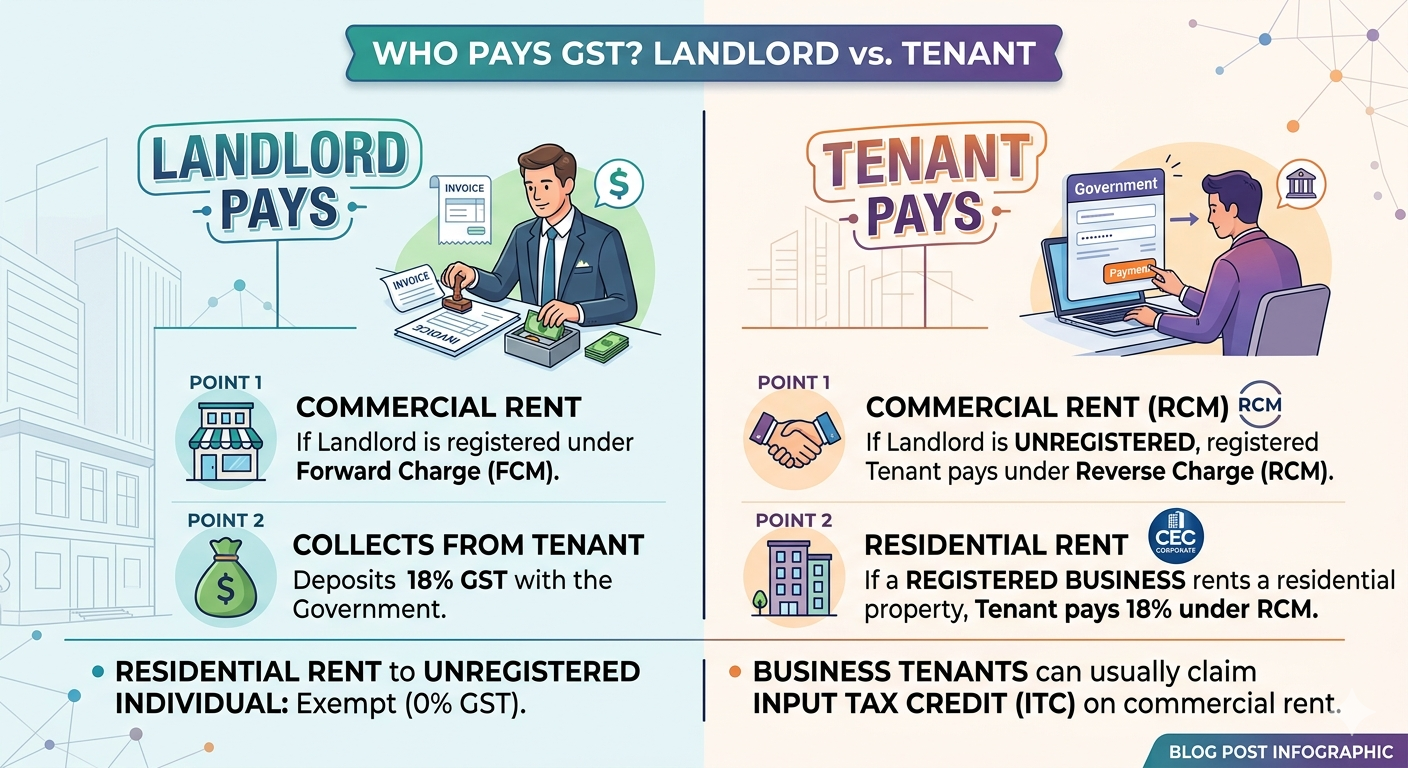
Who pays GST, landlord or tenant? A : GST is ultimately borne by the tenant, although who pays and how depends on the nature of lease and whether or not the owner is registered for tax.
Residential Properties
Personal Residence: if a person rents a home or apartment that the person occupies solely as a residence, there is no GST payable (even though the landlord may be registered).
Business Use: In case, a registered business entity or proprietor has rented any residential dwelling for commercial use or as an accommodation for his employees, the tenant shall pay GST (by way of RCM) directly to government.
Commercial Properties (Offices, Shops, Warehouses)
Standard Mechanism: Applicable 18% GST on commercial properties. The tenant is required to pay this GST every month with their rental payment to the landlord, and then subsequently remitted it (the funds are deposited by the landlord with tax authorities).
When a commercial space owner who is not registered under GST rents the premises to someone who is, it attracts 18% GST. In this case, reverse charge applies and the tenant pays this amount straight to the government.
In most cases of commercial establishments, the GST paid can be offset (as there are registered tenants who can claim an Input Tax Credit(ITC) suggestive obviously when the GST is being applied)
The payment of 18 % GST on rent either by landlord or tenant completely depends upon the nature of house property (commercial vs residential) and GST registration status of both parties.
The rules specify who exactly is liable to pay the tax in each situation:
Commercial Property (Shops, Offices, Warehouses)
Responsibility of commercial property is based under; FCM or RCM
Scenario A: Landlord is GST-Registered → Rent Paid by Landlord (FCM)
The landlord charges 18% GST on the rent bill, recovers from the tenant and pays it to Govt.
Case B: Unregistered Landlord + Registered Tenant $\rightarrow$Tenant Pays (RCM)
Especially after some important tax changes if a GST-registered business rents out commercial space from an unregistered landlord, then the tenant is compelled to calculate and pay the 18% GST directly to the government under RCM. There is no tax collected by the landlord.
Scenario C: Both Unregistered $\rightarrow No GST$
Where neither the landlord nor the tenant is liable to register under GST, rent pays no tax.
Residential Property (Flats, Houses)
Residential real property tax is calculated according to the usage of the property and by profiles of tenants.
Example A: Rented to a Non-Registered Person as Non-Residence $o$ No GST (Exempt)
If an undeclared individual or a salaried worker rents a home simply to live in, it is entirely free. Neither party pays GST.
Scenario B: Rented to a GST Registered Business $\rightarrow$ Tenant is Paying (RCM)
A registered company or firm that leases out a property for residential (like guest house, staff transit facility, home office etc.) use is also liable to pay tax @ 18% as applicable. This is to be paid directly to the government by the tenant business under RCM.
Scenario C: Leased to a Registered Owner for Occasional Use $\rightarrow$ No GST (Out of scope)
A registered sole proprietor who rents a home to live in with their family as such will also not have that deemed rental income subject to tax as long it is not claimed as an expense of the business.
| Property Type | Landlord Status | Tenant Status | Who Pays the 18% GST? | Can Tenant Claim Input Tax Credit (ITC)? |
|---|---|---|---|---|
| Commercial | Registered | Any Tenant | Landlord (via regular invoice) | Yes (if tenant is registered for business) |
| Commercial | Unregistered | Registered | Tenant (via RCM) | Yes (revenue-neutral for the business) |
| Commercial | Unregistered | Unregistered | No GST | N/A |
| Residential | Any Status | Unregistered | No GST (Exempt) | N/A |
| Residential | Any Status | Registered | Tenant (via RCM) | Generally No (blocked for personal use) |
Look at delivered projects, delivery delays, the RERA record and buyer reviews. A builder with a clean, on-time record lowers your risk sharply.
Unclear title, missing approvals or RERA, pending dues, a builder with delays, and prices far below the market. If something feels rushed, slow down and verify.
Appreciation is the rise in the property value over time; rental yield is the annual rent as a share of the price. Most Indian homes give modest yield and rely on appreciation.
Set aside for stamp duty, registration, GST where it applies, interiors, and a contingency. A buffer of a meaningful share above the base price is prudent.
Yes, a pre-approved loan tells you your budget, speeds up booking and strengthens your negotiating position with sellers. Get it before you shortlist seriously.
Compare the builder record, RERA status, carpet area, real amenities, connectivity and total cost, not just the headline price. Visit both before deciding.
Identity and address proof, and a signed rent agreement. Landlords may also ask for employment or reference details and a security deposit.
For longer tenancies a registered agreement is safer and clearer for both sides. The common 11-month agreement is convenient but carries less legal weight.
It varies by property and owner, often a couple of months rent for homes and more for premium or commercial space. Agree it in writing.
Usually the tenant pays monthly society maintenance and utilities, while major repairs stay with the owner. Spell this out in the agreement.
It is the minimum period neither side can exit without penalty. Check the lock-in and notice period before you sign, especially in commercial leases.
It depends on your budget, how long you will stay and your job stability. Renting gives flexibility, buying builds an asset, weigh both before deciding.
Stamp duty and registration vary by state and are usually a few percent of the property value, with a small rebate for women buyers in many states. Confirm the current Gurgaon and NCR rate before you budget.
Most buyers get a loan for 75-90% of the value, tied to income and credit score. Our home loan by salary guide shows the ranges.
Identity and address proof, PAN, income papers for a loan, and the property title chain, approvals and latest tax receipts. Keep both sides KYC ready for registration.
Search the state RERA portal by project or builder name for the registration number and approved plan. Our RERA check guide explains it.
If work is what brought you here, we can sort you a good office — ready to move or pre-rented, with parking, power backup and a proper address. Tell us your team size and budget and we will share the right options.
Share your number — we will call with the right options. No spam.
Or chat on WhatsApp
Sohna Road, Sector 49, HUDA City Centre and Cyber City
Office Space

Manesar, Sohna Road, New Gurgaon and Dwarka Expressway
Office Space
Southern Peripheral Road, Sectors 67-76, Gurugram
Office Space
Sector 63, Golf Course Extension Road, Gurugram
Office Space
Sohna Road, Sector 49, HUDA City Centre and Cyber City
Office Space
Manesar, Sohna Road, New Gurgaon and Dwarka Expressway
Office Space
Southern Peripheral Road, Sectors 67-76, Gurugram
Office Space
Sector 63, Golf Course Extension Road, Gurugram
Office Space
Get the latest price, layout and a site visit for any project in Gurgaon & Delhi-NCR.