Supreme Court orders DDA to refund 165 cr* with 18 years of interest
Supreme Court orders DDA to refund 165 cr* with 18 years of interest New Delhi: Even after being reprimanded by courts dozens of times over the decades, Delhi Development Authority (DDA) has not been able to streamline its functioning.
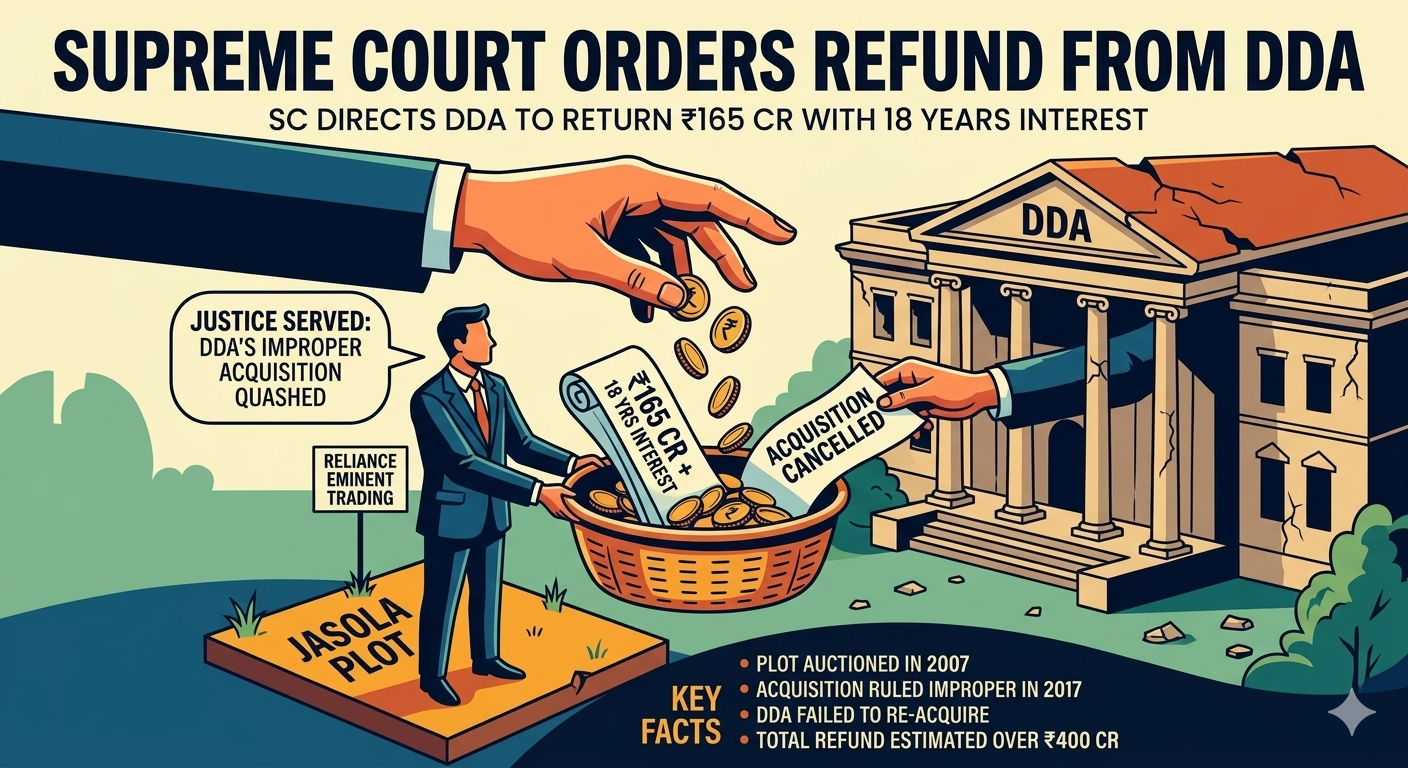
In a recent case, the Supreme Court has ordered Rs 165 crore* along with interest (7.5% for 18 years), that can amount to Rs 400 crore at current market rates of interest, to be refunded to an organisation which had acquired a commercial plot in Jasola at south-east Delhi in an auction itself held in 2007 by DDA. The apex court had ruled in 2017 that DDA’s acquisition of land was improper. Can you believe the acquisition was six months into the regularisation phase granted to the authority, its officials were unable to do so.
Reliance Eminent Trading and Commercial Pvt Ltd had bid highest for the plot, acting on a public auction notice of March 2007 issued by DDA, and deposited Rs 165 crore* as the cost to get it in its name paying an additional Rs 10 crore towards stamp duty and transfer duty. In March 2008, a conveyance deed was carried out by the Delhi Development Authority in favour of corporation for this plot on free-hold basis.
The original owners of the land had moved a petition in 2015 before Delhi High Court, asking for cancellation of acquisition as they were compensated. The high court held in favour of the petitioner and quashed the acquisition. In Dec 2016, the owners selectively re-entered the land. The DDA then challenged the high court decision in the apex court, which in May 2017 endorsed the high court order but allowed the DDA to acquire plot once again from its original owners within six months or else, the land will go back to the latter.
However, DDA did not begin fresh acquisition proceedings and sent a letter to the company six months later seeking additional expenses for acquiring the plot afresh and also inexplicably asking it to be responsible for legal consequences of SC’s May 2017 order. The company chose to be refunded for the money it had spent on the plot.
Unable to locate DDA, the firm moved a suit seeking recovery of Rs 284 crore which include Rs 165 crore principal with interest along with stamp duty and property tax paid till 2018. The matter went to SC since the company filed an appeal.
The appeal was allowed by a bench of Justices J K Maheshwari and Atul S Chandurkar. The apex court also allowed it to withdraw ₹ 186 crore deposited by DDA in the high court and ruled that the remaining amount was to be paid by the authority within eight weeks.
The Supreme Court of India recently directed the Delhi Development Authority (DDA) to refund over ₹164.91 crore to Reliance Eminent Trading and Commercial Limited, paid by it in 2007 for purchase of a commercial plot in Jasola [Reliance Eminent Trading and Commercial Pvt Ltd v. Delhi Development Authority]
After the acquisition of the subject land by DDA was declared as lapsed by Delhi High Court in 2018, Reliance lost its rights over the plot purchased in a public auction. It then led to a civil dispute between Reliance and DDA over refund of the amount.
A Bench of Justices JK Maheshwari and Atul S Chandurkar rejected DDA’s submission that Reliance continued to retain possession of the land and lost it only due to some miscreants.
The Court added that DDA cannot retain the bid amount or seek possession of the land from Reliance as the title of the land had gone back to its original owner.
“The defence of the DDA herein is fanciful as they seek to claim the possession from the appellant herein, whereas it is now for the erstwhile owners to seek appropriate remedies. In addition, it is necessary to observe that once, on a petition filed by the erstwhile owner, lapsing of the acquisition was directed with liberty of re-acquisition, the auction proceedings have lost their efficacy,” the Bench said.
The Court was hearing an appeal filed by Reliance against a Delhi High Court order.
In 2007, Reliance had emerged as the highest bidder in a public auction for the land located in Jasola. It paid the entire consideration amount of over ₹164 crore, along with stamp duty and other charges, and was granted a registered conveyance deed in 2008.
However, in 2015, the original landowner challenged the acquisition of the land itself before the Delhi High Court. The challenge was based on the provisions of the 2013 land acquisition law, under which acquisition proceedings lapse if compensation has not been paid.
In 2016, the High Court declared that the acquisition had lapsed on this ground. This finding was subsequently upheld by the Supreme Court in 2017 which granted DDA six months to initiate fresh acquisition proceedings. It was made clear that if such steps were not taken within the stipulated time, the land would revert to the original owner.
DDA failed to take any steps within the given time. As a result, the acquisition lapsed permanently and DDA lost its title over the land. This rendered the Reliance’s purchase ineffective, as it no longer had any valid rights despite having paid the full consideration.
Reliance then sought refund of the amount but DDA did not respond. The company then instituted a commercial suit in 2020 before the Delhi High Court seeking recovery of the amount paid along with interest.
The High Court ruled that a trial was required in the case. However, it declined to pass a summary judgement as sought by Reliance. The matter then reached the top court.
In the judgement dated April 29, the Court said that the refusal by the High Court to grant summary judgment was unjustified.
“The High Court completely erred in reading the issue of refund as contingent to handing over of the possession. There is nothing in law or fact to show that possession is sine qua non for refund. The DDA is not able to dislodge the fact that the acquisition lapsed by orders of this Court. A necessary corollary is that refund has to be initiated for the auction purchaser. Further, there is no valid reason portrayed by the respondent to refuse refund or retain the amount any longer.”
The Court further observed that the plea of restitution for the return of possession was wholly illusory and misconceived.
The Court emphasised that that a summary judgement under Code of Civil Procedure (CPC) was an important procedural tool for providing a swift and cost-effective alternative to a full-fledged trial, especially in cases where prolonged adjudication would serve no real purpose.
It further said that private arbitration, once seen as a solace, cannot be the panacea for all disputes.
“There is a need, as well as growing support, for developing new extensive pre-trial processes. A conventional trial no longer reflects modern reality and requires re-calibration. In this light, to ensure balance, there is a requirement of simplified and proportionate tools for efficacious adjudication. This implores our system to adopt and embrace a shift in the culture of efficiency in dispute resolution,” the Bench said.
The Court referred to Charles Dickens’ Bleak House to underscore the persistent issue of delays in the justice delivery system.
“There is no doubt that our justice delivery system is premised on being fair, independent, and just. However, it is often criticized for delay. Ordinary citizens complain about the cost and delay associated with civil disputes. There are many instances in India which have the bearings of the infamous fictional case of Jarndyce v. Jarndyce, as recounted by Charles Dickens in his novel ‘Bleak House,” the Court said.
In light of the above, the Court directed DDA to refund ₹164.91 crore to Reliance along with interest at 7.5% from the date of payment. It also set aside the conveyance deed to restore the parties to their original position.
[Read Judgment]
Frequently Asked Questions
How do I verify a property title in Gurgaon and NCR?
Check the chain of ownership, the latest record, any loan or lien and pending dues, and match the seller identity to the title. A local lawyer can vet the deed.
What should I check during a site visit in Gurgaon and NCR?
Construction quality, water and power backup, the neighbourhood, road access, and how the actual unit compares to the brochure. Visit at different times of day if you can.
Can I negotiate the price in Gurgaon and NCR?
Resale and ready inventory are usually negotiable, while fresh launches have fixed rates but may waive some charges. Compare recent deals nearby to judge a fair price.
What is the difference between carpet area and super area?
Carpet area is the usable space inside your walls; super area adds a share of common areas. Always confirm the carpet area you actually get before comparing prices.
What extra costs come beyond the price in Gurgaon and NCR?
Budget for stamp duty and registration, GST on under-construction homes, parking, club and maintenance deposits, and loan fees. Ask for a full cost sheet upfront.
How does Realty Hunting help me buy in Gurgaon and NCR?
We share verified listings, honest area advice and the real paperwork picture, and connect you with builders and sellers. Reach out and we will shortlist options that fit your budget.
Should I buy ready-to-move or under-construction in Gurgaon and NCR?
Ready homes have no wait, no GST and no build risk but cost more; under-construction is cheaper with a longer wait. Choose by your timeline and risk appetite.
How do I book a property in Gurgaon and NCR?
Shortlist, visit, check the papers and RERA, then pay the booking amount and sign the agreement. Read the payment plan and cancellation terms before you commit.
Do I need a lawyer to buy property in Gurgaon and NCR?
For anything beyond a simple, clean deal it helps. A lawyer vets the title, the agreement and the approvals, which is cheap insurance against a costly mistake.
What is a builder-buyer agreement?
It is the core contract between you and the developer, setting the price, payment plan, area, specifications and possession date. Read it fully before signing.
What is an occupancy certificate and why does it matter?
It certifies a building is legally fit to occupy. Never take possession of a completed home without it, since it affects loans, utilities and resale.
What is mutation and why is it important?
Mutation updates the ownership in municipal and revenue records after a sale. Without it the property tax and records still point to the old owner, so get it done.
What credit score do I need for a home loan?
Lenders prefer a healthy score, usually in the mid-700s and above, for the best rates. A lower score can still get a loan but often at a higher rate.
Can I claim tax benefits on a home loan?
Yes, home-loan principal and interest carry deductions under the income tax rules, subject to limits and conditions. Confirm the current rules or ask a tax adviser.
What is the difference between freehold and leasehold?
Freehold gives you full, permanent ownership of the property and land; leasehold runs for a fixed term from an authority. Freehold is generally simpler to resell.
How do I check a builder's track record?
Look at delivered projects, delivery delays, the RERA record and buyer reviews. A builder with a clean, on-time record lowers your risk sharply.