Received alarm-like notification on phone? Loud alert phone? India is rolling out a real-time disaster warning system
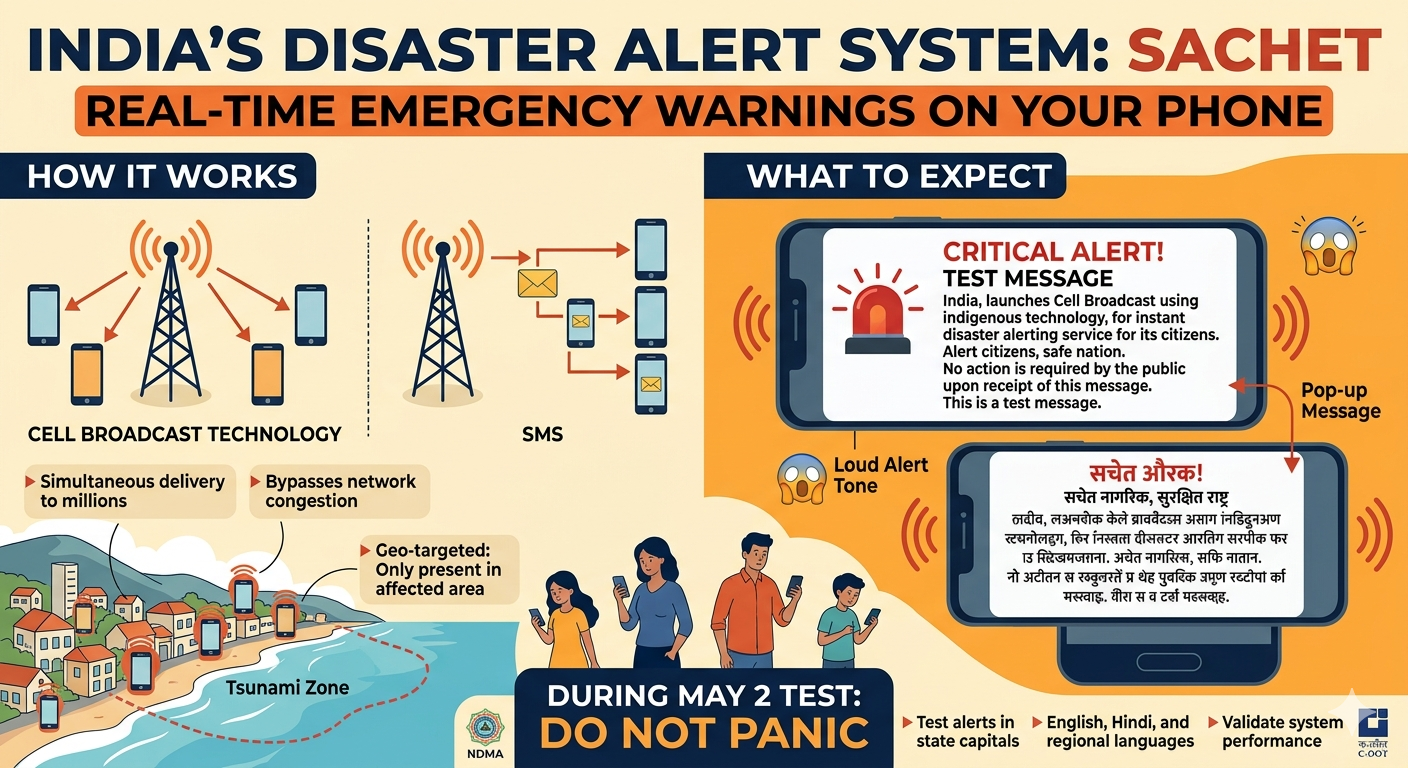
India mobile disaster alert system SACHET launched on May 2, using Cell Broadcast to send fast geo targeted emergency warnings to citizens in multiple languages.
The platform has been developed by the Department of Telecommunications (DoT) in collaboration with the National Disaster Management Authority (NDMA).
At the core is the Integrated Alert System, SACHET, developed by Centre for Development of Telematics (C-DOT), an indigenously developed platform, which is already operational across all states and Union Territories and has delivered over 134 billion SMS alerts in more than 19 Indian languages.
The system is based on the globally recognised Common Alerting Protocol (CAP), as recommended by the International Telecommunication Union.
How the new system will work
The upgrade introduces Cell Broadcast (CB) technology alongside SMS, enabling authorities to push alerts simultaneously to all mobile phones in a specific geographic area, rather than sending messages individually
Unlike SMS, which can get delayed during network congestion, CB messages are transmitted directly from mobile towers to devices using a dedicated channel, allowing millions of users to receive alerts almost instantly.
The system is geo-targeted, meaning only people physically present in an affected area—such as a coastal zone during a tsunami warning—will receive the alert.
Messages are also designed to override typical notification behaviour: they can appear as pop-ups on screens, may trigger a loud alert tone or vibration, and are displayed prominently until acknowledged by the user.
Because the technology is broadcast-based, it does not rely on individual phone numbers and can reach even roaming users or devices without heavy network usage.
What kind of alerts people will receive
Authorities say the system will be used for both natural and man-made emergencies, including earthquakes, tsunamis, lightning strikes and man-made hazards such as gas leaks or chemical incidents.
Alerts can include:
-
- Early warnings (e.g. severe weather or seismic activity)
-
- Immediate threat notifications (e.g. evacuation orders, hazardous leaks)
-
- Public safety advisories (do’s and don’ts during disasters)
-
- Location-specific instructions, such as evacuation routes or shelters
Messages will be delivered in multiple languages based on region and device settings.
What to expect during the May 2 test
As part of the launch exercise, test alerts will be sent to mobile phones in all state capitals, including Delhi-NCR, in English, Hindi as well as regional languages.
The government has shared the exact test message that will be sent:
“India, launches Cell Broadcast using indigenous technology, for instant disaster alerting service for its citizens. Alert citizens, safe nation. No action is required by the public upon receipt of this message. This is a test message.”
“भारत द्वारा स्वदेशी तकनीक का उपयोग करते हुए अपने नागरिकों के लिए त्वरित आपदा चेतावनी सेवा हेतु सेल ब्रॉडकास्ट का शुभारंभ। सचेत नागरिक, सुरक्षित राष्ट्र। इस संदेश की प्राप्ति पर जनता से किसी प्रकार की कार्रवाई की अपेक्षा नहीं की जाती है। यह एक परीक्षण संदेश है।”
These will appear as on-screen messages clearly marked as test communications.
These may show up as flash messages or pop-ups on mobile screens, depending on handset and network compatibility.
The government has urged citizens not to panic, stressing that the exercise is meant to validate the system’s ability to deliver fast, reliable alerts during real emergencies.
India launches disaster alert system: Received alarm-like notification on phone? Here’s what it means
NEW DELHI: India has stepped up efforts to strengthen its disaster preparedness system, with the government rolling out nationwide testing of a mobile-based emergency alert mechanism that has already reached users across the country.
Officials have clarified that there is no reason for concern, as the alerts currently being received on mobile phones are part of a trial phase and not actual emergency warnings.
The system, being tested by the Department of Telecommunications (DoT) in coordination with the National Disaster Management Authority (NDMA), is designed to deliver real-time alerts to people in disaster-prone or affected areas.
“Test messages in English, Hindi, and regional languages may be received on mobile phones; recipients are requested not to take any action during the testing phase,” govt said in a statement.
According to the official release, the Department of Telecommunications (DoT), Ministry of Communications, in collaboration with the National Disaster Management Authority (NDMA), Government of India, is actively enhancing mobile-based disaster communication systems across the country to ensure timely dissemination of critical information to its citizens.
NDMA has successfully operationalised the Integrated Alert System (SACHET), developed by the Centre for Development of Telematics (C-DOT), the premier R&D centre of the Department of Telecommunications.
The system is based on the Common Alerting Protocol (CAP), as recommended by the International Telecommunication Union.
It is currently operational across all 36 States and Union Territories of India and delivers disaster and emergency related alerts via SMS to mobile users within geo-targeted areas.
Officials said the system has already played a major role in public safety communication, enabling the dissemination of over 134 billion SMS alerts so far in more than 19 Indian languages during natural disasters, weather warnings, and cyclonic events.
To further improve response time in critical situations such as earthquakes, tsunamis, lightning strikes, gas leaks or chemical hazards, authorities have introduced Cell Broadcast (CB) technology alongside SMS alerts.
This system allows alerts to be transmitted simultaneously to all mobile devices within a defined geographic area, ensuring near real-time delivery.
C-DOT has been entrusted with the indigenous development and implementation of this Cell Broadcast-based public emergency alert system.
As part of the pan-India rollout and the launch of the Cell Broadcast (CB) facility, nationwide testing and trials are currently being conducted to assess the system’s performance and reliability prior to its formal inauguration and dedication to the nation.
During this period, members of the public may receive test messages in English, Hindi and regional languages on their mobile devices.
These “test messages” will only be received on mobile devices with Cell Broadcast test channels enabled (Users can enable or disable alerts through the following menu path on their mobile devices: Settings → Safety and emergency → Wireless emergency alerts → Test alerts).
Recipients may receive multiple messages as part of the testing process to ensure proper functioning across the entire mobile network infrastructure.
“This is a TEST Cell Broadcast message sent by the National Disaster Management Authority in coordination with the Department of Telecommunications (DoT), Government of India, as part of testing the Cell Broadcast solution for disseminating alerts. During the testing of the Cell Broadcast solution, you may receive this message multiple times on your mobile handset. Please ignore these message(s); no action is required at your end.”
Authorities emphasised that these messages are part of a planned nationwide testing exercise and do not require any action by the recipients.
Frequently Asked Questions
How do I book a property in Gurgaon and NCR?
Shortlist, visit, check the papers and RERA, then pay the booking amount and sign the agreement. Read the payment plan and cancellation terms before you commit.
Do I need a lawyer to buy property in Gurgaon and NCR?
For anything beyond a simple, clean deal it helps. A lawyer vets the title, the agreement and the approvals, which is cheap insurance against a costly mistake.
What is a builder-buyer agreement?
It is the core contract between you and the developer, setting the price, payment plan, area, specifications and possession date. Read it fully before signing.
What is an occupancy certificate and why does it matter?
It certifies a building is legally fit to occupy. Never take possession of a completed home without it, since it affects loans, utilities and resale.
What is mutation and why is it important?
Mutation updates the ownership in municipal and revenue records after a sale. Without it the property tax and records still point to the old owner, so get it done.
What credit score do I need for a home loan?
Lenders prefer a healthy score, usually in the mid-700s and above, for the best rates. A lower score can still get a loan but often at a higher rate.
Can I claim tax benefits on a home loan?
Yes, home-loan principal and interest carry deductions under the income tax rules, subject to limits and conditions. Confirm the current rules or ask a tax adviser.
What is the difference between freehold and leasehold?
Freehold gives you full, permanent ownership of the property and land; leasehold runs for a fixed term from an authority. Freehold is generally simpler to resell.
How do I check a builder's track record?
Look at delivered projects, delivery delays, the RERA record and buyer reviews. A builder with a clean, on-time record lowers your risk sharply.
What red flags should I watch for when buying?
Unclear title, missing approvals or RERA, pending dues, a builder with delays, and prices far below the market. If something feels rushed, slow down and verify.
What is the difference between capital appreciation and rental yield?
Appreciation is the rise in the property value over time; rental yield is the annual rent as a share of the price. Most Indian homes give modest yield and rely on appreciation.
How much should I keep as a buffer beyond the price?
Set aside for stamp duty, registration, GST where it applies, interiors, and a contingency. A buffer of a meaningful share above the base price is prudent.
Is a home loan pre-approval useful?
Yes, a pre-approved loan tells you your budget, speeds up booking and strengthens your negotiating position with sellers. Get it before you shortlist seriously.
How do I choose between two similar projects?
Compare the builder record, RERA status, carpet area, real amenities, connectivity and total cost, not just the headline price. Visit both before deciding.
What stamp duty and registration charges apply in Gurgaon and NCR?
Stamp duty and registration vary by state and are usually a few percent of the property value, with a small rebate for women buyers in many states. Confirm the current Gurgaon and NCR rate before you budget.
How much home loan can I get to buy in Gurgaon and NCR?
Most buyers get a loan for 75-90% of the value, tied to income and credit score. Our home loan by salary guide shows the ranges.