FSI and FAR Explained: How Much Can Be Built on a Plot, and Why Buyers Should Care
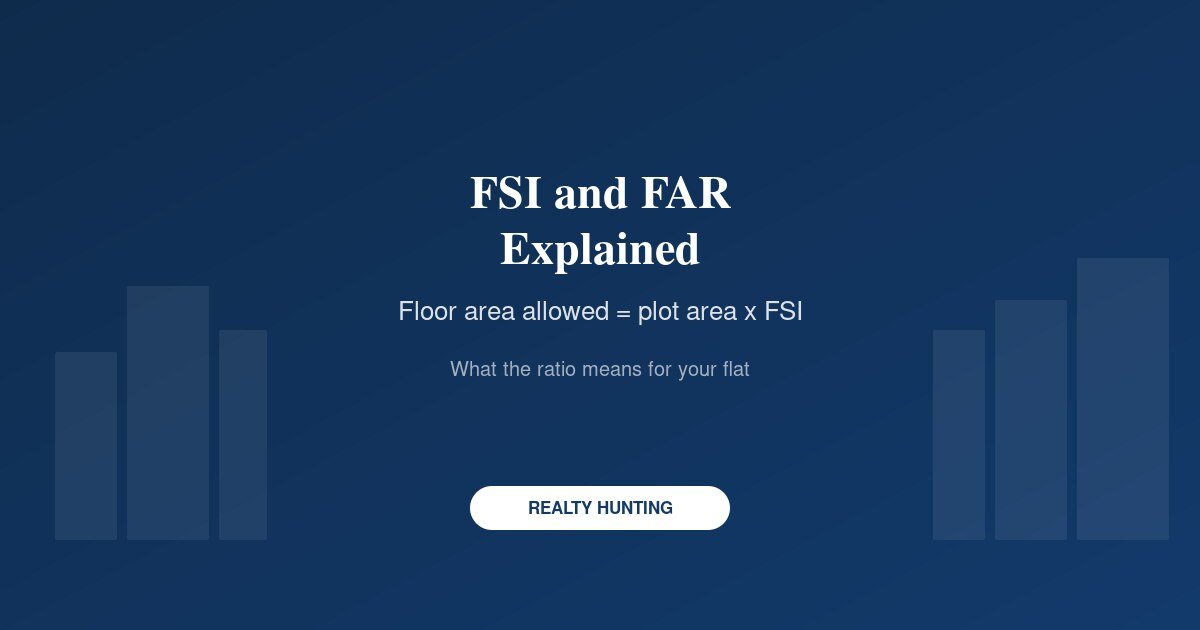
FSI (floor space index) and FAR (floor area ratio) are the same rule: total floor area allowed on a plot divided by the plot's area. An FSI of 2 on a 500 sq m plot allows 1,000 sq m of floors, however many storeys it is spread over. Base figures range from about 1.0 in Mumbai's suburbs to 2.0 in Chennai, and rise with road width, premiums and TDR.
Key takeaways
- FAR is written as a ratio (2.0) or a percentage (200); FSI usually as a ratio. A 200 FAR and an FSI of 2 mean the same thing.
- Most cities now layer the number: a base FSI, extra FSI bought from the authority as a premium, TDR bought from other landowners, and in Mumbai a 35% fungible allowance.
- Road width drives the ceiling in Mumbai, Pune, Bengaluru and Chennai; metro corridors can reach an FSI of 4.0 under Maharashtra's transit-oriented rules.
- For a buyer, FAR shapes density, the loading on your flat, whether an old building can be redeveloped profitably, and the share of land behind each apartment.
- Haryana's stilt-plus-four builder-floor policy has been stayed by the High Court since April 2026, so check its status before relying on it.
How the ratio works
The formula is simple: permitted floor area = plot area x FSI. What counts as "floor area" is the fine print. Rules usually exclude some areas, such as parking, lift wells, staircases or balconies within limits, and each city defines its own list. That is why two buildings with the same FSI can look very different.
FAR is a limit on total floor area, not on height. A separate limit, ground coverage, caps how much of the plot the building can sit on. Divide the permitted floor area by the ground coverage and you get a rough number of floors. On a 200 sq m plot with an FSI of 1.5 and 50% ground coverage, you can build 300 sq m of floors on a 100 sq m footprint: roughly three floors. Raise coverage to 75% and the same 300 sq m fits in two floors of 150 sq m.
FSI and FAR by city
The table gives the headline figures from each city's current rules. They are simplified; each rulebook adds conditions by zone, plot size and use.
| City (rules) | Base residential FSI/FAR | How it goes higher |
|---|---|---|
| Mumbai island city (DCPR 2034) | 1.33 | Premium 0.50-0.84 and TDR 0.17-0.83 by road width, plus 35% fungible |
| Mumbai suburbs (DCPR 2034) | 1.00 | Premium 0.50 and TDR 0.50-1.00 by road width, plus fungible |
| Pune and most of Maharashtra (UDCPR 2020) | 1.10 on the net plot | Premium 0.50 and TDR up to 1.40 on the gross plot; up to 4.0 in a 500 m TOD zone |
| Delhi (MPD 2021) plotted housing | 350 up to 100 sq m, falling to 200 above 750 sq m | TOD zones in the new master plan draft |
| Haryana plotted colonies (Building Code 2017) | 165 up to 100 sq m, 145 for 100-250 sq m, 130 for 250-350 sq m, 120 for 350-500 sq m | Up to 300 on payment for plots to 250 sq m; up to 264 above |
| Bengaluru (RMP 2015), large sites | 2.00 on roads up to 12 m | Rises with road width to 3.25 above 30 m |
| Chennai (TNCDBR 2019) | 2.0 for non-high-rise | High-rise 2.0, 2.5 or 3.25 at 12, 15 and 18 m+ roads; premium FSI at 50% of guideline value |
Mumbai: premium, TDR and fungible
Mumbai's DCPR 2034 sets a base FSI and then lets a developer buy more. Premium FSI is bought from the municipal corporation. TDR (transferable development rights) is bought from owners who gave up land for roads, gardens or slum rehabilitation elsewhere, and DCPR 2034 made it usable in the island city for the first time. On top sits fungible FSI: 35% of the FSI consumed, for balconies, ducts, lobbies and similar space. Redevelopment schemes under the 33-series regulations add incentive FSI.
Delhi and the master plan
Delhi still builds under the Master Plan for Delhi 2021. The 2041 draft was never notified. The DDA approved a Master Plan for Delhi 2047 on 12 August 2026 and sent it to the housing ministry for final approval, so its FAR changes do not yet apply. Delhi's plotted FAR is generous on small plots (350 up to 100 sq m) because they are expected to build up, not out.
Haryana's builder floors
In Gurgaon and other Haryana colonies, FAR decides how many independent floors a plot can carry. The 2024 stilt-plus-four policy allowed four floors over stilt parking where the layout supported four dwelling units per plot. The Punjab and Haryana High Court stayed the policy in April 2026 and fresh sanctions stopped; the detail is in stilt plus four floors in Gurgaon.
Worked examples
A Mumbai island-city plot
Take a 1,000 sq m plot in the island city on a 10 m road. Base FSI 1.33 gives 1,330 sq m. Premium FSI of 0.50 adds 500 sq m and admissible TDR of 0.17 adds 170 sq m, for a total of 2,000 sq m (FSI 2.00). Fungible at 35% of the consumed 2,000 sq m adds 700 sq m. The building can therefore have about 2,700 sq m of floor area, 2.7 times the plot, before counting exempt areas like parking.
A Haryana builder floor
On a 250 sq m plot, the base FAR of 145 allows 250 x 1.45 = 362.5 sq m of floors. Buying FAR up to 300 raises that to 750 sq m, about 8,073 sq ft. Split across four floors, that is roughly 187.5 sq m (about 2,018 sq ft) a floor, which is the arithmetic that made four-floor builder floors attractive to developers, and the load on local roads and sewers that worried the court.
What one old building can gain
Suppose a 1970s society in Mumbai's suburbs used an FSI of 1.0 on a 2,000 sq m plot: 2,000 sq m of flats. If the plot, on a wide road, can now reach around 2.5 with premium and TDR, before fungible, the new building can hold about 5,000 sq m. After rehousing members in bigger flats, the developer sells the rest, which is what pays for the rebuild. The process and its risks are in housing society redevelopment.
Why FAR matters to a buyer
- Density. A high FAR on a small plot means more flats, more cars and more pressure on lifts, parking and water. Compare the number of units with the plot size, not just the amenities list.
- Loading. The gap between carpet and super built-up area, usually 25-35% in Indian apartments, comes partly from how the developer used the FSI on common areas. RERA's section 13 requires the price to be based on carpet area; see carpet area vs super built-up area.
- Your share of land. The more floor area packed onto a plot, the smaller the undivided share of land behind each flat. That share matters most when the building is redeveloped; see undivided share of land.
- Redevelopment potential. An old building that used little of today's permissible FSI has value locked in its land. One that already used most of it has less.
- Legality. Floors built beyond the sanctioned FAR are unauthorised construction, which banks will not fund and authorities can seal or demolish.
Where FAR numbers mislead
A high permissible FSI is a ceiling, not a promise. Premium FSI and TDR cost money, and a developer may not use them. Road-width rules mean that the FSI shown for a zone may not apply to a plot on a narrow lane. Height limits near airports, heritage precincts and fire-safety rules can stop a building from using its full FSI. Master-plan changes, like Delhi's pending plan or Haryana's stayed floor policy, can take years to settle or be reversed in court. And once flats are booked, RERA's section 14 bars changes to the sanctioned plan without two-thirds of the allottees agreeing, so unused FSI is not the builder's to add at will. The layout and sanction documents are the only reliable guide; see floor plan vs layout plan vs master plan.
Frequently asked questions
Is FSI the same as FAR?
Yes. Both measure total built floor area divided by plot area. FSI is the term used in Maharashtra, Tamil Nadu and several other states, usually written as a ratio like 1.5; FAR is used in Delhi, Haryana and Karnataka, and is often written as a percentage like 150. The difference is presentation, not substance.
How do I calculate how much I can build on my plot?
Multiply the plot area by the permitted FSI or FAR for your zone, plot size and road width. That gives the total floor area across all storeys. Then check ground coverage, setbacks and height limits, which decide how that floor area is arranged. Your local building bye-laws or development control rules give the figures, and an architect can confirm what applies.
What is TDR and how does it add to FSI?
TDR, or transferable development rights, is floor area issued to an owner who surrenders land for a public purpose, such as a road or garden, or who builds rehabilitation housing. The owner can sell it, and a developer elsewhere can load it onto a plot, up to a cap set by road width, to build more than the base FSI.
Does a higher FSI mean a better flat?
Not necessarily. Higher FSI means more floor area on the same land, which usually means more units, higher density and a smaller land share per flat. It can make a location affordable, but check parking, lifts and open space against the number of flats. A lower-FSI project can be more comfortable to live in.
Can a builder add floors after I buy?
Only within the sanctioned plan and the law. Under section 14 of RERA, a developer cannot alter the sanctioned plans or common areas without the written consent of two-thirds of the allottees. Floors added beyond the sanction are unauthorised, can be sealed or demolished, and are a common reason homeowners go to court. Ask for the sanctioned plan and the FSI already used.
If you are comparing projects or weighing a redevelopment offer and want a second opinion on what the numbers mean, the Realty Hunting team can help.