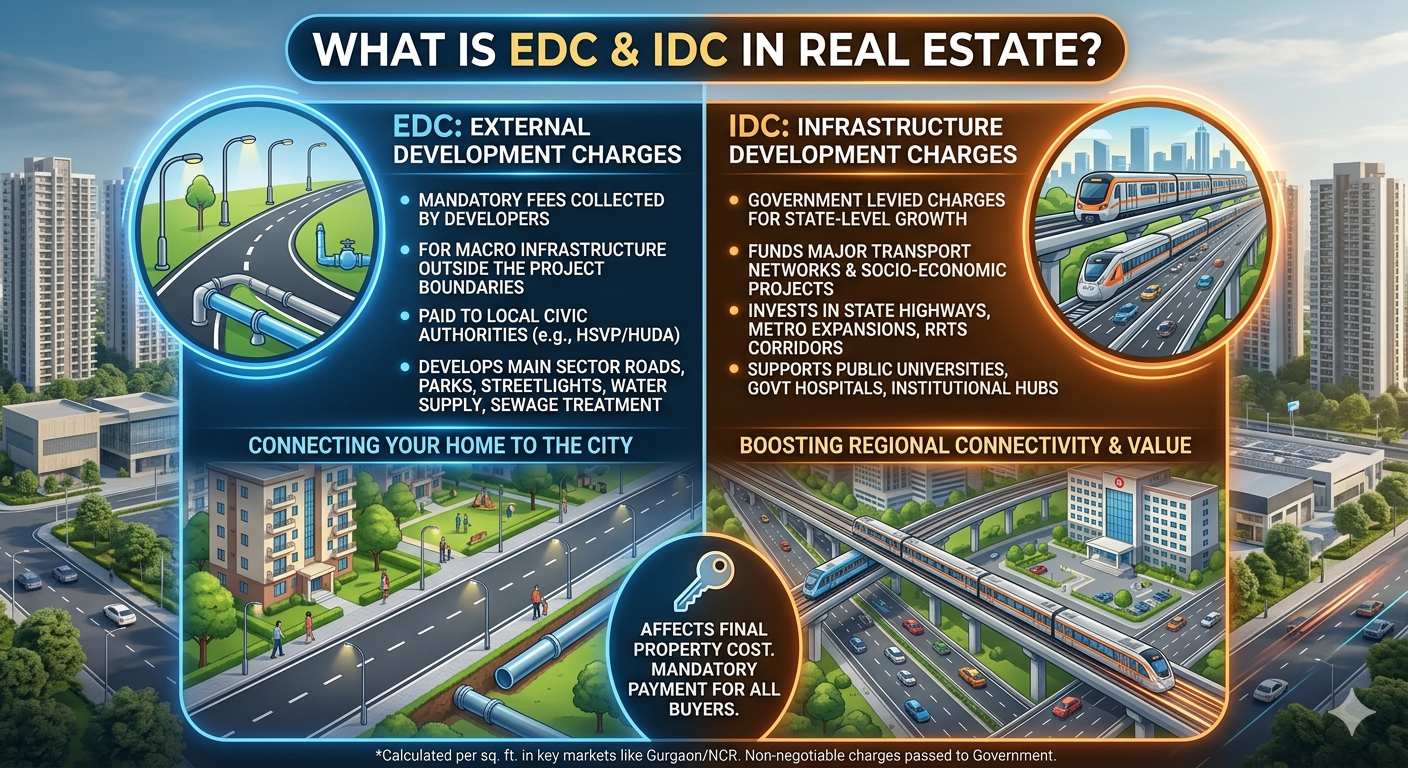
What is EDC IDC in Real Estate ? In the real estate sector, especially in India, EDC and IDC are construction charges imposed by a government./State agency on the builder which then usually gets transferred to the homebuyer.
EDC (External Development Charges)– External development charges are charged from investors who set up by the developer in order to fund civic infrastructure outside of the project area such as Roads, Water supply, Sewage system and Electrical grid.
Infrastructure Development Charges (IDC): This is where the one-time fee to develop wider state level infrastructure works by constructing national highways, big bridges large scale power and transport projects.
The following fees are not included in the Basic Selling Price (BSP) of the property and have been found to increase from 8 \mathbin{\%} up to 15 \mathbin{\%}, making them an additional cost for you.
How They Work
Payment: The developers pay these fees to the government, but they calculate this over costs per square foot and usually pass it on to buyers.
Transparency: Under real estate regulation, developers must make a rational and elaborate breakdown of these charges.
Taxability: These are state taxes so they usually attracts no additional Goods and Services Tax (GST).
What to Keep in Mind
When you are buying a property, you must scrutinize the payment terms well and ensure that the developer has cleared these dues to the local authorities. The legitimacy of such charges can be double checked on your local state Real Estate Regulatory Authority (RERA) portal, where you will get to know track every project detail.
Without fail, EDC and IDC are inherently government-imposed charges that developers will collect from buyers when they purchase in real estate. They are distinct from the basic sale price (BSP) of a property and glaringly visible in large Indian real estate markets including Gurgaon, Noida and rest of the National Capital Region (NCR).
EDC: External Development Charges
EDC or External Development Charges Because the developer collects this fee on behalf of local civic authorities like (as in Haryana, HSVP and as per DDA in Delhi) to meet infrastructure development at a location outside your respective housing project.
The government must also link a high-rise or township to the rest of the city when a developer builds one. Your donations to EDC go directly towards the foundation and upkeep of this public infrastructure.
What does EDC cover?
Connecting project with major highways or sector roads (Roads connecting components of towns/cities))
Water Supply Systems: The setting of the pipelines for supplying water to Statues and for Save Zones.
Sewage & Drainage: Development of large city-level drains and Sewage Treatment Plant (STP).
Electricity Infrastructure: Establishment of local substations, and power grid wires.
Civic Facilities: Building regional parks, streetlights & community garbage disposal.
IDC: Infrastructure Development Charges
IDC is a fee charged by state governments for the socio-economic and macro-level infrastructure development of the entire state or some large urban corridors.
EDC is local to your sector or colony, whereas IDC goes into an overall state fund that builds vast transit networks/high-end public goods, increasing the total value of a region.
What does IDC cover?
Metro Rail Systems – Financial extenuation for various metro networks, RRTS (Rapid rail) corridors and main expressways;
State Highways : Enhancing connectivity between key commercial centres.
Core Public Utilities: Establishment of Government hospitals, Universities, Transport hub and Institutional Areas.
Key Differences At a Glance
| Feature | External Development Charges (EDC) | Infrastructure Development Charges (IDC) |
| Primary Scope | Local: Immediate vicinity and sector surrounding the project. | Macro: City-wide or state-wide mega infrastructure. |
| Collected By | Local urban development authorities (e.g., DTCP, HSVP). | State government infrastructure funds. |
| Utilization | Local roads, water mains, sector electricity, sewage plants. | Metros, expressways, highways, major public institutions. |
| Pricing basis | Usually calculated per square foot or per acre. | Usually calculated per square foot or per acre. |
Key Considerations for Buyers
Statutory Nature: EDC as well as IDC both are statutory charges. Developers do not pocket this money: they are forced to hand it over to government by law.
RERA guidelines: RERA (Real Estate Regulatory Authority) rules mandate all transparency with regard to EDC/IDC by developers. Of course, they cannot raise these charges unilaterally unless the government makes an official amendment to the rates.
Charges Payment Schedule: These charges are not accounted for in the Basic Selling Price (BSP). They appear as line items in your builder-buyer agreement and are collected over time in one or more instalments, at various stages of construction or when possession is taken.
Impact on Overall Cost: Charges as per location/city/state, EDC plus IDC can add ₹200 to ₹500+ per sq. and price per sq.
IDC Full Form in Real Estate
IDC stands for Infrastructure Development Charges.
What is EDC & IDC in Realestate? (Quick Summary)
If you are seeing a real-estate cost sheet, or more commonly a brochure (that is downloaded from the web as a PDF), EDC and IDC are government-leveed fees payable to the developer viz.
These are independent from the Basic Selling Price (BSP) of the property.
In this role, the developer becomes a collection agent and is obligated by law to transfer all of these amounts in full to the state or local civic authorities.
What is IDC in Real Estate?
The IDCs, or Infrastructure Development Charges, are levies imposed by the state government on a city or an urban corridor for developing the fundamental civic infrastructure.
Goal: Fund big regional (not municipality) projects at the state level.
Covers — Expansions of metro rail, all major national/state highways, peripheral expressways, rapid transit corridors (like RRTS), government hospitals and public universities.
EDC IDC Charges Full Form
EDC: External Development Charges
IDC: Infrastructure Development Charges
EDC Full Form in Real Estate
EDC — External Development Charges
EDC IDC Charges in Gurgaon & 7. Haryana EDC and IDC Charges
These charges are mainly regulated by the DTCP (Directorate of Town and Country Planning) in Haryana, and charged for authorities such as HSVP (Haryana Shahari Vikas Pradhikaran, previously known as HUDA).
How this adds up: They are determined on a per-acre basis for developers, which is then further divided and passed down to homebuyers on a per-square-foot distribution.
Zoning Rule: In Haryana EDC and IDC rates differ massively as per the city zone. Gurgaon falls into the Hyper-Potential zone, and hence its EDC/IDC rates are highest in the state when compared against ‘Low-Potential’ zones (for example areas of Jhajjar or Palwal).
Financial: Currently, due to EDC and IDC across various parts of Gurgaon (especially the hottest high-growth corridors like the Dwarka Expressway, Golf Course Extension Road, New Gurgaon), it can etraillypark management anywhere between ₹350-₹700/- per sq. ft. — hence the variation in cost for a final apartment or plot.
TDS Component: Under Section 194C, a legal standard in Haryana mandates real estate developers to deduct tax at source on these total EDC payments upon transferring them to the HSVP.
EDC Charges Leverage Banking
What is EDC in Banking?
EDC (In Banking) →Electronic Data Capture
Charges: An EDC charge is the cost/merchant discount rate (MDR)/rental for an EDC Machine (PoS / Point of Sale terminal or Credit/Debit Card swipe machine).
What to Know About EDC Charges :
Core Technology: EDC terminals electronically capture credit/debit card information, authorize the transaction through a payment gateway, and electronically transfer funds from the customer’s bank account to the merchant’s bank account.
Types of EDC Charges:
Setup/Up-front Cost: One-time payment levied by the bank or financial institute to install the terminal in a shop or Que.
Monthly Rental Fees: A static monthly charge by the bank to the merchantfor possessing the machine, updating your software and providing SIM card/network alignments.
Merchant Discount Rate (MDR) — A fee charged on every transaction basis, as a percentage. For instance, if a merchant card swipe has an MDR of 1%, then the bank would retain ₹10 on a purchase of ₹1,000.
Why Banks Charge It: A huge amount of background technology support is required to operate an EDC infrastructure. Banks end up paying for secure network switches, interchange fees to card networks (Visa, Mastercard or RuPay) and fraud protection mechanisms.
Benefits to the Financial System:
Cost-Effective: In the longer run, banks incur lower costs when they process digital money through EDC machines than physically handling cash at a branch counter. Handling physical notes incurs huge operational expenses in manual labor, transport and other factors regarding safety and security.
Financial Inclusion: Customised EDCs are extensively deployed in “Branchless Banking” and by BCAs to bring banking services closer to people in rural/spread-out/less-banked areas.
Impact on Merchants: Although merchants enjoy security, speed and automated bookkeeping features, excessive EDC transaction fees can deter acceptance at many small vendors who have to avoid card payments in favour of receiving cash-in-hand immediately in order to maintain profit margins.