
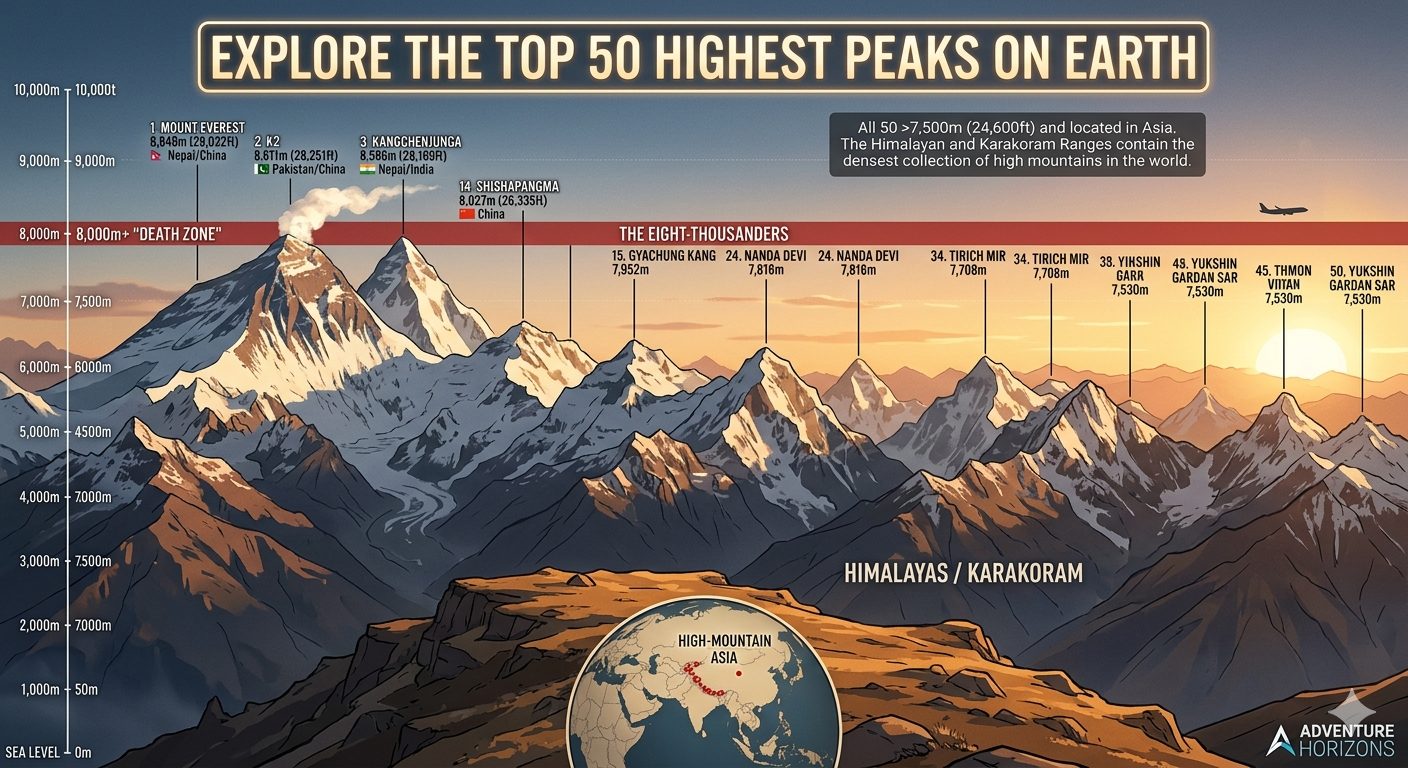
Top 50 highest mountain in the world : All of the world’s highest 50 mountains are in Central and South Asia, all in the Himalayas and Karakoram ranges, and all over
the Highest Mountains in the world (over 8,000m)
- Everest Peak 8,849 m – Himalaya
- K2 (8,611 m) – Karakoram
- Kangchenjunga (8,586 m) – Himalayas
- Lhotse (8,516 m) – Himalayas
- Makalu (8,485 m) – Himalayas
- Cho Oyu (8,188 m) – Himalayas
- 8,167 m (26.795 ft) – Himalaya (Dhaulagiri I)
- Manaslu (8,163 m) – Himalayas
- Nanga Parbat (8126m) — Himalayas
- Annapurna I (8,091 m) – Himalayas
- Gasherbrum I (8,080 m) – Karakoram
- Broad Peak (8,051 m) – Karakoram
- Gasherbrum II (8,035 m) – Karakoram
- Shishapangma (8,027 m) – Himalayas
- Gyachung Kang (7,952 m) – Himalaya Range
Where: All top 50 peaks are in Asia
Top 50 Highest Mountains in the World
| Rank | Mountain | Height (m) | Height (ft) | Range | Location |
| 1 | Mount Everest | 8,848 | 29,031 | Himalayas | Nepal/China |
| 2 | K2 | 8,611 | 28,251 | Karakoram | Pakistan/China |
| 3 | Kangchenjunga | 8,586 | 28,169 | Himalayas | Nepal/India |
| 4 | Lhotse | 8,516 | 27,940 | Himalayas | Nepal/China |
| 5 | Makalu | 8,485 | 27,838 | Himalayas | Nepal/China |
| 6 | Cho Oyu | 8,188 | 26,864 | Himalayas | Nepal/China |
| 7 | Dhaulagiri I | 8,167 | 26,795 | Himalayas | Nepal |
| 8 | Manaslu | 8,163 | 26,781 | Himalayas | Nepal |
| 9 | Nanga Parbat | 8,126 | 26,660 | Himalayas | Pakistan |
| 10 | Annapurna I | 8,091 | 26,545 | Himalayas | Nepal |
| 11 | Gasherbrum I | 8,080 | 26,509 | Karakoram | Pakistan/China |
| 12 | Broad Peak | 8,051 | 26,414 | Karakoram | Pakistan/China |
| 13 | Gasherbrum II | 8,035 | 26,362 | Karakoram | Pakistan/China |
| 14 | Shishapangma | 8,027 | 26,335 | Himalayas | China |
| 15 | Gyachung Kang | 7,952 | 26,089 | Himalayas | Nepal/China |
| 16 | Annapurna II | 7,937 | 26,040 | Himalayas | Nepal |
| 17 | Gasherbrum IV | 7,932 | 26,024 | Karakoram | Pakistan |
| 18 | Himalchuli | 7,893 | 25,896 | Himalayas | Nepal |
| 19 | Distaghil Sar | 7,884 | 25,866 | Karakoram | Pakistan |
| 20 | Ngadi Chuli | 7,871 | 25,823 | Himalayas | Nepal |
| 21 | Nuptse | 7,864 | 25,801 | Himalayas | Nepal |
| 22 | Khunyang Chhish | 7,852 | 25,761 | Karakoram | Pakistan |
| 23 | Masherbrum | 7,821 | 25,659 | Karakoram | Pakistan |
| 24 | Nanda Devi | 7,816 | 25,643 | Himalayas | India |
| 25 | Chomo Lonzo | 7,804 | 25,604 | Himalayas | China |
| 26 | Batura Sar | 7,795 | 25,574 | Karakoram | Pakistan |
| 27 | Kanjut Sar | 7,790 | 25,558 | Karakoram | Pakistan |
| 28 | Rakaposhi | 7,788 | 25,551 | Karakoram | Pakistan |
| 29 | Namcha Barwa | 7,782 | 25,531 | Himalayas | China |
| 30 | Kamet | 7,756 | 25,446 | Himalayas | India |
| 31 | Dhaulagiri II | 7,751 | 25,430 | Himalayas | Nepal |
| 32 | Saltoro Kangri | 7,742 | 25,400 | Karakoram | India/Pakistan |
| 33 | Kumbhakarna | 7,711 | 25,299 | Himalayas | Nepal |
| 34 | Tirich Mir | 7,708 | 25,289 | Hindu Kush | Pakistan |
| 35 | Molamenqing | 7,703 | 25,272 | Himalayas | China |
| 36 | Gurla Mandhata | 7,694 | 25,243 | Himalayas | China |
| 37 | Saser Kangri I | 7,672 | 25,171 | Karakoram | India |
| 38 | Chogolisa | 7,665 | 25,148 | Karakoram | Pakistan |
| 39 | Kongur Tagh | 7,649 | 25,095 | Pamir | China |
| 40 | Shispare | 7,611 | 24,970 | Karakoram | Pakistan |
| 41 | Trivor | 7,577 | 24,859 | Karakoram | Pakistan |
| 42 | Gangkhar Puensum | 7,570 | 24,836 | Himalayas | Bhutan/China |
| 43 | Gongga Shan | 7,556 | 24,790 | Daxue Shan | China |
| 44 | Annapurna III | 7,555 | 24,787 | Himalayas | Nepal |
| 45 | Kula Kangri | 7,554 | 24,783 | Himalayas | China/Bhutan |
| 46 | Muztagh Ata | 7,546 | 24,757 | Pamir | China |
| 47 | Skyang Kangri | 7,545 | 24,754 | Karakoram | Pakistan/China |
| 48 | Changtse | 7,543 | 24,747 | Himalayas | China |
| 49 | Liankang Kangri | 7,535 | 24,721 | Himalayas | Bhutan/China |
| 50 | Yukshin Gardan Sar | 7,530 | 24,705 | Karakoram | Pakistan |
Frequently Asked Questions (F&Q)
General Geography & Science
Q1. Why have all of Earth’s 50 tallest mountains within Asia?
Every single one of the 50 tallest peaks are found within the Himalaya, Karakoram, Hindu Kush, and Pamir ranges. This is because of the extremely large and continuous tectonic collision of Indian Plate with Eurasian Plate. Since this collision involves two thick plates of continental crust (neither of which wants to dive under the other into the mantle), the earth is pushed up more vigorously here than anywhere else on the planet.
Q2: Are these mountains still growing by 2026?
Yes. According to geologists, the Himalayas rise around 4–5 mm annually. But that growth is countered by erosion and rare events that can change height, such as the 2015 Nepal quake.
Q3: What is the “Death Zone”?
The Death Zone is defined as all heights above 8,000 meters. The atmospheric pressure at this altitude is so low that just around 33 percent of the oxygen at sea level is available. No human body can adapt itself to this elevation — it simply starts to perish, which is why most climbers rely on additional oxygen.
Climbing Records & Statistics
Q4: — Who has climbed Everest most?
Kami Rita Sherpa is the world record holder of all time with 32 ascents of Mount Everest, as of the 2025/2026 climbing season That is why he has also called the “Man of Everest”.
Q5: What is the ‘Crown of the Earth’?
Such a label is given to mountaineers who are able to reach all 14 of the “eight-thousands” (the peaks above 8,000m). Only around 60 athletes in history had achieved this milestone by 2026.
Q6: What is the most lethal mountain statistically?
Though K2 is more notorious for danger, Annapurna I has the highest ratio of deaths per summit attempt (a little over 30%). Still, 2026 is far safer than any peak in the 20th century, thanks to improved logistics and better weather forecasting.
Common Comparisons
Q7: Mount Everest – the “tallest” mountain — is it?
Well that depends on how you measure:
Altitude Record — Everest (8,849m; 29,032ft from sea level)
Highest from base to summit: Mauna Kea, Hawaii Its height is more than 10,000m but its base is on the ocean floor and only 4207metres above the sea level.
Most Proximity to Space: Mount Chimborazo (Ecuador) Its peak is actually Earth’s closest point to the stars because the planet bulges at the equator.
Q8: Which Indian mountain has the highest peak?
Kangchenjunga The highest peak of India (Sikkim-Nepal border) Although K2 is in the same range as the other mountains in the Karakoram, the mountain is situated in the region of Gilgit-Baltistan.
Environment & Travel
Q9: When is the ideal season for visiting these mountain ranges?
Himalayas (Nepal / India): Pre-monsoon (April–May) and Post-monsoon (September–October)
Karakoram (Pakistan): The window to climb is a lot shorter, generally restricted to June–August.
Q10: Is there a way to view these mountains without climbing?
Yes. This includes “Mountain Flights” from Kathmandu, which in 2026 will get you up close to Everest and Lhotse. Also, you get to see these giants from their base without having to have the climbing skills to get to their summit by trekking to Everest Base Camp (EBC) or to the Annapurna Circuit.
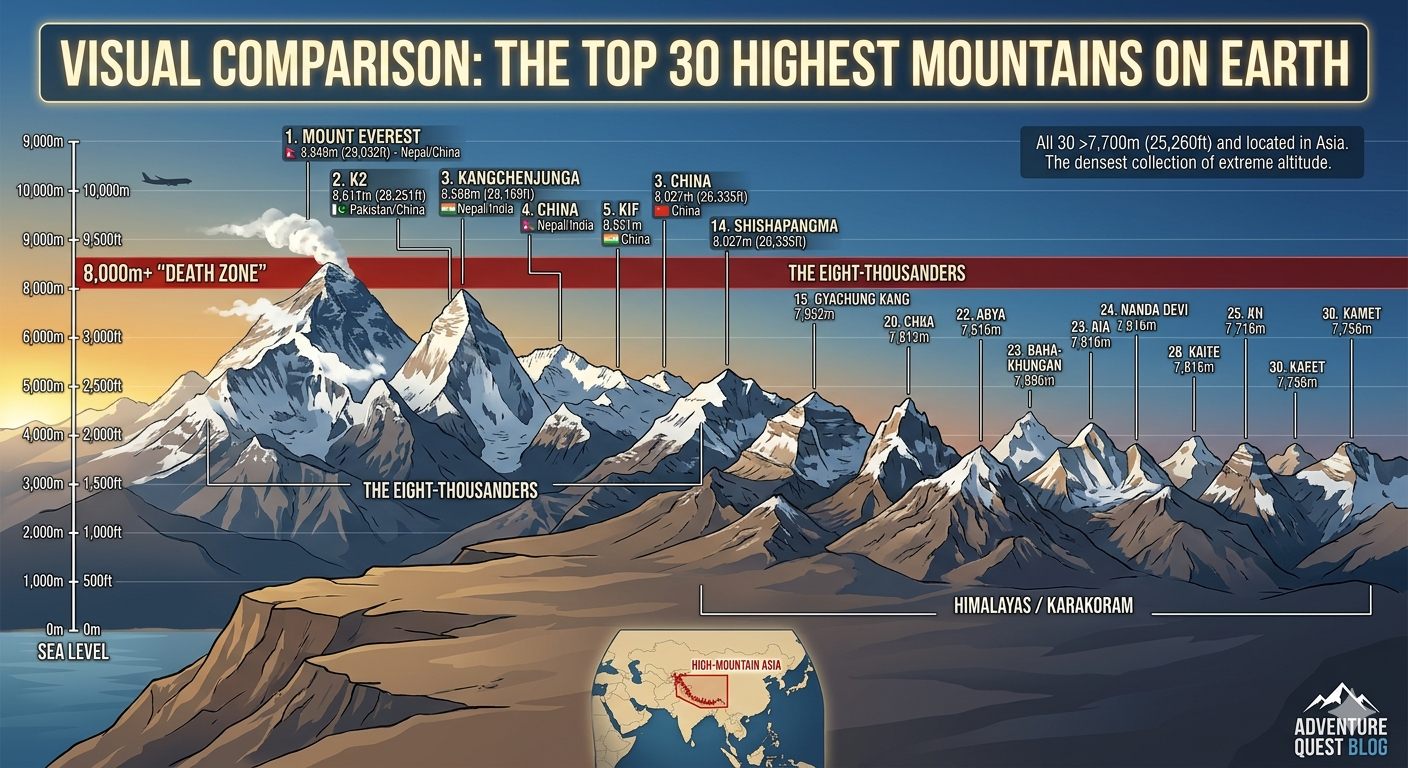
The 30 Highest Peaks in the World
| Rank | Mountain | Height (m) | Mountain Range | Location |
| 1 | Mount Everest | 8,849 | Himalayas | Nepal / China |
| 2 | K2 | 8,611 | Karakoram | Pakistan / China |
| 3 | Kangchenjunga | 8,586 | Himalayas | Nepal / India |
| 4 | Lhotse | 8,516 | Himalayas | Nepal / China |
| 5 | Makalu | 8,485 | Himalayas | Nepal / China |
| 6 | Cho Oyu | 8,188 | Himalayas | Nepal / China |
| 7 | Dhaulagiri I | 8,167 | Himalayas | Nepal |
| 8 | Manaslu | 8,163 | Himalayas | Nepal |
| 9 | Nanga Parbat | 8,126 | Himalayas | Pakistan |
| 10 | Annapurna I | 8,091 | Himalayas | Nepal |
| 11 | Gasherbrum I | 8,080 | Karakoram | Pakistan / China |
| 12 | Broad Peak | 8,051 | Karakoram | Pakistan / China |
| 13 | Gasherbrum II | 8,035 | Karakoram | Pakistan / China |
| 14 | Shishapangma | 8,027 | Himalayas | China |
| 15 | Gyachung Kang | 7,952 | Himalayas | Nepal / China |
| 16 | Annapurna II | 7,937 | Himalayas | Nepal |
| 17 | Gasherbrum IV | 7,932 | Karakoram | Pakistan |
| 18 | Himalchuli | 7,893 | Himalayas | Nepal |
| 19 | Distaghil Sar | 7,884 | Karakoram | Pakistan |
| 20 | Ngadi Chuli | 7,871 | Himalayas | Nepal |
| 21 | Nuptse | 7,864 | Himalayas | Nepal |
| 22 | Khunyang Chhish | 7,852 | Karakoram | Pakistan |
| 23 | Masherbrum | 7,821 | Karakoram | Pakistan |
| 24 | Nanda Devi | 7,816 | Himalayas | India |
| 25 | Chomo Lonzo | 7,804 | Himalayas | China |
| 26 | Batura Sar | 7,795 | Karakoram | Pakistan |
| 27 | Kanjut Sar | 7,790 | Karakoram | Pakistan |
| 28 | Rakaposhi | 7,788 | Karakoram | Pakistan |
| 29 | Namcha Barwa | 7,782 | Himalayas | China |
| 30 | Kamet | 7,756 | Himalayas | India |
Q1: Why are the top 30 mountains all in Asia?
This collision of the land plates, one of the largest collision of tectonic plates in the world between the Indian plate and the Eurasian plate – created this result. The so-called “continental crunch” produced the most extreme elevation on the planet. The highest peak (Aconcagua) in the longest range (the Andes in South America, which is not exactly know for its high peaks) is only 6,961m (and wouldn’t even qualify in the running for top 100).
Q2: Which is the highest peak in India?
Nanda Devi (Rank 24) is the highest mountain entirely in India. Kangchenjunga is taller, but it straddles the border between India, and Nepal, as well.
Q3: Of the top 30 hardest mountains to climb which is the most difficult?
The most technical and dangerous of the four is K2 (Rank 2). At the same time, Annapurna I (Rank 10) has the highest fatality rate historically. Gasherbrum IV (Rank 17) is notorious among the elite level of climbers for its steep rock faces and extreme difficulty among the “lower” peaks.
Q4: Is any mountain from this list has never been climbed?
Only the top 30 have been climbed. Nevertheless Gangkhar Puensum (Rank 42, not listed above) is usually recognized as the highest peak never to have been climbed, since Bhutan has banned climbs on her high peaks, on religious grounds.
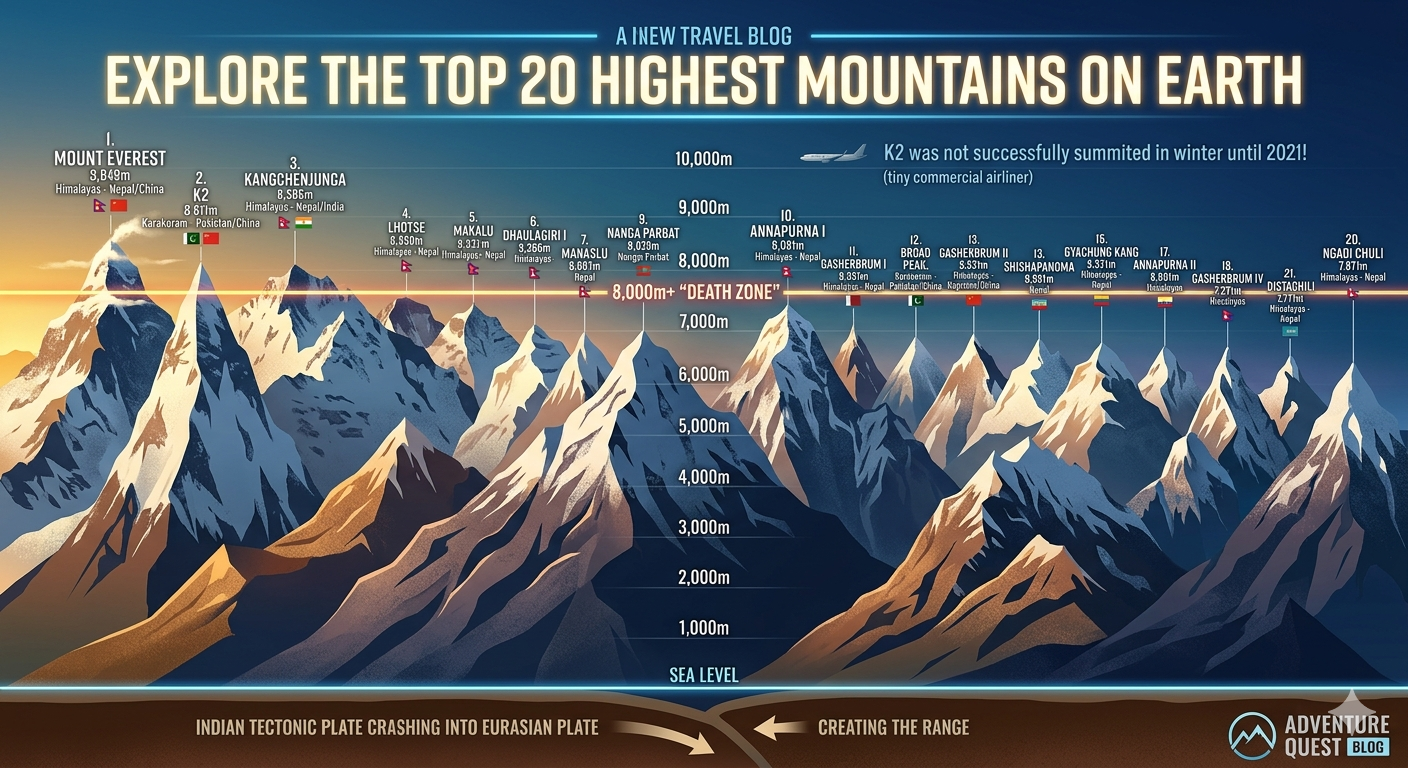
The 20 Highest Mountains
| Rank | Mountain | Height (m) | Height (ft) | Mountain Range | Country/Region |
| 1 | Mount Everest | 8,849 | 29,032 | Himalayas | Nepal / China (Tibet) |
| 2 | K2 | 8,611 | 28,251 | Karakoram | Pakistan / China |
| 3 | Kangchenjunga | 8,586 | 28,169 | Himalayas | Nepal / India |
| 4 | Lhotse | 8,516 | 27,940 | Himalayas | Nepal / China (Tibet) |
| 5 | Makalu | 8,485 | 27,838 | Himalayas | Nepal / China (Tibet) |
| 6 | Cho Oyu | 8,188 | 26,864 | Himalayas | Nepal / China (Tibet) |
| 7 | Dhaulagiri I | 8,167 | 26,795 | Himalayas | Nepal |
| 8 | Manaslu | 8,163 | 26,781 | Himalayas | Nepal |
| 9 | Nanga Parbat | 8,126 | 26,660 | Himalayas | Pakistan |
| 10 | Annapurna I | 8,091 | 26,545 | Himalayas | Nepal |
| 11 | Gasherbrum I | 8,080 | 26,509 | Karakoram | Pakistan / China |
| 12 | Broad Peak | 8,051 | 26,414 | Karakoram | Pakistan / China |
| 13 | Gasherbrum II | 8,035 | 26,362 | Karakoram | Pakistan / China |
| 14 | Shishapangma | 8,027 | 26,335 | Himalayas | China (Tibet) |
| 15 | Gyachung Kang | 7,952 | 26,089 | Himalayas | Nepal / China (Tibet) |
| 16 | Annapurna II | 7,937 | 26,040 | Himalayas | Nepal |
| 17 | Gasherbrum IV | 7,932 | 26,024 | Karakoram | Pakistan |
| 18 | Himalchuli | 7,893 | 25,896 | Himalayas | Nepal |
| 19 | Distaghil Sar | 7,884 | 25,866 | Karakoram | Pakistan |
| 20 | Ngadi Chuli | 7,871 | 25,823 | Himalayas | Nepal |
F&Q: Insights & Curiosities
Q1: Why are all top 20 mountains in Asia?
This is a consequence of the great, continuous tectonic collision between the Indian Plate and the Eurasian Plate. This “continental crunch” thrust up the land more violently than elsewhere on Earth, producing the highest density of extreme elevation. Even the second highest range, the Andes of South America, is only half as high on average.
Q2: What is the “Death Zone”?
The term Death Zone applies to the area above 8,000 meters (26,247 feet). Despite the decreased weight and size, the oxygen is too thin to be viable as a life-sustaining gas for humans at this height. The body dies cell by cell. The degree of difficulty for climbers on mountains 1 to 14 is such that they require supplemental oxygen and extreme conditioning in order to survive.
Q3: So K2 really is harder than Everest?
Yes. Everest may be taller, but K2 (Rank 2) is deemed far more technical. The rock faces are steeper, the weather less predictable, and the fatality-summit ratio is far higher. And it also has a history of being the most difficult mountain to climb in winter.
Question 4: On which mountain do climbers die most?
Rank 10: Annapurna I Littered with bodies, Annapurna I has the highest death rate of any “eight-thousander.” If three climbers reached the summit, one would die trying to.
The next question is obvious, though, in case you did ahead to the following installment:
Q5: Isn’t there a mountain that is taller than Everest?
By traditional altitude measurement, no. However:
Total height (base to peak): Mauna Kea in Hawaii is tallest at ~10,210m, although more than half is under the ocean.
For distance from the center of Earth: Mt. Chimborazo in Ecuador is farthest from Earth’s core, because of the equatorial bulge of our planet.