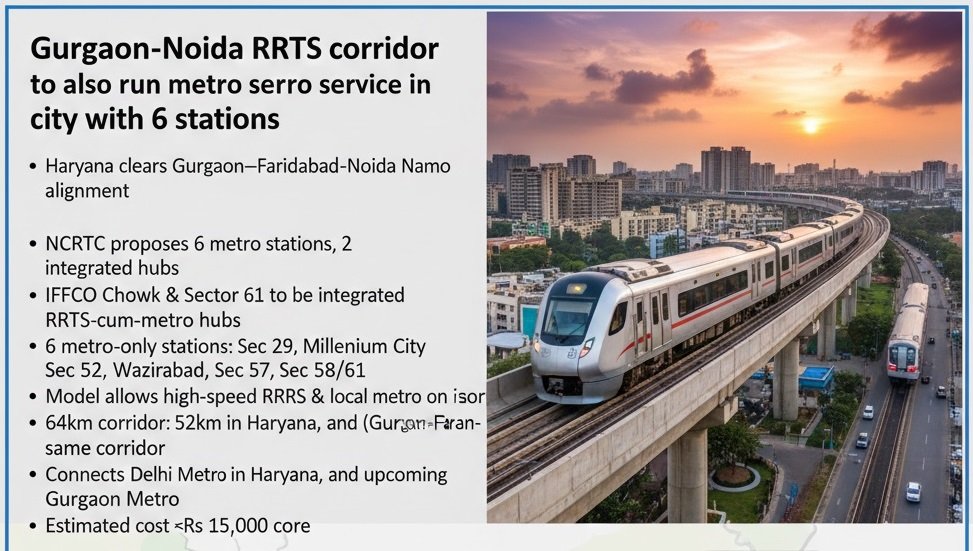
Gurgaon: The alignment of the Gurgaon–Faridabad–Noida Namo Bharat corridor has been approved by Haryana, with Delhi-based NCRTC proposing six metro stations in the city along with two integrated RRTS Cum Metro hubs.
On the floor of the Assembly on Wednesday, chief minister Nayab Singh Saini said that with approval of RRTS corridor alignment in the region, “an important step in the direction of urban transport” had been taken by government.
The proposal was, however, discussed at a meeting chaired by Saini on Tuesday after NCRTC proposed running Namo Bharat along with metro trains on the same alignment in the city.
According to the plan, IFFCO Chowk and Sector 61 will be integrated RRTS-cum-metro hubs. Other metro-only stops have been planned, including stations at Sector 29, Millennium City Centre, Sector 52 and Wazirabad as well as at Sector 57 and at Sector 58/61 to facilitate daily intra-city movement.
According to an NCRTC official, with this model, the high-speed RRTS trains would be used for intercity movement and metro services (for shorter trips in the city) will operate on the same corridor. According to them, the plan is similar to that of Delhi–Meerut corridor where metro services run within Meerut along RRTS route.
Last year in Dec, the Haryana Mass Rapid Transport Corporation (HMRTC) had requested NCRTC to examine the feasibility of planning a metro system along the RRTS alignment to enhance local connectivity and prevent duplication of infrastructure.
The proposed corridor has a 64km length, of which 52km lies in Haryana covering Gurgaon and Faridabad. The route will start in IFFCO Chowk and head to Gwal pahari passing through Sector 29, Millennium City Centre (MCC), and sectors 52, 57 and 61 along the Golf Course Road Extension.
NCRTC officials said the alignment was decided upon as it caters to existing and upcoming sectors while avoiding ecologically sensitive areas such as Tau Devi Lal Biodiversity Park. On the Infinity/INT Between, about 450 m of common corridorway needs to be built above ground levelThe Rapid Metro line may need an extension of around 1 km at Sector 61 for integration. The alignment will be connected with DMRC’s Yellow Line at Millennium City Centre, Rapid Metro at Sector 61 and a proposed metro corridor between Sector 56 and Pachgaon.
The corridor is likely to enhance longterm connectivity between IGI Airport and the as-yet in completion Noida International Airport at Jewar. The project will cost approximately Rs 15,000 crore.
The detailed project report (DPR) will be ready shortly, said Saini. “The corridor will connect the Delhi Metro, Rapid Metro and proposed Gurgaon Metro network, and promote investment and employment in tune with PM Narendra Modi’s dream of a Viksit Bharat,” he said.
Union minister Rao Inderjit Singh had earlier flagged congestion at IFFCO Chowk, pointing out that the site would already have an RRTS station under the Delhi–Gurgaon–Bawal corridor as well as an operational metro station on the Yellow Line.
Earlier, Gurgaon Metro Rail Limited (GMRL) had proposed that the Gurgaon–Faridabad–Noida Namo Bharat corridor be constructed under the ground in the city instead of being elevated. It also suggested that the underground stretch be extended to start from Rajiv Chowk instead of IFFCO Chowk, claiming that just as IFFCO Chowk served less-dense residential and commercial areas in New Gurgaon, Rajiv Chowk serves denser residential and commercial areas of Old Gurgaon, thus generating higher all-day ridership. GMRL claimed that this option would offer better integration with the proposed Delhi–Gurgaon–Manesar–Bawal RRTS corridor, a more significant multimodal hub and a balanced Old and New Gurgaon network while facilitating future expansion towards Manesar railway station as well.
In Faridabad, an integrated stretch of about 16km from Sainik Colony to Badshapur has been approved. About 60 percent of the stretch falls within key areas, including NIT, Bata Chowk and Sectors 12 to 15 as well as parts of New Faridabad. It will link to the Violet Line of the Delhi Metro. Two integrated RRTS-cum-metro stations and eight only-metro stations have been proposed in the area of Faridabad.
The corridor will provide seamless and fast travel to lakhs of passengers, help to decongest the cities (by reducing traffic jam with construction work) while maintaining an environment-friendly approach as well, the CM added.
The corridor will also open new avenues in investment, employment generation and balanced urban growth in the state of Haryana,” he added. The project will be designed to cater to the future mobility needs keeping such factors in mind, especially with Gurugram and Faridabad witnessing rising population and traffic pressure.
The administration is fully committed to and monitoring the timely execution per all timeliness, with close coordination being ensured between the central and state governments: Saini
news sources Times of India