Gurgaon Real Estate Market Report
📈 1. Market Snapshot & Price Trends
The average property price in Gurgaon has stabilized significantly, though certain corridors continue to see double-digit growth.
| Segment | Expected Annual Growth | Avg. Price Range (per sq. ft.) |
| Luxury / Ultra-Luxury | 8% – 12% | ₹20,000 – ₹65,000+ |
| Premium Residential | 7% – 9% | ₹14,000 – ₹22,000 |
| Mid-Segment / Affordable | 5% – 7% | ₹8,000 – ₹13,000 |
| Commercial (Grade-A) | 7% – 10% | ₹15,000 – ₹35,000 |
-
The “Luxury” Boom: Sales of homes priced above ₹10 Crore have seen a nearly tenfold jump in the last two years.
-
Rental Yields: Residential yields remain modest at 2–3%, while commercial properties in prime corridors are delivering 7–10%+.
📍 2. Top Investment Corridors
The market is currently gravitating toward three main “growth spines”:
-
Dwarka Expressway (Sectors 102–113): Now fully functional, this is the city’s star performer. It offers seamless connectivity to IGI Airport and is the primary hub for new ultra-luxury launches (e.g., Puri Diplomatic Residences, Emaar Urban Ascent).
-
Golf Course Extension Road (Sectors 61–70): Known as the “New Billionaire’s Row,” this area attracts HNIs and NRIs. It is shifting toward low-density, high-rise luxury projects.
-
New Gurgaon & SPR (Sectors 76–95): These areas are the “work-play” hubs. Projects like DLF Privana South (Sector 77) and Signature Global Titanium (Sector 71) are bridging the gap between mid-segment and luxury.
🏗️ 3. Key Trends
-
Consolidation & Quality: Buyers are moving away from local developers toward “branded” giants (DLF, Godrej, M3M, Tata, Emaar) to avoid execution risks.
-
Senior Living: A new niche is emerging with roughly 15 dedicated senior living projects receiving licenses in, targeting the aging population with specialized wellness amenities.
-
Sustainability as Standard: Features like EV charging stations, solar energy, and AI-driven smart home systems are no longer “premium” add-ons but expected standards in new launches.
-
Commercial Evolution: Investment in SCO (Shop-cum-Office) plots along the Dwarka Expressway is currently a high-yield favorite for investors seeking better liquidity than traditional office space.
⚠️ 4. Risks to Watch
-
Shadow Inventory: Analysts warn of “shadow inventory” (investor-held units hitting the resale market simultaneously) which could temporarily cap price appreciation in specific sectors like 102 or 84.
-
Infrastructure Lag: While the main expressways are ready, “last-mile” internal sector roads and water/sewage systems in parts of New Gurgaon are still catching up.
Investor Tip: Focus on projects with RERA completion dates within 12–18 months. In the current market, “Ready-to-Move” (RTM) properties command a 15–20% premium over under-construction units due to immediate rental demand from the corporate workforce.
1. Dominant Projects & Developer Shifts
In 2026, the market is no longer just about “location” but about “branding.” Buyers are paying a 15–25% premium for established names due to stricter RERA enforcement and a desire for “legacy” living.
-
Ultra-Luxury Benchmark: Projects like DLF The Arbour and DLF Magnolias continue to set the ceiling, with resale prices in some DLF Phase V pockets crossing ₹30,000 – ₹45,000 per sq. ft.
-
New Launch Leaders (2026):
-
Elan The Statement (Sector 49): A major luxury focus on Sohna Road.
-
Signature Global Titanium (Sector 71): Redefining the SPR corridor with premium high-rises.
-
Sobha Aranya (Sector 80): Targeting the “wellness” segment with low-density, green-focused layouts.
-
Puri Diplomatic Residences (Sector 111): A top-tier play on the Delhi-Gurgaon border.
-
💼 2. The Rise of “Branded Residences” & SCOs
A significant shift in 2026 is the diversification beyond traditional apartments.
-
Branded Residences: Collaborations like M3M Elie Saab and Whiteland Westin Residences have introduced “hotel-style living” to Gurgaon. These units often see higher rental demand from expats and C-suite executives.
-
SCO (Shop-Cum-Office) Plots: These have become the “gold mine” for retail investors. In sectors like 62, 65, and 114, SCO plots are delivering annual rental returns of 8–12%, far outperforming the 3% seen in residential apartments.
-
Senior Living: With nearly 8% of Gurgaon’s population now over 60, specialized projects (like those by Ashiana) are seeing 100% absorption within months of launch.
🚦 3. Micro-Market Breakdown (2026 Prices)
| Micro-Market | Status in 2026 | Avg. Rate (per sq. ft.) | Why it’s moving |
| Dwarka Expressway | Mature Growth | ₹18,000 – ₹25,000 | Full connectivity to IGI Airport & Yashobhoomi (IICC). |
| Southern Peripheral (SPR) | High ROI Potential | ₹12,000 – ₹18,000 | Recent infra upgrades & extension of the Metro Yellow Line. |
| New Gurgaon (82–95) | End-User Hub | ₹9,000 – ₹14,000 | Proximity to IMT Manesar and improved internal sector roads. |
| Golf Course Ext. Road | Billionaire’s Row | ₹22,000 – ₹35,000 | The epicenter of “Branded Luxury” and Grade-A office supply. |
📊 4. Inventory & Supply Dynamics
-
Inventory Overhang: The “overhang” (time taken to sell current stock) has dropped to an all-time low of approximately 17–20 months, down from nearly 80 months in 2020.
-
Supply Crunch in Mid-Segment: There is a notable shortage of homes in the ₹1.5 Cr – ₹2.5 Cr range, as most developers have pivoted to “Ultra-Luxury” (₹5 Cr+) to maximize margins. This makes well-located 3BHKs in New Gurgaon highly liquid.
-
Rental Pressure: Rentals in “ready-to-move” gated societies have surged by 40% over the last two years, driven by the return-to-office mandates of Fortune 500 companies in Cyber City and Horizon Center.
💡 Summary Investment Advice
If you are looking for capital appreciation, the SPR (Southern Peripheral Road) is currently the “sweet spot” due to lower entry prices compared to Dwarka Expressway. For rental income, focus on SCO plots or serviced apartments near Sector 63/65.
🧐 General Market FAQs
Q: Is 2026 a good time to buy, or is there a “Gurgaon Bubble”?
A: Most analysts see 2026 as a stabilization year. While prices rose by over 150% in some sectors between 2021 and 2025, the market has moved from speculation to infrastructure-backed growth. It’s not a “bubble” in the traditional sense because demand is driven by high-income corporate employment and NRI capital, but the era of “doubling your money in two years” has likely passed. Expect more realistic 8–12% annual appreciation moving forward.
Q: Which are the best sectors for investment in 2026?
A: * For High Appreciation: Dwarka Expressway (Sectors 102, 106, 113) and Southern Peripheral Road (Sectors 71, 77).
-
For High Rental Yield: Golf Course Extension Road (Sectors 65, 66) and Sector 49/Sohna Road.
-
For Entry-Level/Mid-Segment: New Gurgaon (Sectors 82–95) and South Gurgaon (Sohna).
💰 Financial & Legal FAQs
Q: What are the Stamp Duty and Registration charges in Gurgaon for 2026?
A: Haryana continues to offer gender-based incentives. Charges are calculated on the circle rate or agreement value (whichever is higher):
| Ownership Type | Urban Area (Gurgaon City) | Rural Area |
| Male | 7% | 5% |
| Female | 5% | 3% |
| Joint (Male + Female) | 6% | 4% |
| Registration Fee | Up to ₹50,000 (Slab-based) | Same |
Q: What is the current average rental yield in Gurgaon?
A: * Residential: 3.5% – 4.5% (Highest in “Branded Residences” and Studio apartments).
-
Commercial (SCO/Office): 8% – 11%.
-
Warehousing: 10% – 12% (Particularly along the KMP Expressway).
🏗️ Infrastructure & Connectivity
Q: How is the Metro expansion affecting property prices?
A: The proposed Gurugram Metro loop (linking HUDA City Centre to Cyber City via Old Gurgaon and Palam Vihar) has already caused a 15–20% premium in sectors like 4, 7, and Palam Vihar. Properties within 500 meters of proposed stations are currently seeing the highest demand.
Q: Is the Dwarka Expressway “fully” live?
A: As of early 2026, the main carriageway and most cloverleaf connections are fully operational. The focus has now shifted to service roads and last-mile connectivity to the internal sectors. Sectors 102 through 113 are now effectively “prime” rather than “peripheral.”
🏘️ Buyer Preferences
Q: Should I buy a Plot or a Flat?
A: * Plots: Offer higher long-term appreciation (often 15%+ YoY) and greater control, but require higher upfront capital. Best for those looking at Deen Dayal Jan Awas Yojana (DDJAY) schemes.
-
Flats: Better for immediate rental income and “lifestyle” amenities (clubhouses, security). In 2026, the resale market for gated societies is very strong due to high demand for “ready-to-move” (RTM) inventory.
Q: What are “SCO Plots” everyone is talking about?
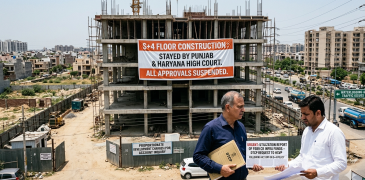
A: Shop-Cum-Office (SCO) plots allow you to build a basement + ground + 4 floors for retail and office use. They are currently the favorite of HNIs because they combine the land ownership of a plot with the high rental yields of commercial property.
Regulatory & Policy FAQs
Q: What are the current Circle Rates (Collector Rates) for 2026?
A: The Haryana government revised collector rates upward in August 2025. These are the minimum values at which you must register a property:
-
Prime Areas (Sectors 42, 43, 54): Approximately ₹1,15,000+ per sq. yard for plots; ₹15,000–₹35,000 per sq. ft. for premium flats.
-
Dwarka Expressway (Sectors 102–115): Recently hiked to ~₹7,000 per sq. ft. for group housing (up from ₹4,200).
-
Newer Developed Sectors (63–68): Range between ₹6,500 and ₹7,500 per sq. ft.
Q: How do I check if a project is “Blacklisted” or “Lapsed” in 2026?
A: You should visit the HARERA Gurugram portal. In 2026, the authority has become stricter with “Quarterly Progress Reports” (QPR). If a developer hasn’t updated their QPR for two consecutive quarters, the project is flagged. Always check for a valid Registration Certificate that hasn’t passed its “Registration Up-to” date.
🚀 Future Hotspot FAQs
Q: What is the “Global City” project and how does it affect nearby prices?
A: The Global City (Sectors 36, 36B, 37, 37B) is a 1,000-acre mixed-use “city within a city” being developed by HSIIDC. In early 2026, phase-1 internal infrastructure (roads/drainage) is nearing completion.
-
Impact: Sectors 84, 88, and 37D have seen a 20% price surge due to their proximity to this hub, which is expected to house 1.8 lakh residents and a massive “Iconic Tower” intended to be India’s tallest commercial building.
Q: Is “South Gurgaon” (Sohna) still considered a separate market?
A: By 2026, the gap has closed. The Sohna Elevated Road has reduced the commute to 15 minutes. It is now the primary hub for Affordable and Mid-segment housing (₹5,500–₹8,000 per sq. ft.), appealing to those priced out of the main city.
🏠 Logistics & Lifestyle FAQs
Q: What is the “Shadow Inventory” risk mentioned by analysts?
A: This refers to apartments bought by investors during the 2023–2024 boom that are now hitting the resale market as they approach possession. In specific sectors like 102, 106, and 84, this high supply of resale units can make it harder for individual sellers to exit at a high premium, though it offers great opportunities for end-user buyers to negotiate.
Q: Are “Senior Living” projects a viable investment?
A: Yes. With over 15 dedicated licenses issued by 2026, this is the fastest-growing niche. These projects offer high rental demand from the “Silver Economy” and often feature specialized medical tie-ups (e.g., Max or Medanta), ensuring better long-term occupancy than standard apartments.
Comparison of Circle Rates vs. Market Rates (2026)
| Locality | Circle Rate (Approx.) | Market Rate (Avg.) | Gap/Premium |
| DLF Phase II | ₹1,15,100 /sq. yd | ₹2,50,000+ /sq. yd | ~115% |
| Sec 102-113 | ₹7,000 /sq. ft | ₹18,000 – ₹24,000 /sq. ft | ~150%+ |
| Sector 49 | ₹9,100 /sq. ft | ₹14,000 – ₹17,000 /sq. ft | ~60% |
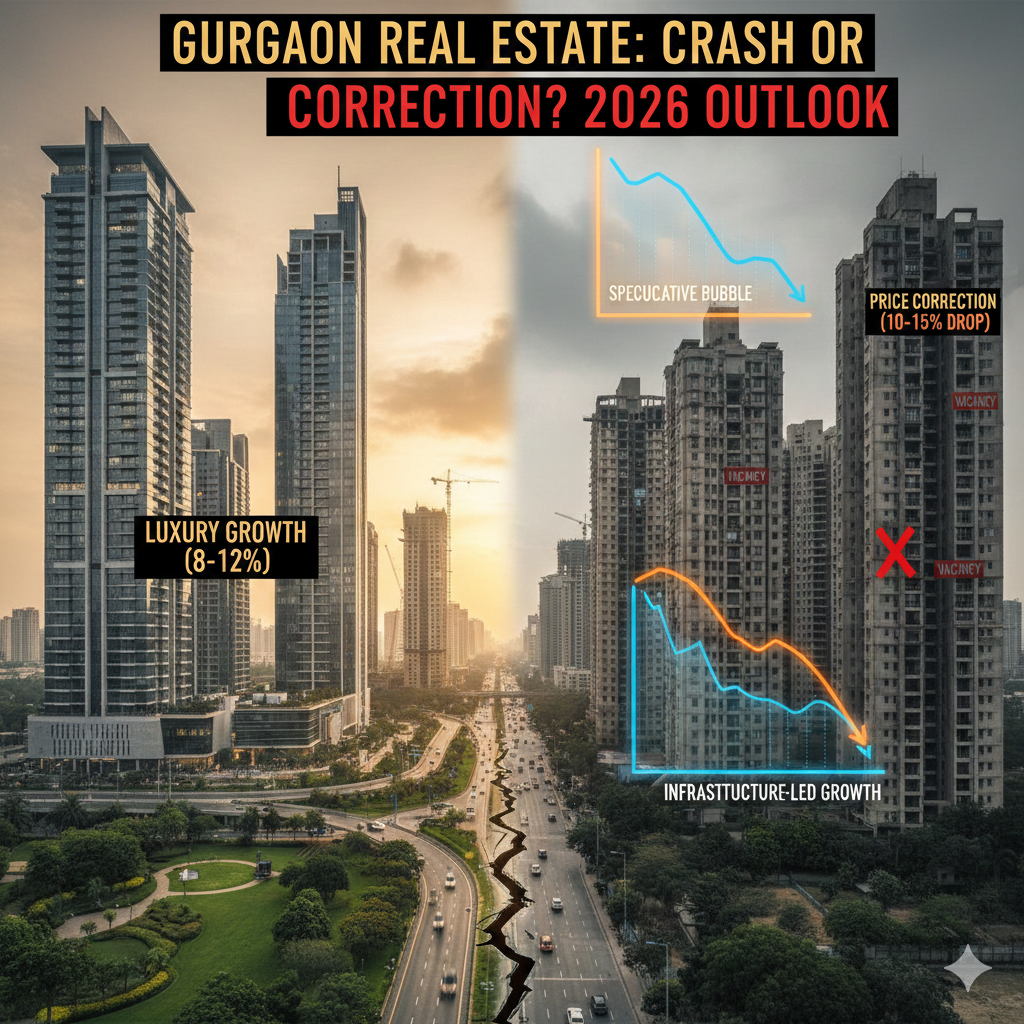
Gurgaon real estate market crash..?
🧐 Crash vs. Correction: The 2026 F&Q
Q: Is the Gurgaon real estate market currently crashing?
A: No, not a city-wide crash. It is a “Segmented Correction.” * The Reality: Ultra-luxury projects by top-tier builders (DLF, Godrej, Signature Global) are still seeing price growth of 8–12%.
-
The “Crash” Zone: Properties in secondary locations with poor last-mile connectivity or those by “non-branded” developers are seeing prices drop by 10–15%. Some high-end penthouses in Sector 104 recently saw official price cuts of up to ₹1.5 Crore as buyers became more selective.
Q: What are the primary “Red Flags” in 2026?
A: 1. Shadow Inventory: Thousands of units bought by investors in 2023–24 are hitting the resale market simultaneously as projects near completion. This oversupply in specific sectors (like 102, 106, and 84) is forcing sellers to lower prices.
2. The “Luxury” Fatigue: Nearly 50–60% of new launches in 2025 were “luxury” (₹5 Cr+). There aren’t enough end-users to occupy these at current price points, leading to a glut in the premium segment.
3. Affordability Gap: Property prices have risen by over 150% in five years, while average white-collar salaries have only grown by ~30–40%. This gap has slowed down the “entry-level” luxury market.
Q: Is this a “Real Estate Bubble”?
A: Most experts call it an Imbalance rather than a bubble. A bubble usually involves excessive lending (like 2008), but 2026 buyers are mostly high-income professionals and NRIs with low leverage.
Market Verdict: Expect Stagnation (sideways movement) for the next 18–24 months rather than a vertical drop in prices.
Q: Which areas are most “at risk” of a price dip?
A: * New Gurgaon (Sectors 82–95): High supply and slower-than-expected commercial development.
-
Over-Hyped Pockets of Dwarka Expressway: Sectors where internal roads and water/electricity infrastructure are still lagging behind the flashy apartment gates.
🛡️ How to Protect Your Investment
If you are buying or holding in 2026, follow the “Safety First” rules:
| Risk Factor | How to Mitigate |
| Resale Difficulty | Buy only in projects within 1km of a Metro Station or Major Expressway Exit. |
| Price Fall | Stick to Grade-A Developers (DLF, Tata, Godrej, M3M). Their “brand tax” acts as a floor for prices. |
| Rental Vacancy | Invest in the Golf Course Extension or SPR where corporate demand is highest. |
Q: Should I wait to buy until late 2026?
A: If you are an Investor, yes. The “Shadow Inventory” will likely peak in late 2026, offering better negotiation power. If you are an End-User, look for “Ready-to-Move” (RTM) units in sectors with completed infrastructure; these are the least likely to lose value.
🛑 The “Crash” & “Correction” F&Q
Q: Why are some people calling it a “soft” market right now?
A: In January 2026, major developers like Signature Global signaled they might miss their sales targets due to a “soft” environment. The frenzy of 2023–2024 (where projects sold out in 72 hours) is gone. Buyers are now “resisting” high prices, especially for units priced above ₹6 Crore, which are staying on the market longer than before.
Q: Which segment is most at risk of a price drop?
A: The “Pseudo-Luxury” Segment. Between 2024 and 2025, many developers rebranded mid-segment projects as “Ultra-Luxury” to charge ₹18,000/sq. ft. or more. In 2026, buyers have realized these projects lack the density, service, and location to justify the price. Expect a 10–15% correction in these “lifestyle-lite” projects.
Q: Is there an oversupply of homes?
A: Ironically, it’s a supply-demand mismatch:
-
Oversupply: There is a “Luxury Bulge” of unsold units in the ₹4 Cr–₹10 Cr range.
-
Extreme Shortage: There are almost no new affordable or mid-segment launches. Because of high land costs, developers stopped building for the “salaried professional” (₹1 Cr–₹2 Cr range). This has created a “Paper Promise” where the city has homes, but not for the people who actually live and work there.
Q: What is the “₹6 Crore Ceiling”?
A: Market data from early 2026 shows that sales velocity drops off a cliff once a property crosses the ₹6 Crore mark. While Mumbai remains more expensive per sq. ft., the “weighted average price” of an unsold unit in Gurgaon is now ₹4 Crore, which is higher than Mumbai’s average of ₹3 Crore. This makes Gurgaon statistically “overvalued” for the average buyer.
🏗️ Sector-Specific Warning Zones
| Micro-Market | 2026 Status | The “Crash” Risk |
| Dwarka Expressway | Mature / High Supply | Moderate. High “Shadow Inventory” from investors trying to exit before their final payment installments are due. |
| New Gurgaon (80s-90s) | Infrastructure Lag | High. Water table depletion and slow last-mile road connectivity are causing some buyers to cancel bookings and move toward more established sectors. |
| Sohna (South Gurgaon) | Affordable Hub | Low. This is the only area still offering value (₹6,000–₹8,000/sq. ft.), keeping demand steady from first-time buyers. |
📉 Investor “Panic” vs. “Pivot”
Q: Are NRIs and HNIs still buying?
A: Yes, but they have pivoted. They are no longer buying “anything with a balcony.” They are moving toward Global Capability Centers (GCCs)—investing in commercial office spaces and high-end retail (SCOs) where rental yields are 7–9%, compared to residential yields which have stagnated at 2.5–3%.
Q: What happens if I bought at the 2025 peak?
A: If you bought for “end-use” (living), your investment is safe because Gurgaon’s job market remains India’s strongest. If you bought for a “quick flip,” you may face liquidity issues. It might take 12–18 months longer to find a buyer than you initially planned.
Expert Insight: “The next 5 years (2026–2030) will be defined by structural strength, not speculative momentum. The era of the 25% annual price spike is officially over.” — Consensus from Q1 2026 Developer Reports.
🛑 The “Crash” Indicators: 2026 Reality Check
1. The Luxury “Glut” & Resale Stagnation
The most visible sign of a correction is the absorption slowdown in properties above ₹6 Crore. * Unsold Inventory: Units priced at ₹4 Cr+ have seen a 47% jump in inventory build-up compared to 2024.
-
Secondary Market Stress: Investors who bought “off-plan” in 2023–24 are now struggling to find buyers at their expected 40–50% premiums. In sectors like 102, 103, and 84, resale prices have softened by 5–8% as “Shadow Inventory” (investor-held stock) floods the market simultaneously.
2. Developer Sales Warnings
In February 2026, major players like Signature Global and DLF reported a “soft” environment for luxury. Signature Global notably signaled they might miss their ₹12,500 Cr sales target for the fiscal year, citing buyer resistance to current price levels.
3. The Affordability Disconnect
The weighted average price of an unsold unit in Gurgaon has hit ₹4 Crore—statistically higher than Mumbai’s average of ₹3 Crore. This has effectively priced out the mid-income corporate professional, the backbone of Gurgaon’s economy, leading to a “hollow” market at the top.
📉 Correction Micro-Markets (Risk Heatmap)
| Risk Level | Micro-Market | 2026 Situation |
| High Risk | Sectors 106–113 (DXP) | High concentration of “pseudo-luxury” projects. Prices surged 160% in 3 years; now seeing “distress listings” from over-leveraged investors. |
| Moderate Risk | New Gurgaon (Sec 82–95) | Good end-user base but plagued by infrastructure lags. Prices are stagnant, and rental growth has slowed. |
| Low Risk | Golf Course Ext. Road | The “Safe Haven.” High-quality Grade-A supply and corporate demand keep this area stable, though growth has moderated to single digits. |
🏗️ The “Infrastructure Floor” (Why it won’t be a 2008-style crash)
Despite the “soft” residential sales, the market has a strong foundation preventing a total collapse:
-
GCC Expansion: Global Capability Centers continue to lease massive office spaces in Cyber City and Horizon Center, keeping the rental demand for 2–3 BHKs (₹1.5 Cr – ₹2.5 Cr) extremely high.
-
Dwarka Expressway Maturity: The highway is no longer a “promise”—it’s a functional reality. This has converted many speculative holdings into actual “end-user” homes, providing a price floor.
-
Metro Connectivity: The start of construction on the Metro loop has protected values in Old Gurgaon and Palam Vihar.
💡 2026 “Crash” F&Q (Deep Dive)
Q: Are there actual “Distress Sales” happening right now?
A: Yes. As of February 2026, portals like Ghar.tv and 99acres are showing a spike in “Distress” tags for 3BHKs in Sector 102 (Heritage Max, Emaar Imperial) and Sector 66. These are often from investors who cannot serve their final “Possession” demand letters from builders.
Q: Should I buy a “New Launch” in 2026?
A: Be extremely cautious. Developers are now offering innovative payment plans (like 20:80 or 10:90) to hide the fact that they are struggling to move inventory. In a correction phase, Ready-to-Move (RTM) properties are your best bet as they carry zero execution risk and offer immediate rental yields.
Q: Where is the “Smart Money” moving?
A: Investors are exiting residential luxury and moving into Commercial SCOs (Shop-cum-Office) and Senior Living projects. These segments are delivering 8–10% yields, double the residential average of 2.5–3.5%.