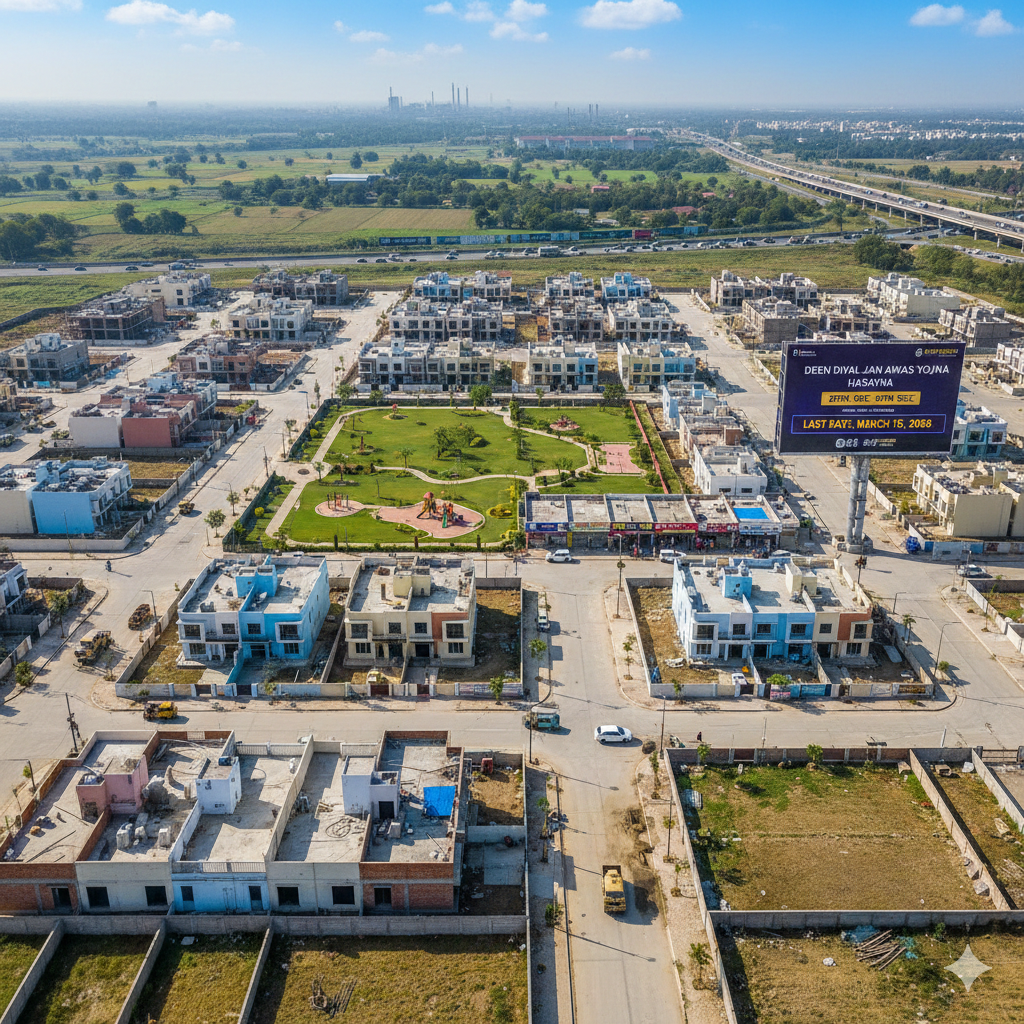
DDJAY Haryana – Deen Dayal Jan Awas Yojna Haryana (DDJAY) : The Deen Dayal Jan Awas Yojna (DDJAY) is Haryana’s flagship policy for affordable plotted housing. Unlike the high-rise apartments of the Affordable Housing Policy, DDJAY allows you to own land (plots) or independent floors (stilt + 4 floors) with separate registries for each floor.
As of late 2026, here is the status of the scheme:
1. Active & Upcoming Projects (Feb–March 2026)
Several projects are currently in their registration window. If you are looking to book, these are your immediate options:
| Project Name | Location | Registration Closes | Allotment Date |
| Lykehomes Avenue | Sector 3, Farukhnagar | March 1, 2026 | March 2, 2026 |
| Majestic Green 02 | Sector 10, Kharkhoda | March 2, 2026 | March 3, 2026 |
| RRITAM Peace Valley | Sector 80, Sonipat | March 8, 2026 | March 12, 2026 |
| Prima City 2 | Sector 22A, Rohtak | March 15, 2026 | March 17, 2026 |
| Ganga Realty Nxt | Sector 78, GGN | Ongoing | Contact Developer |
2. Key Policy Updates for 2026
-
Discontinuation in Core Cities: Note that the government has discontinued the issuance of new DDJAY licenses in the core “High Potential” zones of Gurugram Manesar Urban Complex and Faridabad. Only projects that received licenses before the cutoff (or those in low/medium potential zones like Sohna, Farukhnagar, and Kharkhoda) are moving forward.
-
Freeze Clause Removed: The government has removed the rule that froze 50% of the saleable area until project completion. This has speeded up the availability of plots for buyers.
-
Separate Registry: You can still build up to 4 floors on a DDJAY plot and sell/register each floor independently, which remains the biggest draw for investors.
3. Pricing & Sizes
-
Plot Sizes: Typically range from 60 sq. yards to 180 sq. yards (max 150 sq. meters).
-
Price Indication: * Kharkhoda/Jhajjar: ₹35,000 – ₹45,000 per sq. yard.
-
Sohna/Farukhnagar: ₹60,000 – ₹85,000 per sq. yard.
-
Sonipat (NH-44): ₹80,000+ per sq. yard.
-
4. How to Apply
-
Select a Licensed Project: Ensure the project has a valid HRERA number and a DDJAY License (e.g., “License No. 141 of 2025”).
-
Registration: Visit the developer’s specific portal or the TCP Haryana site.
-
Booking Amount: Usually ranges from ₹10,000 to ₹50,000 (fully refundable if you don’t win the draw).
-
Payment Plan: Most DDJAY plots follow a 10:40:25:25 plan (10% on allotment, 40% within 30 days, etc.).
Warning on “Confirmed Allotment”
Be wary of brokers promising “confirmed plots” for a premium. DDJAY allotments are legally required to be transparent, and many projects still utilize a draw of lots if they are oversubscribed.
Chief Minister Urban Housing Scheme (2026 Status)
This is a massive government-led initiative targeting EWS and BPL families.
-
The Draw: As of February 2026, the government is reviewing over 1.2 lakh applications for approximately 6,700 houses in Gurgaon.
-
Cost: Flats are priced exceptionally low, around ₹1.5 Lakh for eligible families.
-
Next Step: Applicants are currently being verified for “property-less” status. If you applied, watch for an SMS regarding the ₹10,000 shortlisting deposit.
How to Verify a Project:
Before paying any registration fee (usually ₹49,000 for DDJAY or 5% for AHP), go to haryanarera.gov.in and search for the RERA Registration Number. If the project is “Lapsed” or not listed, do not invest.
🏗️ Key Features & Construction Rules
The DDJAY is unique because it combines the freedom of owning a plot with the infrastructure of a planned township.
-
Plot Sizes: Ranging from 60 sq. mt. to 150 sq. mt. (approx. 72 to 180 sq. yards).
-
Stilt + 4 Floors: You are permitted to construct a stilt parking level plus four independent floors.
-
Independent Registry: Each floor can be registered and sold separately, allowing for high rental income or multi-generational living.
-
FAR (Floor Area Ratio): Typically allowed up to 2.68, providing significant built-up area.
-
Loan Facility: Being a government-backed scheme, banks like SBI, HDFC, and ICICI provide loans up to 75–80% on plots and up to 90% on built-up floors.
📅 Current Status & Deadlines (2026)
Several projects in key areas like Sonipat, Rohtak, and Bahadurgarh have active application windows:
| Project / Location | Last Date to Apply | Allotment Date |
| Majestic Green (Kharkhoda) | March 1, 2026 | March 2, 2026 |
| Vasa Avenue (Bahadurgarh) | March 15, 2026 | March 17, 2026 |
| General DDJAY (Govt Quota) | March 8, 2026 | March 12, 2026 |
Note: A 33% quota is often reserved for women and government employees in many DDJAY projects, sometimes accompanied by price discounts (e.g., ₹1500/sq. yd).
💰 Financials & Benefits
-
Registration Fee: Usually ranges between ₹31,000 and ₹49,000 (fully refundable for unsuccessful applicants).
-
Development Charges: License fees and External Development Charges (EDC) are significantly lower compared to standard projects, which keeps the end-price affordable for the middle class.
-
Infrastructure: Developers are legally mandated to provide 9-meter internal roads, parks (7.5% of land), and community sites.
📝 Eligibility & Documents
-
Who can apply: Any Indian citizen aged 18+. Preference is often given to first-time homebuyers.
-
Documents needed:
-
Aadhaar Card & PAN Card.
-
Address Proof (Voter ID/Passport).
-
Income Proof (ITR/Salary Slips).
-
Bank account details for refund/payment.
-
Building on the initial overview, here are the technical, financial, and procedural details for the Deen Dayal Jan Awas Yojna (DDJAY) as of early 2026.
🏗️ Technical Construction & Zoning Rules
The policy has recently been updated to maximize land use and buyer flexibility.
-
Stilt + 4 Floors: You can construct a stilt parking level and up to four floors above it. Each floor can be owned by a different individual.
-
Floor Area Ratio (FAR): The standard FAR is 2.0, but with the purchase of “Purchasable FAR,” it can be increased to 2.68.
-
Internal Infrastructure: Developers must provide 9-meter wide internal roads and a minimum of 7.5% of the total project area as organized green/open space.
-
Commercial Use: Up to 4% of the total licensed area can be developed for commercial purposes (shops, etc.) to serve the residents.
💰 Financial Breakdown (2026)
Investing in DDJAY is considered lower risk because of heavy government oversight.
-
Pricing: While prices vary by location, the “Circle Rate” in Haryana usually governs the base price. Projects in growing hubs like Sonipat or Rohtak currently start around ₹48.50 Lakh for plots.
-
Payment Plans: Most developers offer a Possession Linked Payment Plan (PLP) or a construction-linked plan.
-
Mortgage Security: Instead of just a bank guarantee, developers can now mortgage 10% of their saleable area to the government as security for completing the project, which speeds up project launches.
-
PMAY Benefits: If you are a first-time homebuyer, you may still be eligible for interest subsidies under the Pradhan Mantri Awas Yojana (PMAY) credit-linked subsidy scheme.
📋 Eligibility & Application Rules
The scheme is designed for the common citizen, but there are specific “priority” rules:
-
Income Categories:
-
EWS: Up to ₹3 Lakh annual household income.
-
LIG: ₹3 Lakh to ₹6 Lakh.
-
MIG: ₹6 Lakh to ₹12 Lakh.
-
-
Priority Allotment: Preference is given to those who do not own any other residential property or plot in urban areas of Haryana.
-
Government Quota: 33% of units in many projects are reserved for Women and Government Employees.
-
Refund Policy: If you are not successful in the allotment (which is usually done via a transparent draw or first-come-first-serve basis), your registration amount (typically ₹31k to ₹49k) is fully refundable within 15–30 days.
📍 Active Locations (Current Windows)
If you are looking to apply right now, these are the primary zones with active or upcoming registrations:
-
Rohtak: Sector 21E and 22A (e.g., Prima City, NV City).
-
Bahadurgarh: Sector 36 and 50 (e.g., Vasa Avenue, Trust City).
-
Gurugram Area: Farukh Nagar and Sohna (e.g., Lykehomes Avenue).
-
Sonipat/Kharkhoda: Sector 10 and 11 (e.g., Majestic Greens).
⚠️ Checklist Before Buying
-
HRERA Number: Ensure the project has a valid Haryana Real Estate Regulatory Authority (RERA) registration.
-
License Verification: Cross-check the license number on the TCP Haryana (Town & Country Planning) portal.
-
Completion Certificate: For older projects, ensure 50% of the saleable area freeze has been lifted by the government.
Beyond the basics, the Deen Dayal Jan Awas Yojna (DDJAY) operates under a sophisticated “Public-Private Partnership” (PPP) framework that has seen significant policy shifts as of early 2026.
Here are the deeper technical and legal details you need to know.
🏗️ Technical Policy Updates (2025–2026)
The Haryana government has recently refined the policy to speed up project delivery and increase density.
-
Removal of the 50% Freeze: Previously, developers could only sell 50% of their plots initially; the rest were “frozen” until the project was completed. As of 2025/26, this freeze has been removed in many projects. This allows developers better cash flow to finish infrastructure faster and gives buyers more plot options from day one.
-
The 10-Meter Road Rule: While Stilt + 4 floors are allowed, a critical update in 2026 requires the internal road to be at least 10 meters wide for this approval. If the road is narrower (e.g., 9 meters), construction may be limited to Stilt + 3.
-
Community Space Transfer: Developers must transfer 10% of the total licensed area to the Government free of cost for community facilities (schools, dispensaries, or community centers).
💳 Financial & Investment Dynamics
Investing in DDJAY in 2026 is often seen as a “hedge” against the high prices of high-rise apartments.
-
Separate Floor Registry: This is the “magic” of DDJAY. You can build 4 independent floors on a 150 sq. yd. plot and sell them individually. This has created a massive “Builder Floor” market in cities like Gurgaon (Sohna Road/New Gurgaon) and Sonipat.
-
GST-Free Land: Buying a plot under DDJAY attracts 0% GST, unlike under-construction apartments which carry a 5% GST (or 1% for affordable housing).
-
Mortgage Flexibility: New rules allow developers to mortgage a portion of the land to banks to secure funding for development, which has reduced the “stuck project” risk significantly.
🗓️ Active Registration Deadlines (Current)
Many projects have active application windows closing in late February and March 2026.
| Project Name | Location | Registration Amount | Last Date |
| Vasa Avenue | Sector 50, Bahadurgarh | ₹49,000 | March 15, 2026 |
| Majestic Greens 02 | Sector 10, Kharkhoda | ₹49,000 | March 1, 2026 |
| Lykehomes Avenue | Sector 3, Farukh Nagar | ₹49,000 | March 2, 2026 |
| Prima City 2 | Sector 22A, Rohtak | ₹49,000 | Early March 2026 |
⚖️ Legal & Compliance Check
Before you deposit your registration amount, verify these three pillars of a “Safe DDJAY Project”:
-
HRERA Number: The project must have an “HRERA-PKL” (Panchkula) or “HRERA-GGM” (Gurugram) number.
-
CLU & License: Ensure the Change of Land Use (CLU) and the DDJAY License Number are clearly listed on the builder’s brochure. For example, License No. 149 of 2024.
-
Allotment Method: Allotment is usually First-Come-First-Serve (FCFS) or via a Lottery Draw if applications exceed the number of plots. Confirm which method your chosen project is using.
Pro Tip: In 2026, the Urban Extension Road 2 (UER-II) is a major value driver. Projects near this corridor (like those in Bahadurgarh and Kharkhoda) are seeing higher appreciation rates due to direct connectivity to Delhi’s IGI Airport.
Investment & Allotment Logic
-
First-Come, First-Serve (FCFS): Unlike the “Affordable Housing Flats” which use a lottery draw, DDJAY plots are typically allotted on an FCFS basis. Once the registration period ends, units are confirmed via email.
-
Priority Categories: While open to all Indian citizens, application forms now specifically include categories for Women Empowerment, Govt Employees, and Army Personnel, who may receive priority in specific sectors.
-
Price Appreciation: Plots in Kharkhoda are seeing a surge because of the Maruti Suzuki plant and proximity to the Urban Extension Road-II (UER-II), which connects to Delhi Airport in under 40 minutes.
🔍 How to Verify a Project
Before paying, always ask the developer for these three documents:
-
HRERA Certificate: e.g., HRERA-PKL-SNP-654-2025 (for Majestic Green).
-
DDJAY License: e.g., License 119 of 2024.
-
Approved Demarcation Plan: This shows the exact width of the road in front of your specific plot to ensure you can build 4 floors.
Here are the Frequently Asked Questions (FAQs)
🏛️ Policy & Construction
Q: Can I really build 4 floors on a small plot? A: Yes. Under the 2024–2026 guidelines, you can build a Stilt + 4 Floors structure. However, this is only allowed if the road in front of your plot is at least 10 meters (33 ft) wide. On 9-meter roads, you are generally restricted to Stilt + 3.
Q: Can I sell each floor separately? A: Yes. One of the biggest advantages of DDJAY is the Independent Floor Registry. Each of the four floors can be sold to different buyers, each with their own registry and bank loan.
Q: What is the maximum plot size? A: The maximum plot size permitted under this scheme is 150 sq. meters (approx. 180 sq. yards). The minimum size is usually 60 sq. meters (approx. 72 sq. yards).
💰 Payments & Refunds
Q: Is there GST on DDJAY plots? A: No. There is 0% GST on the purchase of residential plots. However, if you buy a pre-built “Builder Floor” from a developer, standard GST for affordable housing (1%) or mid-segment (5%) may apply.
Q: What if I don’t get a plot in the draw? Is my money safe? A: Yes. The registration amount (typically ₹31,000 to ₹49,000) is 100% refundable. Most developers/authorities process the refund within 7–15 working days of the allotment date if you are unsuccessful.
Q: What is the bank loan limit? A: You can get up to 75–80% loan on the plot value. If you are building or buying a floor, banks can offer up to 90% loan on the total cost.
📋 Eligibility & Application
Q: Who can apply for DDJAY? A: Any Indian citizen aged 18 or above. While it is designed for middle and low-income groups, there is no strict income “cap” for most projects, though preference is given to first-time homebuyers.
Q: Is there a quota for specific people? A: Yes, most 2026 projects reserve a 33% quota specifically for Women and Government Employees. Some developers also offer a price discount (e.g., ₹1,000–₹2,000 per sq. yard) for this category.
Q: How is the allotment done? A: Unlike the “Affordable Flats” scheme (which is a strict lottery), DDJAY plot allotment is usually done on a First-Come, First-Serve (FCFS) basis or a transparent draw if applications exceed availability.
🛡️ Safety & Verification
Q: How do I know if a project is genuine? A: Always check for two things:
-
HRERA Number: It must be registered with the Haryana Real Estate Regulatory Authority.
-
DTCP License: The developer must have a valid DDJAY license from the Town & Country Planning Department (e.g., License No. XX of 2025).
Q: Is the maintenance of the colony handled by the government? A: Initially, the developer is responsible for 5 years. After that, the colony is typically handed over to the local municipal body (MCG, MCB, etc.) or a Resident Welfare Association (RWA).
🏛️ Construction & Planning
Q: What is the “Mutual Consent” or NOC rule for Stilt+4? A: In most Haryana sectors, if you want to build a 4th floor, you usually need a written NOC from the owners of the adjoining plots to ensure structural safety. However, for new DDJAY colonies, this NOC is often waived because the entire township is pre-approved for high-density (4-floor) living from the design stage.
Q: Can I build a basement in a DDJAY plot? A: Generally, no. Basements are typically not permitted on plots smaller than 250 sq. meters in Haryana. Since DDJAY plots are capped at 150 sq. meters, your construction is limited to Stilt + 4 Floors.
Q: What is the “10% Area Transfer” rule I see in brochures? A: Developers are legally required to transfer 10% of the total project land to the Haryana Government free of cost. This land is reserved for community facilities like dispensaries, post offices, or community centers.
💰 Resale & Transfer
Q: Can I sell my plot immediately after allotment? A: Yes, you can sell your plot in the secondary market. However, you must pay Transfer Charges to the developer or the authority. In 2026, these charges vary by project but are generally transparent and capped by HRERA guidelines.
Q: What are the Stamp Duty rates for 2026? A: * Male Buyers: 7% (Urban) / 5% (Rural)
-
Female Buyers: 5% (Urban) / 3% (Rural)
-
Waiver: As of late 2025, the Haryana government has waived stamp duty for plots up to 50 sq. yds in urban areas and 100 sq. yds in rural areas to promote extreme affordability.
⚖️ Comparison: DDJAY Plots vs. Affordable Flats
| Feature | DDJAY Plots | Affordable Housing Flats |
| Customization | High (Build your own design) | Zero (Fixed layout) |
| Density | Low to Medium (Plotted) | High (Multi-story towers) |
| Allotment | First-Come-First-Serve (mostly) | Strict Lottery Draw |
| Appreciation | Higher (Land appreciates faster) | Moderate (Flat value caps) |
| Possession | Faster (Infrastructure-ready) | Slower (Construction-heavy) |
🛡️ Safety & Red Flags
Q: The developer says the project is “DDJAY-like.” Is that the same? A: No. This is a common marketing trap. A project is only DDJAY if it has a specific DDJAY License Number from the Town & Country Planning Department and a RERA Registration. “DDJAY-like” or “Affordable Plots” without these numbers may be unauthorized (Kacha) colonies that lack government infrastructure.
Q: How do I verify if the “Stilt+4” is actually approved for a specific plot? A: Ask for the Approved Service Plan. Even if the scheme allows it, the specific plot must have a road width of 10 meters or more and the developer’s drainage/sewage plans must be upgraded to support four families per plot.
📅 Next Application Deadlines
-
Majestic Green (Kharkhoda): Closes March 1, 2026.
-
Vasa Avenue (Bahadurgarh): Closes March 15, 2026.
-
Lykehomes (Farukhnagar): Closes March 1, 2026.
🏛️ Policy & Plot Specifics
Q: Can I merge two adjacent DDJAY plots? A: Generally, no. The DDJAY policy is designed to maintain high-density housing. Amalgamation of plots is usually prohibited to prevent the creation of large luxury estates, ensuring the “affordable” nature of the colony is preserved.
Q: What is the “1.8 Meter Setback” rule for 4th floors? A: If your plot is on a road narrower than 10 meters, or if you cannot get mutual consent from neighbors, the 2026 guidelines allow you to still build a 4th floor if you leave a 1.8-meter side setback (empty space) on all floors from the adjoining plots to ensure light and ventilation.
Q: Does the “Stilt” area count towards my FAR? A: No. The stilt parking level is FAR-free, meaning it does not count against your total built-up area limit. However, if you enclose the stilt area to make a room or office, the government can cancel your Occupation Certificate (OC) and impose heavy penalties.
💰 Commercial & Financial
Q: Are there commercial shops available under DDJAY? A: Yes. Every DDJAY colony is allowed to develop a Commercial Belt (usually 4% of the total area). In 2026, many projects (like those in Sector 95, Gurgaon) are selling “DDJAY Shops”—these are popular because they serve a guaranteed “captive” audience of the thousands of families living in the plots.
Q: Is there any hidden cost like “External Development Charges” (EDC)? A: Yes. While the government reduced EDC for developers, these costs are still passed to the buyer. Always check if the quoted price is All-Inclusive. In 2026, EDC/IDC can range from ₹5,000 to ₹15,000 per sq. yard depending on the town’s potential.
Q: Can I apply for a plot if I already own a flat in a different state? A: Yes. The “first-time homebuyer” preference applies specifically to property ownership within urban areas of Haryana. Owning a house in Delhi, Noida, or Mumbai does not disqualify you, though you must declare it in your application.
🚀 2026 “Next Step” Checklist
If you are planning to apply for any of the March 2026 deadlines (e.g., Vasa Avenue or Majestic Green), ensure you have these ready:
-
Quota Verification: If applying under the Women or Govt Employee quota, ensure the Aadhaar/Service ID matches the applicant exactly to claim the ₹1,500/sq. yd discount often offered.
-
Refund Account: Ensure the bank account used for the registration amount (₹31k–₹49k) is active, as refunds for unsuccessful applicants are auto-credited back to the original source.
-
Loan Pre-Approval: Contact a bank (SBI and HDFC have specialized DDJAY desks) to check your eligibility for a 75% plot loan before the allotment date.
Deen Dayal Awas Yojna Haryana official website list
To navigate the Deen Dayal Jan Awas Yojna (DDJAY) effectively in 2026, you need to distinguish between Government Regulatory Portals (where you verify projects) and Private Project Sites (where you actually apply).
There is no single “DDJAY.gov.in” website for applications; instead, the government provides oversight through these official portals:
1. Official Government Regulatory Websites
Use these to verify if a project is legally approved before paying any money.
-
TCP Haryana (Town & Country Planning): tcpharyana.gov.in
-
Purpose: This is the source of truth. You can search for the developer’s License Number (e.g., “License 149 of 2024”) to ensure the land has been legally converted for DDJAY use.
-
-
HRERA (Haryana Real Estate Regulatory Authority): haryanarera.gov.in
-
Purpose: Every DDJAY project must have a RERA number. You can search the project name here to see the “Quarterly Progress Reports” (QPR) and verify if the developer is behind schedule or has legal disputes.
-
-
HSVP (Haryana Shehri Vikas Pradhikaran): hsvphry.org.in
-
Purpose: Formerly HUDA, this site is used to check circle rates and external development charges (EDC) which impact your final cost.
-
2. Active 2026 Project Application Sites
For the specific registration windows closing in March 2026, applications are usually handled through dedicated project portals or developer-authorized platforms.
| Active Project (2026) | Application/Info Portal | Deadline |
| Majestic Greens (Kharkhoda) | deendayaljanavasyojna.org | March 1, 2026 |
| Vasa Avenue (Bahadurgarh) | deendayaljanavasyojnaplots.com | March 15, 2026 |
| Lykehomes Avenue (Farukhnagar) | deendayalplot.com | March 1, 2026 |
| Flora Avenue (Sohna) | ddjayhousing.org | Active Window |
3. How to Spot a “Fake” or “Unauthorized” Site
Because DDJAY is popular, many unauthorized colonies use the “Deen Dayal” name to sound official. Always look for these three green flags on any website you use to apply:
-
License No: It should look like License No. XX of 2024/2025.
-
RERA No: It should look like HRERA-PKL-SNP-XXX-2025 (PKL for Panchkula/rest of Haryana or GGM for Gurugram).
-
Payment Recipient: The registration amount (₹31k–₹49k) should ideally go to a RERA-designated Escrow Account or a reputable real estate private limited company, never a personal account.