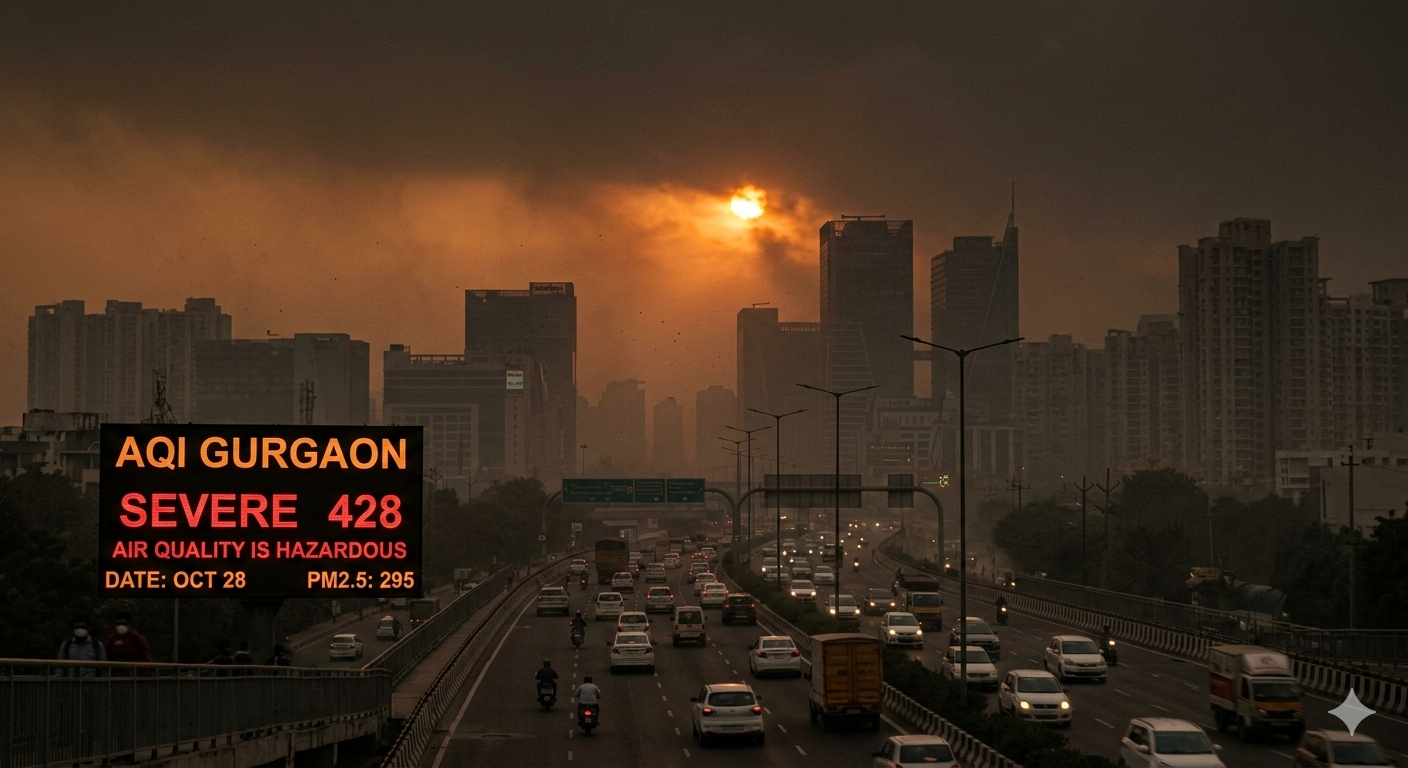
AQI Gurgaon – Breathing and Haze: A Snapshot of AQI Gurgaon, Once known as a hub of IT and commercial growth, Gurgaon, popularly referred to as Cyber City, is also infamously crowned with another title: the air pollution capital of India. Gurgaon air quality index most of the times comes into limelight, especially in winters when a thick blanket of smog covers the city. This article will outline the situation, explain why it’s happening and suggest some simple things you can do to keep yourself safe.
What Does Gurgaon’s Air Quality Look Like Right Now?
Currently as I write, Gurgaon’s AQI is predominantly Very Poor and Severe. That means a mixture of pollutants, including PM2. PM2.5 and PM10 particles being the most wittering, chokes up our atmosphere. This haze is more than an issue of visibility; it’s a major health risk. Although some days are better than others, the trend has been recurring for years and points to a persistent problem that cannot be ignored.
Why is Gurgaon’s AQI so high?
Gurgaon’s abhorrently high pollution levels are the result of a patchwork phenomenon. Here are some of the major contributors:
Construction Dust: The construction that is going on rampantly throughout the city ends in a continuous supply of dust particles are accumulating and thus PM10 levels increase drastically. This is a constant contributor to pollution in a rapidly urbanized landscape.
Vehicular Emissions: The phenomenal proliferation of vehicles plying on the roads is a major contributor to air pollution. Automobiles, motorcycles, and commercial vehicles generate vast quantities of pollutants such as nitrogen dioxide, carbon monoxide, and particulate matter (PM).
Industrial Emissions: Gurgaon is home to various industries that release harmful pollutants into the air. The combustion of fossil fuels for industry and electricity generation drives the high levels of air pollution.
Crop Burning (Seasonal): During post-harvest season, generally from mid-October to start of November, burning of crop all over neighboring Punjab and Haryana agricultural states adds up to regional air pollution creating a thick layer of haze around the city.
Weather: Weather doesn’t create pollution, but it can affect its buildup. Lack of wind, temperature inversions (regular during winter) and low humidity may hold pollutants closer to the earth surface, worsening the grim air quality.
Health Care Facets of High AQI Gurgaon
Living in a city with chronically bad air takes a health toll. The short- and long-term ramifications are a serious concern:
Short- Term Effects: High levels of pollution can irritate the eyes, nose and throat. It causes shortness of breath, coughing, wheezing and chest tightness. It frequently induces headaches, fatigue and even causes temporary alterations in heart function. Individuals with pre-existing respiratory conditions such as asthma or chronic obstructive pulmonary disease (COPD) are especially sensitive to these acute effects.
Ongoing Effects: Sustained long-term exposure to high levels of air pollution have been associated with serious health problems. These include chronic respiratory diseases, cardiovascular conditions like heart attack and stroke, and even lung cancer. Children are particularly at risk; that’s because pollution can harm the development of their lungs.
Create a storm shelter at home and store supplies.
With air quality remaining negative, it’s critical to take proactive measures to protect your health. Here are a few simple but meaningful steps:
Know Your AQI: Visit sites or download apps that help you track the Air Quality Index (AQI) in your area to plan outdoor activities accordingly. If air quality is poor, plan around days when the AQI is high so you can spend less time outdoors.
Avoid Going Out When The Pollution Is At Its Peak: According to the study, PM 2.5 levels are generally at their highest early in the morning and later in the evening. “So try to remain inside during these periods. Shut all doors and windows to keep outside air from leaking in.
Inflate or deflate the pillow to achieve your desired loft. It can effectively remove PM2. 5 particles, allergens, and other contaminants from your home.
N95/N99 Masks Outdoors: When forced to go outside, especially on days when you know that air pollution levels are particularly bad, wearing a high-quality N95 or N99 mask can filter a majority of the harmful particulate matter. Surgical or cloth masks provide little protection against fine particles.
Grow Air-Purifying Plants: Although it will not remove all the pollutants, certain houseplants like Snake Plant, Areca Palm, and Spider Plant can slightly improve air quality indoors.
And if outdoor exercising is unavoidable on high AQI days, then exercise outdoors only when the AQI is low in your specific area. On relatively better days, opt for parks and places with more greenery to workout.
Conclusion
Gurgaon deals with air quality in layers and requires an individual response from all of us along with systematic changes in policy. As the government takes measures — including bans on construction, odd-even and better waste management — we must also do our bit. Related: By keeping ourselves updated, taking precautions and fighting, we together can make a cleaner Gurgaon for breathing. The choices we make now will determine the health of our families and generations to come. The city that sparkles in terms of progress should also be the one to sparkle in terms of the air quality it provides for its people.
Understanding Gurgaon’s Air Quality
The “Cyber City” is regularly enveloped in a haze of grey. Below are the answers to the most frequent questions that residents and visitors have about the air they’re inhaling in Gurgaon.
Why is Gurgaon so polluted?
Gurgaon suffers not from a single source, like some cities, but poses a “triple threat”:
Hyper-local Construction: An endless construction site. The PM10 levels are seriously affected by dust from huge residential and commercial constructions.
Bycar on Indian Roads: Gurgaon boasts India’s highest ownership of cars. There is continuously flowing local pollutants due to massive traffic congestion on the road and thousands of diesel generator (DG) sets for power backup in high-rises.
External Factors: In October and November, winter winds trap thick smoke that streams in from seasonal stubble burning across the borderlands of Punjab and Haryana.
What is the reason behind this discrepancy between Gurgaon’s AQI and Delhi’s?
You may find Gurgaon having “Moderate” AQI and Delhi having “Severe.” This can be due to:
Open Spaces: There is superior natural ventilation in the areas around the Aravallis, rather than in “urban canyons” dense clusters like Old Delhi.
Station Location: Some experts say that Gurgaon’s monitoring devices have been stationed in greener, less congested areas (such as Gwal pahari), while the data reflects lower readings than what a human being breathes standing on Sohna Road or at IFFCO Chowk.
What are the best months for air quality?
The “pollution season” extends mainly from late October to early February.
Winter Inversion: When temperatures drop, colder air becomes denser and moves slower in pockets, allowing it to trap pollutants closer to the ground.
Post-Monsoon: When the rains cease, this natural “wash” of the atmosphere ceases as well and dust and smoke accumulate again.
Can you exercise outside in Gurgaon?
It varies with the daily index:
AQI 0-100 (Good/Moderate): Stick to indoors.
AQI 101-200 (Poor): Sensitive groups, including asthmatics, children and the elderly should limit outdoor exertion.
AQI 201+ (Very Poor/Severe): No outdoor exercise is advisable for all. The deep breathing during a run actually draws in more toxic PM2. 5 particles into your bloodstream.
Do indoor plants really help?
Although plants such as the Snake Plant, Areca Palm and Aloe Vera can take in minimal amounts of toxins (formalised, for one), these are not capable of filtering out heavy particulate matter (PM2. 5) at the scale required when a smog spike hits. Consider them a kind of “nice to have” as opposed to sort of the major piece. And a HEPA-filter air purifier is needed for real protection.
Which mask should I use?
Regular cloth/surgical masks are useless against the fine dust of finally gurugram. Look for:
N95 and N99 Masks: These types of masks are meant to reduce at least 95% to 99% of airborne particles.
Fit Matters: It is only effective if there’s a tight seal around your nose and chin.
Pro Tip: Download a real-time tracking app like AQI India or Sameer (CPCB) and see the specific station closest to your sector, not the city average.
What is the “Cigarette Equivalence” of Gurgaon’s air?
When the air quality index ranges from “Poor” to “Unhealthy” (AQI 150–200) or worse, breathing air in Gurgaon for 24 hours can be compared to smoking approximately 3 to 4 cigarettes. During “Severe” spikes (AQI 400+), that can spike over 15–20 cigarettes in a single day, for both smokers and non-smokers alike.
What is GRAP and how will it impact my day-to-day life?
The Graded Response Action Plan (GRAP) is a set of emergency steps that are triggered depending on the severity of pollution:
Stage I (Poor): Dust control at construction sites and an open trash burning ban.
Stage II (Very Poor): Restrictions on diesel generator (DG sets) use — a biggie for high-rise residents of the city — and higher parking charges to dissuade people from using private cars.
Stage III (Severe): Closure of non-essential construction activities and potential restrictions on older BS-III petrol and BS-IV diesel vehicles.
Stage IV (Severe+): Truck entry into city may be banned, offices placed under “Work From Home” advisories.
Do Aravalli Hills contribute to the air quality in Gurgaon?
The Aravallis are the “green lungs” of Gurgaon, and a natural barricade.
The Barrier: They serve as a physical barrier that shields the regions from sand and dust storms blowing in from the Thar desert in Rajasthan.
The Warning: Environmentalists say the degradation of these hills by mining and construction is weakening this shield, giving more leeway to desert dust to settle into Gurgaon’s atmosphere in future years.
Is air indoors really safer than outside?
Not necessarily. Polluting agents such as PM2. In contrast, 2 and 3 are small enough to leak through gaps around windows and doors. These particles are trapped indoors without a breeze to diffuse them — unless you have a HEPA air purifier.
Is the monsoon good for Gurgaon’s AQI?
Yes, significantly. When it rains, a process known as “washout” occurs in which water droplets combine with particulate matter and carry them back down to Earth. July and August for most months the only periods of “Good” or “Satisfactory” air quality in Gurgaon.
What’s the best time to ventilate my home?
Do not open windows during the early morning (8:00 AM – 11:00 AM) when traffic and “temperature inversion” make pollution worst at ground level. The ideal times for a quick, 15-minute ventilation is usually in the middle of the afternoon (14:00h – 16:00h), when the sunlight reaches its maximum intensity and air can most likely move upward.
Summary Table: Air Quality Action Plan
| AQI Range | Category | Immediate Action |
| 0–100 | Good/Satisfactory | Enjoy the outdoors; ventilate your home. |
| 101–200 | Moderate/Poor | Limit outdoor playtime for children; use masks if sensitive. |
| 201–300 | Very Poor | Switch on air purifiers; avoid outdoor morning walks. |
| 301–400+ | Severe/Hazardous | Keep windows sealed; avoid all outdoor physical exertion. |
Recent: Gurgaon AQI (February 27, 2026)
Air quality has eased somewhat when compared to the “Severe” spikes earlier this year in January.
AQI Forecast Today: Moderate to Unhealthy for Sensitive Groups (64 – 165) depending on location.
The Trend: Coffice spiffs and peppy heels make for clean afternoons, whilst mornings still creep into “Unhealthy” spikes (221 on average at 8am).
Current Scenario of GRAP: Stage-II (Very Poor) measures have been withdrawn by the government on February 18, 2026. The city is at present under Stage-I (Poor) restrictions aimed at dust control and road sweeping.
Advanced FAQ: The 2026 Edition
What is ‘Gurugram Clean Air Plan 2026’?
It’s a HUGE new initiative that kicked off in early February of 2026. The government has sought ₹ 291 crore for:
Aim to decrease PM2 by 10% Levels for PM2.5 and PM10 by the end of year 5
Electrify Transport: 200 more electric buses by Sept. 2026 and add 20 new public EV chargers.
Dust Suppression on Roads: Pave or rehabilitate more than 600 km of uncontrolled dusty road shoulders, a significant local source of PM10.
I live in a high-rise; what changed about my power backup recently?
CAQM, (Commission for Air Quality Management) made its rules regarding Diesel Generator (DG) sets stricter in 2025–26. These have now been allowed to operate only during Stage-II of GRAP or higher: non-essential uses such as elevators and medical equipment are similarly banned from operation, unless they are fitted with RECDs (Retrofit Emission Control Devices), or your society has converted its generators to work on a dual-fuel mode (70% Natural Gas + 30% Diesel).
What is the role of RWAs regarding “Hyperlocal AQI”?
Some societies (in sectors 48, 50 & 52) have already taken matters into their own hands by working on their own “Micro-Climate” projects. They have:
The members installed their own digital AQI displays at the main gates of the societies.
Automated sprinkler systems (artificial rain) can drop the AQI level inside complex up to 100 points compared to main road outside.
What is “Temperature Inversion”-is it worse in Gurgaon than Delhi?
It can be. Since Gurgaon falls adjacent to the Aravalli range, cold air tends to “pool” in its low-lying areas between buildings and the hills. This forms a “lid” of warm air that stops smog from rising, often making Gurgaon’s 7:00 AM air a lot more poisonous than Delhi’s on windless winter mornings.
Does “Air Recirculation” mode in my car actually do anything?
Yes, but only if your cabin filter is HEPA-grade. Standard car filters often filter out only dust and pollen. For Gurgaon’s PM2. A carbon-HEPA cabin filter is highly recommended after the 5th. On that note, keep the “recirculate” button ON when you drive through congestion like IFFCO Chowk or Cyber City to mitigate sucking exhaust fumes straight into the cabin.
November 1, 2023 are there ” Safe Zones” in Gurgaon?
Though there is no completely clean area, data indicates that areas such as Gwal Pahari and sectors near the Leisure Valley Park witness 15-20% less pollution on an average than industrial hubs such as Udyog Vihar or heavy-traffic corridors like Sohna Road.
Real Time Current Air Quality in Gurgaon
The city is inhaling a toxic cocktail of “Moderate” and “Poor air”); today, February 27, 2026.
The Good News: Afternoon readings (around 4:00 PM) have been dropping down to an unexpectedly good 94–105 AQI.
The Reality Check: The morning “peak” still peaks at 180–220 AQI between 7:00 AM and 9:00 AM.
World ranking: Today, Gurgaon is the 164th most polluted city in the world, a decent improvement over frequent spots in top-10 during winter months.
Where are the new monitoring stations being constructed?
The government is widening the grid to end the “guessing game” on pollution by sector. Again the Existing CAAQMS at Vikas Sadan, Sector 51 and TERI Gram will be supplemented with four new stations.
The New Targets — Spot Locations are being finalized to cover a traffic-centric area (most likely close to the Delhi-Gurgaon border), two high-density private sectors and one development road (Udyog Vihar/Manesar).
How do we handle ₹291 Crore “Air Pollution Scheme”?
This is the colossal budget that Municipal Corporation (MCG) has just proposed to overcome two main foes: Dust and Waste in 2026.
Anti-Smog Fleet: ₹6 crore has been allocated for a fleet of truck-mounted anti-smog guns, which will patrol hotspots such as Sohna Road and Golf Course Extension.
Mechanical Sweeping: The city is increasing its mechanical sweeping machines from 18 to 42 so that road dust won’t be sucked up into the air by cars, buses and trucks.
The Task: PM2 — a reduction of 10% 5 and particulate matter PM10 by the end of 2026.
Is the “AQI Average” applicable to my sector?
Be careful with city averages! Recent data reveal a stark diversity within the city:
Gwal Pahari (Greenery/Hills): Often between 208 (Poor).
Sector 51 (University Area): Can climb to 329 (Very Poor).
Vikas Sadan (Central/Traffic): On the same day, it has reached as high as 361 (Very Poor).
Always monitor the specific sensor nearest you to your office or home, not the general “Gurgaon” reading.
Does the “Cigarette Equivalence” vary by sector?
Yes. Based on today’s levels:
If you live in DLF Phase 2, simply by inhaling the air you are “smoking” 3.6 cigarettes per day.
If its in a high-volumne area like Sector 51, that number can soar to 5–6 cigarettes on an ugly day.
Gurgaon User Tip (2026)
[ ] The “4 PM Rule”: 4:00 PM is the currently “cleanest” window of the day if you must ventilate your house or exercise.
[ ] The so-called “N95 Seal”: Most pollution is fine dust (PM2. 5) and cloth masks are only 10-20% effective.
[ ] Filter Your Air (Again): After the heavy January smog, your air purifier filters are probably clogged. Inspect and clean your pre-filters now so they do their job in the dusty spring season ahead.
So the air is cleaner this week?
Yes, though with a “morning penalty.” As of February 27, 2026:
The Afternoon Window: Between 3:00 PM and 5:00 PM, AQI’s have been lowering closer to the range of (Satisfactory/Moderate) 90–110.
The Morning Spike: It might be tempting to think the sun in the afternoon puts a dent into pollution, not so much; 6:00 AM — 9:00AM are still regularly causing spikes of 250–300 (Very Poor) as “morning inversion” keeps cold air trapped near ground level allowing traffic exhaust to wallow there.
How is the “Dust-Free Roads” initiative of 2026?
The MCG (Municipal Corporation of Gurugram) has recently initiated a back-breaking project for the redevelopment of 611 km long roads (~30% share in total road inventory) as broken road shoulders are now accepted to be basic generators of PM10.
The Aim: Schmidt wants every unpaved “kutcha” shoulder paved to prevent traffic uprighting dust.
Target Areas: Approximately 500 km of narrow residential roads (less than 10m wide).
And why have so many new cameras popped up?
Phase 2 of the CCTV project includes 2,722 smart cameras in March 2026. Although they’re aiding traffic, they are also being deployed to:
Environmental Enforcement: Identifying illegal garbage burning or C&D (Construction & Demolition) waste dumping in real-time using AI.
Automated Challans: Catching “visibly polluting” vehicles and old-age diesel cars that are prohibited under GRAP Stage-I.
So are they now monitoring construction sites?
All sites over 500 sq are now required to use a new web portal for dust control. meters.
The Tech: PM2 must be located on sites PM10 sensors and “video fencing” mechanisms with remote connectivity to the HSPCB (Haryana State Pollution Control Board) dashboard.
Still In Progress: Compliance remains challenging — less than 15% of large sites are fully registered and connected to the live dashboard at this time.
What became of the “City Cooling Action Plan”?
The 2025-26 Cooling Action Plan, which was launched late last year, seeks to combat the “Urban Heat Island” effect that worsens pollution.
DELIBERATIONS Strategy: 37 km of central verges and pathways to plant green cover
Native Planting: Replacing ornamental plants for “native Indian shrubs,” which trap dust more easily and require less water.
Is the “GRAP” continuing in place?
The CAQM has officially revoked Stage-II on 18th February, 2026.
What’s Permitted: Diesel generators are once again allowed to operate for non-essential backup.
What’s Prohibited: We are still in Stage-I, which means dust-control at construction sites is compulsory and open burning is prohibited.
Actionable Tip: The “Clean Air” Window
| Time of Day | AQI Status (Typical Feb 2026) | Recommendation |
| 6 AM – 10 AM | 220 – 310 (Very Poor) | Keep windows closed; use air purifiers; avoid outdoor runs. |
| 11 AM – 2 PM | 140 – 180 (Poor) | Moderate activity; okay for short commutes. |
| 3 PM – 5 PM | 95 – 120 (Satisfactory) | Best time for ventilation and outdoor exercise. |
| 8 PM – 12 AM | 160 – 210 (Poor) | AQI begins rising as the ground cools; seal windows. |