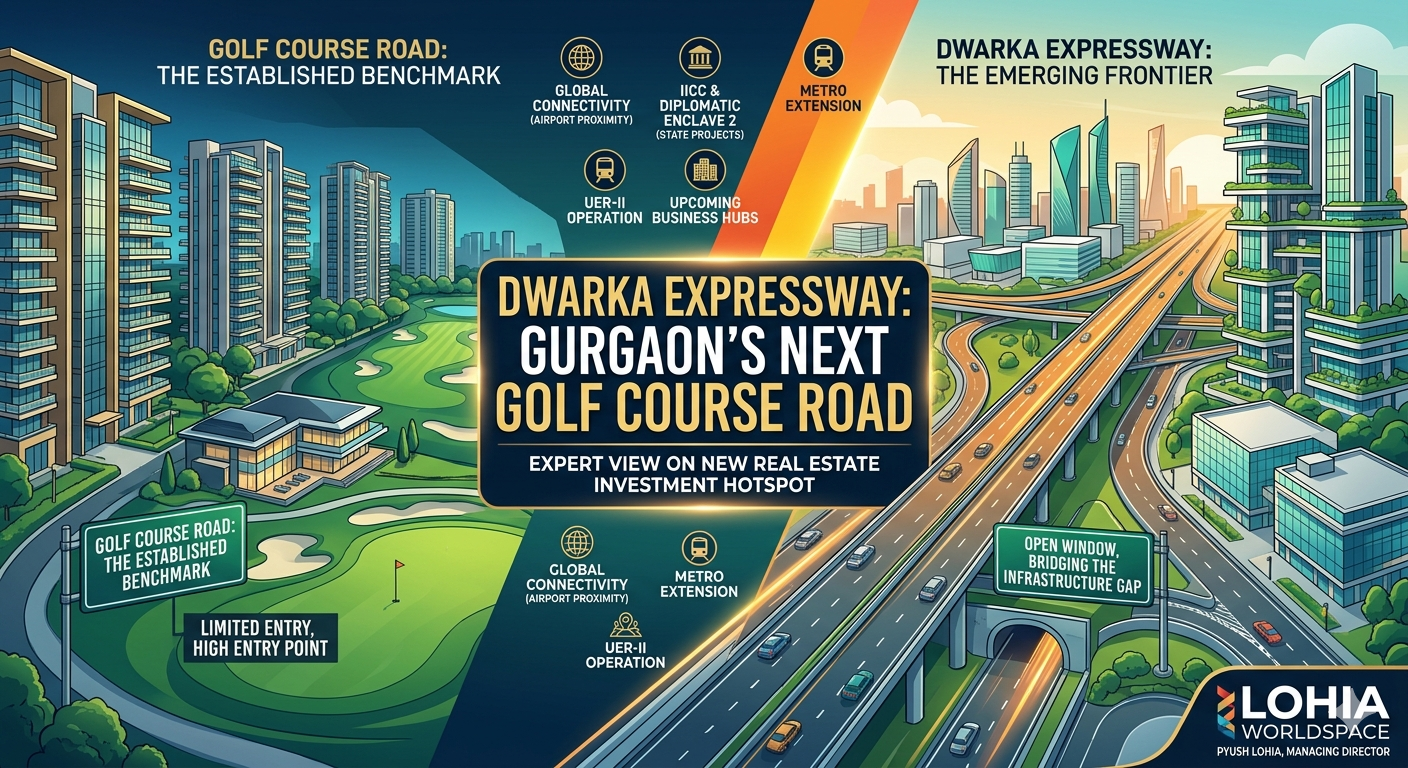
Dwarka Expressway Gurgaon’s next Golf Course Road: Expert on why it is the new real estate investment hotspot : During the last 20 years, Golf Course Road was the picture of what the high-end real estate in Gurgaon looked like. It established the standard of luxury housing, fetched the highest per square foot rates in the NCR and drew global capital and corporate leadership. That period is clinging to its own, yet an emerging one is very evident. The new value anchor of the area comes in the form of Dwarka Expressway, the 29km Northern Peripheral Road that lies between Gurgaon and Dwarka in Delhi.
The Golf Course Road was costly since individuals waited to be convinced before purchasing. The entry point had been closed before the evidence was received. That is exactly where Dwarka Expressway is today. It is a finished expressway. The UER-II is in operation. The extension of the metro is being promoted. The Diplomatic Enclave and IICC are changing their plans into groundwork. All the similar corridors in Gurgaon, Golf Course Extension Road, Southern Peripheral Road, Sohna Road experienced the most steep price increase within two to three years after the infrastructure of these areas came together. There is an open window on Dwarka Expressway at the moment. It is not going to remain open forever.
Gurgaon has been the kind of place that has rewarded an individual who read the infrastructure map correctly and arrived ahead of time before the crowd came. The map now indicates beyond doubt the Northern Peripheral Road. Pyush Lohia Managing Director, Lohia worldspace expounds Dwarka Expressway has become the center of real estate investment and how it is competing with the legendary Golf Course Road Gurgaon.
The infrastructure gap has been bridged.
Golf Course Road established its reputation on the good infrastructure and accessibility to business districts. Dwarka Expressway is no exception and in many aspects it is even better. It is the first 16 lane expressway in India, which has eight elevated lanes with eight parallel service roads. It originates at Shiv Murti on NH48 and crosses 18.9 kilometres in Gurgaon and 10.1 kilometres in Delhi. The corridor incorporates multi-level interchanges, tunnels, flyovers and grade separators that ensure traffic flows at a magnitude that the older Gurgaon roads were never intended to support. This stretch has received serious planning and capital investment by NHAI and HUDA that has ensured that implementation is geared towards long term urban expansion as opposed to patching reactively. The difference between the planning and all similar corridors is that, planning has been truly progressive. The design has included underground cabling, water management systems, green buffers and sewage treatment. It has been constructed on the ground level and it reflects in the quality of day to day movement on the expressway.
Location stands out
There are not many corridors in the NCR that would be as effective in terms of the proximity to the city of Delhi, the access to the airport, and the direct connections to the working centers. Dwarka Expressway is close to the Indira Gandhi International Airport in a few minutes and provides clean routes to Cyber City and Udyog Vihar, which are two of the most populated commercial areas in Gurgaon. Diplomatic Enclave 2 and the India International Convention Centre coming up give residential corridors something they can hardly have. These are long term, state sponsored projects that will attract foreign activity, diplomacy and massive institutional functions. The effects that they have on the surrounding real estate are irreversible and compound over time. This is reinforced by Urban Extension Road II that offers an alternative high speed connection between Delhi and Gurgaon which would reduce the travel time by a great deal. These networks combined can provide residents and businesses with dual connectivity which minimizes reliance on older routes which are congested. Such redundancy on access is not common in the NCR and it is the exact thing that long term investors seek before they invest the capital.
Now a core market
Several years ago, this corridor was regarded as a latent bet. At this point, the construction is mostly done, the connectivity is getting better, and the demand is following suit. Residential activity across Sectors 102, 103, 104, 106, 108 to 110, and 112 to 113 is picking up. These are becoming a unified city strip, with schools, medical, shops, and everyday comforts developing with housing. Sector 106 is becoming one of the major urban nexuses. Industries that are more proximate to Delhi are much easier to access particularly when people consider airport accessibility. The green environment of Sector 80 is a bonus, where there is more openness but at the same time it is well connected.
Premium living takes off.
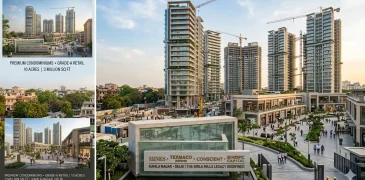
The supply along the Dwarka Expressway is indicative of the trust of the developers who are good readers of markets. The new supply here is mostly made up of high rise residences, integrated townships and gated communities in which space, design and lifestyle are given much attention. It is a high-quality play. The corridor is attracting buyers who seek huge houses, superior facilities and planned living where day to day activities are run without a hitch. The focus on sustainability and contemporary utilities indicate the change in the desires of the buyers and what developers can provide to compete and win that buyer. The projects in this area are well connected, with planned facilities, and are also compliant with RERA. They show the way the corridor is developing within ten years.
Business pressure is gaining momentum.
When jobs come in, a residential corridor becomes mature. That change has started in this place. Office areas, business communities and shopping malls are emerging around the Dwarka Expressway. It is close to the airport and the city of Delhi and thus can be considered by companies as an option that can be used to grow without the expense that comes with Cyber City. With the increasing number of workplaces, rents become more demanded and houses are absorbed more quickly. This is the same path that had transformed Golf Course Road into a business district.
The outlook of investment is bright.
The strongest argument that can be made in favor of Dwarka Expressway is price. Although Golf Course Road has been priced high enough to discourage new buyers in the market today, the area remains at its initial pricing phase when compared to the value that the infrastructure deserves. The average prices in major industries are between 7,000 and 9,500 per square foot. The prices will increase by 15-25 percent in 2025-2027 once the infrastructure is fully utilized and the office activity gains momentum.
The proximity to the airport and close work hubs will also contribute to growth and stable returns as there will also be an increase in the rental demand. This renders the corridor attractive to a large group of purchasers, NRIs and local investors seeking a house and long-term worth.
Source : https://timesofindia.indiatimes.com/