
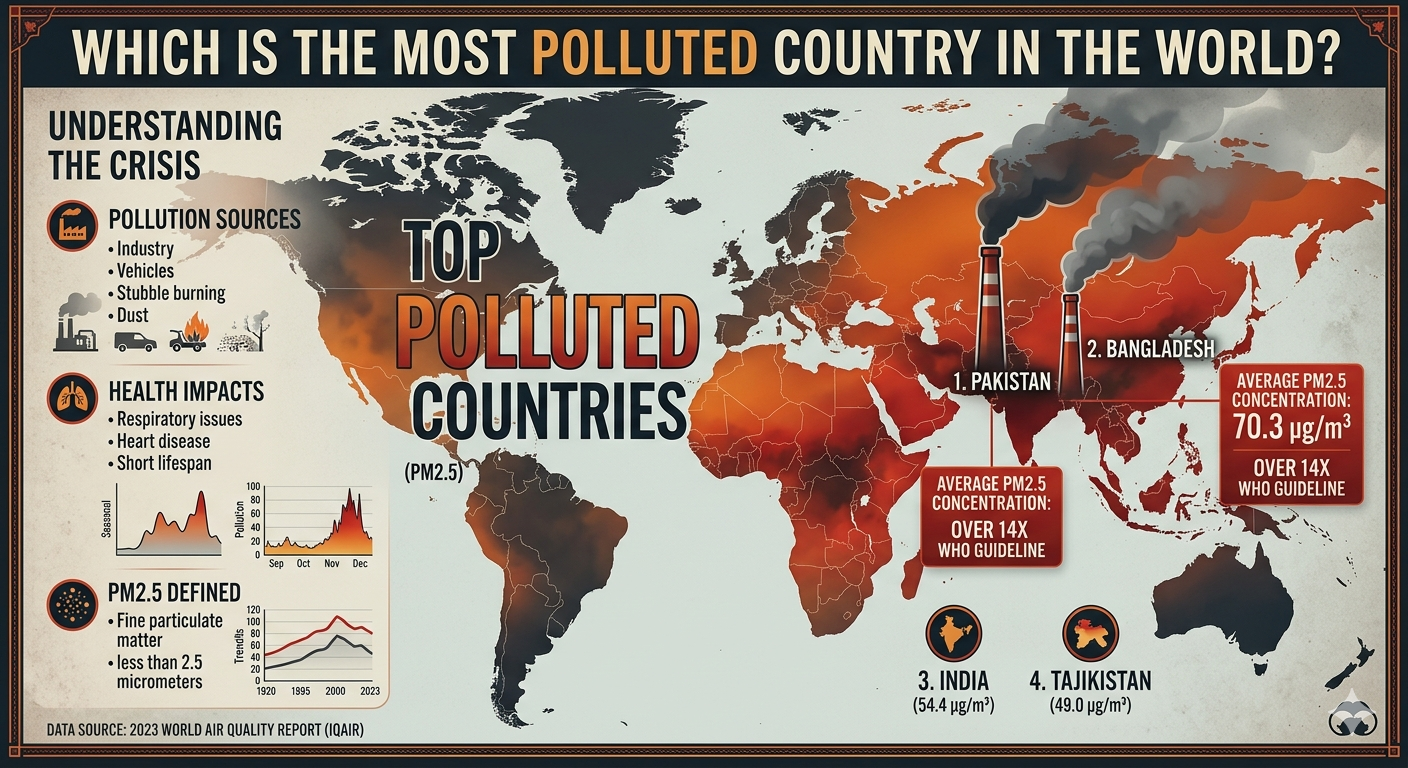
Which is the most polluted country in the world : A Pakistan is the world’s most polluted country according to the IQAir World Air Quality Report 2025 (published in March 2026). Pakistan’s average PM2. Was 13 times above World Health Organization (WHO) recommended levels, sources of pollution included burning agricultural waste, industrial emissions and vehicle pollution.
10 Most Polluted Nations in the World (2025):
- 🇵🇰 Pakistan
- 🇧🇩 Bangladesh
- 🇹🇯 Tajikistan
- 🇹🇩 Chad
- 🇨🇩 Dem. Rep. of the Congo
- 🇮🇳 India
- 🇰🇼 Kuwait
- 🇺🇬 Uganda
- 🇪🇬 Egypt
- 🇺🇿 Uzbekistan
Highlights from the 2025 Report:
Most Polluted City: Loni, Uttar Pradesh, India
Most Polluted Capital: New Delhi, India, was named the most polluted capital city in the world for a record eighth year.
Regional Focus: Central and South Asia are the hardest-hit regions, with all of the 25 most polluted cities from India, Pakistan or China.
World Status: 130 (approx. 91%) out of the estimated yearly average of 143 countries monitored did not meet WHO outdoor air quality guidelines in 2025.
Although Chad remained ranked as the most polluted country in the 2024 report, their rankings flipped in 2025 due to worsening conditions across south Asia and gaps in data collected elsewhere.
As per the World Air Quality Report 2025 by IQAir (published in March 2026), Pakistan is the dirtiest country on Earth.
The report tracks PM2. 5 (fine particulate matter), which is the tiny harmful stuff that can make its way into the lungs and blood. Pakistan’s average concentration was reported as 67.3 µg/m³, over 13 times greater than the WHO recommended annual limit of 5 µg/m³.
Most Polluted Countries in 2025 (Top 5)
The rankings within it do jitter somewhat each year depending on weather patterns (La Niña, for example) and monitoring capacities, but South Asia consistently comes up as the most affected region.
| Rank | Country | Avg. PM2.5 (µg/m³) |
| 1 | Pakistan | 67.3 |
| 2 | Bangladesh | 66.1 |
| 3 | Tajikistan | 57.3 |
| 4 | Chad | 53.6 |
| 5 | DR Congo | 50.2 |
India ranked 6th in this latest report, though it is home to 66 of the world’s 100 most polluted citiesNote:
Key Pollution Hotspots
Most Polluted City: Loni, an industrial town in Uttar Pradesh, India that was declared the world’s most polluted city in 2025.
World’s Most Polluted Capital: Out of the world’s 30 most polluted capital cities, New Delhi in India came out on top for the seventh time in eight years.
Cleanest Areas: Territories such as French Polynesia, Iceland and Australia were some of the few thatpassed the stringentWHO air quality guidelines.
Why Are Pollution Levels in These Ranking Regions So High?
There are some common factors contribute to the hazardous air quality in these countries which ranked on top:
Rapid urbanisation and poor emission regulations for old vehicles & factories.
Agricultural burning: Every winter, millions of tons of plant residue are burnt by farmers (especially in India and Pakistan), creating gigantic clouds of smog.
Dust & Construction: Heavy infrastructure projects and natural absolute desert dust are significant sources of particulate matter.
Weather Inversion: In winter months, when a mass of cold stagnant air settles at ground level, pollutants are trapped in this layer and cannot be dispersed.
According to the 2025 World Air Quality Report, South Asia — and especially the bordering regions of Pakistan and India — continue to be a matter of great international concern. Below are further breakdowns of the data, pollutants involved and regional factors that are pushing these numbers.
The PM2. 5 Crisis in South Asia
PM2 is the main metric for these rankings. 5, fine particulates that are less than 2.5 micrometers in diameter. These particles pose particular danger because they are small enough to get into the bloodstream and affect every organ in the body.
Pakistan (Rank 1): Cities like Lahore and Faisalabad saw “hazardous” levels for weeks at a time during the winter “smog season.” Average concentrations of 67.3 µg/m³ were measured, clearly above the previous year
Bangladesh (rank:2): High levels due to emissions from brick kilns, vehicles and prescribed trans-boundary pollution. Its capital, Dhaka, is one of the five most polluted cities year after year.
India (Rank 6): The national average is slightly lower than its neighbors, but northern India (the Indo-Gangetic Plain) has the world’s highest density of high-pollution cities.
Regional Hotspots: Gurgaon and NCR
Because of geography and density of industry, the National Capital Region (NCR) is usually the worst-affected region in India.
The Winter Inversion: The period between October and January sees a meteorological effect called “temperature inversion”. Cold air is trapped beneath a layer of warmer air, like a lid on a pot that keeps dirt from escaping.
GRAP (Graded Response Action Plan): To address these spikes, stages of GRAP are implemented by local governments when the AQI crosses certain thresholds. Bans on construction work, use of diesel generators and moving schools to online classes may be some immediate measures taken under GRAP.
Sources of Pollution
Pollution in the countries most affected by it generally comes from four main sources:
Industrial Clusters: Airborne pollutants from power plants, textile mills and chemical manufacturing.
Stubble Burning: Crop residue burns in fields of Punjab and Haryana (India) and Punjab (Pakistan), where farmers have come to rely on burning as a way to clear farmland quickly. This burning releases huge plumes of smoke that blanket the region.
Burning of Solid Waste: In the absence of a proper waste management system in place, plastic and domestic waste are often set ablaze which releases toxic gases.
Transport: Older, heavy-duty vehicles are more plentiful and lack most new moderm catalytic converters.
Health and Economic Impact
Air pollution is costing the global economy trillions of dollars in lost labor productivity and health care expenses, according to World Bank estimates.
Health: Persistent exposure contributes to higher rates of asthma, heart disease and stroke, as well as reduced lung development in children.
The “Clean Air” Initiatives: According to the World Bank, better monitoring and stricter industrial regulations were included in countries like India, which has set a target of reducing particulate matter concentration by 20–30% between 2017 and 2026 under its National Clean Air Programme (NCAP).
Global Comparison: The Cleanest Air
Unlike the elevated levels in South Asia, several regions managed to achieve the WHO guideline of 5 µg/m³:
Iceland: Also the cleanest country in Europe, primarily powered by geothermal energy and relatively low-density population.
New Zealand & Australia: Jehova the gentry by strict environmental laws and geography that lets sea breezes clear the air.
urbanair qualidade ar urbanaEstonia & Finland: Best urban air in the world via green transit and forest conservation