
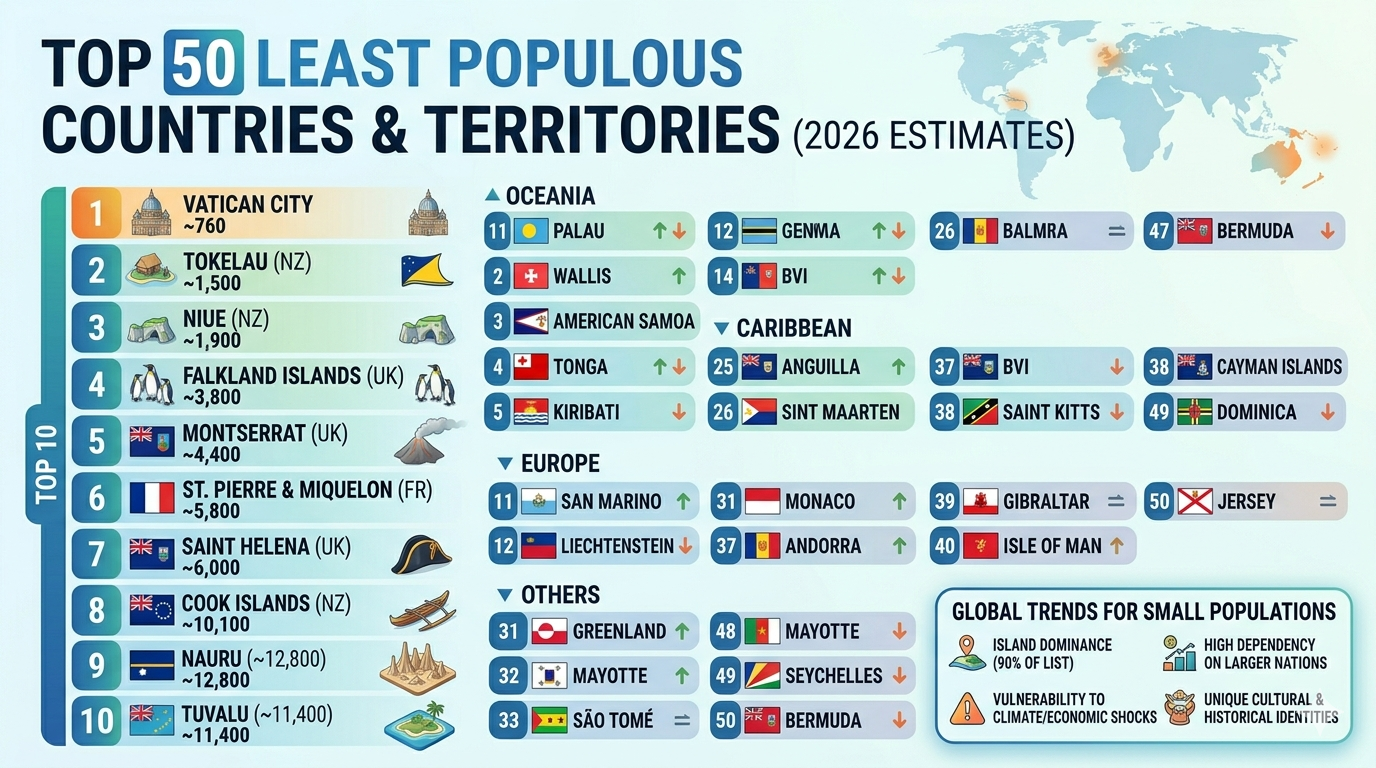
Top 50 lowest population country in the world : The list below includes the fifty most populous sovereign states and territories. This classification includes not only fully sovereign states but also different self-governing territories and dependencies.
The Fifty Least Populous Counties and Territories (2026 Estimates)
| Rank | Country / Territory | Estimated Population | Region |
| 1 | Vatican City | 500 | Europe |
| 2 | Tokelau (NZ) | 1,500 | Oceania |
| 3 | Niue (NZ) | 1,900 | Oceania |
| 4 | Falkland Islands (UK) | 3,800 | South Atlantic |
| 5 | Montserrat (UK) | 4,400 | Caribbean |
| 6 | Saint Pierre and Miquelon (FR) | 5,800 | North Atlantic |
| 7 | Saint Helena (UK) | 6,000 | South Atlantic |
| 8 | Cook Islands (NZ) | 10,100 | Oceania |
| 9 | Nauru | 12,800 | Oceania |
| 10 | Tuvalu | 11,400 | Oceania |
| 11 | Anguilla (UK) | 15,900 | Caribbean |
| 12 | Wallis and Futuna (FR) | 16,000 | Oceania |
| 13 | Palau | 18,100 | Oceania |
| 14 | British Virgin Islands (UK) | 31,500 | Caribbean |
| 15 | San Marino | 33,600 | Europe |
| 16 | Gibraltar (UK) | 34,000 | Europe |
| 17 | Monaco | 36,300 | Europe |
| 18 | Saint Martin (FR) | 36,500 | Caribbean |
| 19 | Liechtenstein | 39,800 | Europe |
| 20 | Turks and Caicos Islands (UK) | 40,000 | Caribbean |
| 21 | Marshall Islands | 42,100 | Oceania |
| 22 | Sint Maarten (NL) | 43,200 | Caribbean |
| 23 | Saint Kitts and Nevis | 47,800 | Caribbean |
| 24 | Faroe Islands (DK) | 54,000 | North Atlantic |
| 25 | American Samoa (US) | 55,000 | Oceania |
| 26 | Greenland (DK) | 56,800 | North Atlantic |
| 27 | Northern Mariana Islands (US) | 57,000 | Oceania |
| 28 | Cayman Islands (UK) | 69,500 | Caribbean |
| 29 | Bermuda (UK) | 64,000 | North Atlantic |
| 30 | Dominica | 73,100 | Caribbean |
| 31 | Andorra | 81,000 | Europe |
| 32 | Isle of Man (UK) | 84,500 | Europe |
| 33 | Antigua and Barbuda | 94,500 | Caribbean |
| 34 | Seychelles | 108,000 | Indian Ocean |
| 35 | Tonga | 109,000 | Oceania |
| 36 | U.S. Virgin Islands (US) | 110,000 | Caribbean |
| 37 | Grenada | 117,000 | Caribbean |
| 38 | Aruba (NL) | 118,000 | Caribbean |
| 39 | Kiribati | 120,000 | Oceania |
| 40 | Saint Vincent and the Grenadines | 111,000 | Caribbean |
| 41 | Micronesia | 114,000 | Oceania |
| 42 | Jersey (UK) | 116,000 | Europe |
| 43 | Guam (US) | 170,000 | Oceania |
| 44 | Saint Lucia | 181,000 | Caribbean |
| 45 | Samoa | 206,000 | Oceania |
| 46 | São Tomé and Príncipe | 232,000 | Africa |
| 47 | Mayotte (FR) | 260,000 | Indian Ocean |
| 48 | French Polynesia (FR) | 284,000 | Oceania |
| 49 | Vanuatu | 310,000 | Oceania |
| 50 | Barbados | 282,000 | Caribbean |
Key Takeaways from the Top 50
Island States: The whole list of countries mentioned here is almost entirely islands or archipelagos. The distinguishing features of these low-population hubs are geography and isolation, and these features combine to make up about ninety percent of the list.
The Localized Focus: The vast majority of such microstates are located in the Oceania and the Caribbean and, thus, demonstrate the unique demographic processes that dominate in distant oceanic lands.
Independent vs. Dependent: A significant number of the given entries (such as Tokelau, Niue, Montserrat) are not truly sovereign states but a collection of self-governing islands with their own unique populations and autonomous governments.
The European Exceptions: Microstates like Vatican City, Monaco and San Marino continue to be among the smallest, not simply because of their current geographic isolation, but because of historical borders and their location between borders.
The Economics of Small Scale: Special Problems of the fifty smallest populations on the planet.
Although the fifty most populous nations and territories in the list of the low-population are inhabited by less than 300,000 people each, they all face a common complex of economic issues that are related to their size and geographical location in a unique way. These economies are not just small, but in essence asymmetric.
1. Economies of Scale and High Cost of Living.
The least evident challenge is the lack of economies of scale. In a small population, the fixed expenses of the maintenance of a modern state, the building of a hospital, the airstrip, the government, or a power system, have to be paid by an extremely small number of taxpayers.
The Infrastructure Tax: It can take tens of millions of dollars to install a single fibre-optic cable that connects an island, but that only supports less than ten thousand people. Infrastructure is much costlier per capita than in larger countries.
High Import Dependence: Since these peoples are unable to produce most items or produce food sufficiently diverse to domestically, they are virtually totally dependent on imports. This, together with low volumes of shipment (another type of diseconomy of scale), leaves the cost of common goods and energy very high.
2. Ultra Economic Susceptibility and Shocks.
One event, a worldwide economic change, a natural catastrophe, or the collapse of one business, can completely disrupt the economy of a small number of people.
Insufficient Diversification: These economies rely on a single or two major sources of activity (tourism, as in the Maldives or the Caribbean islands) or on financial services (as in the Cayman Islands or Bermuda). In case these sectors are impacted (as was the case during the 2020 pandemic), the whole economy collapses.
Environmental Disasters: To low-lying island countries (such as Kiribati, Tuvalu) a single strong hurricane or sea-level rise can cause them severe losses that exceed annual GDP. Recovery may take decades.
3. Brain Drain and low Human Capital.
Having very small labour forces these populations have little internal depth in terms of specialised skills.
The Specialized Worker Dilemma: When a small country needs a talented surgeon, an engineer in a power-plant, or a specialised diplomat, it may have just one or two available. In the event of their departure or retirement, the whole industry becomes crisis-ridden.
Brain Drain: Educated and talented youth often drift out of these communities to more expansive nations that have better professional opportunities in terms of career and investment in the local knowledge base is hampered.
4. Geography as Destiny: Remoteness vs. Enclosure.
The economic enclosure between these two types is produced by geography of these small fifty:
The Uncontacted Island (such as St. Helena, Tokelau): The biggest challenge is the remoteness itself. The long supply chains have high shipping costs and a constant connectivity battle. Economic choices are characterized by strong constraints, usually on fishing and local sustainable production.
The Enclosed Microstate (ex, Vatican City, Monaco, San Marino): These are the states, which are enclosed in by other states (Italy, France etc). It is their survival which is based on unconditional geopolitical stability and the free borders, making them vulnerable to any shifts in their relations with the greater neighbour.
5. Niche Reliance and Aid Dependency.
A number of these small populations survive on the basis of having unique international niches or relationships due to the challenges they face.
Financial Haven and flags of convenience: A few have made themselves available as low-tax financial centres or international shipping registries, so collecting vast revenues but putting themselves under great regulatory risk and attention.
Compact/Treaty Reliance (such as Niue, Cook Islands, Tokelau): A significant number of these are Associated States or dependencies (such as that of New Zealand, the United Kingdom or France). This arrangement often entails assured economic assistance and defence aid, and free movement of individuals that serves as their economic cushion.
Summary: A Delicate Balance
In the case of the fifty smallest populations, economic success is a fragile balance in the continuous. They act as beacons of determination and tend to be extremely sustainable and heavily socially bound, whilst they are always faced with a series of vulnerabilities that bigger countries have seldom experienced. Their main approach is not the wide spread growth, but risk management and connectivity.
🏘️ India’s Population Growth Has One Clear Real Estate Beneficiary — Gurgaon
With India now the world’s most populated country, housing demand is not slowing down any time soon. Gurgaon absorbs thousands of families relocating from UP, Delhi and other states every year — which is exactly why property values here have stayed resilient even during market dips elsewhere.
Understanding global population trends can help Gurgaon real estate developers anticipate and cater to the housing needs of a growing population in the Delhi-NCR region.
See what fits your budget in Gurgaon right now:
Want honest advice on any of these? WhatsApp us: +91 88512 75418 — no sales pressure, just straight answers.