
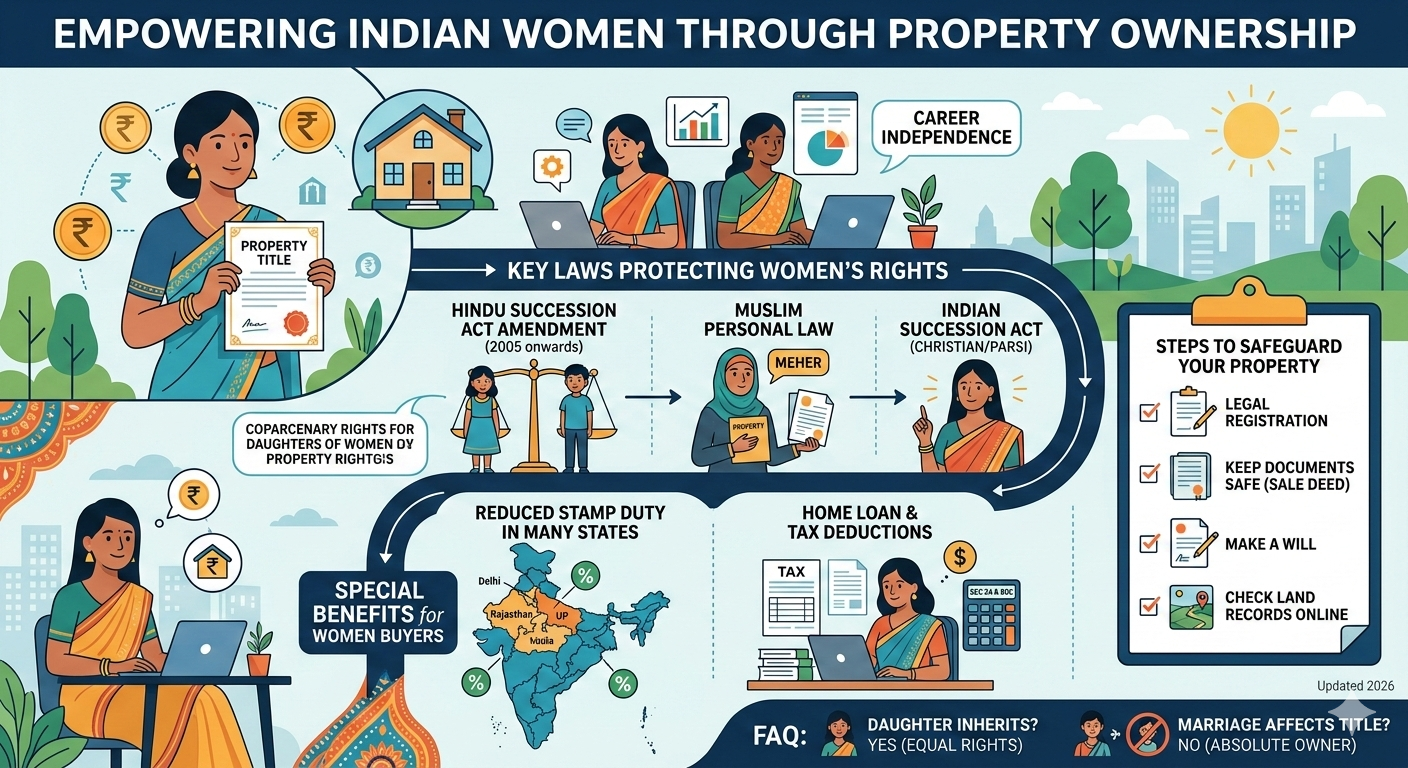
Women Property Ownership in India | Rights, Laws & Benefits
The role of women in property ownership in India has evolved significantly over time. Historically, women had very little rights in terms of owning land, houses or other assets. Most property remained registered in the names of fathers, husbands or sons. The situation is so much better today. Indian women have the same legal right to own, inherit and buy and sell property. Women’s property ownership across all religions is strongly protected by law. However, many women remain but vaguely aware of their property rights, inheritance laws and the related tax benefits and stamp duty advantages. This ignorance causes a lot of women to either lose out on their rightful property or getting into legal issues down the line.
This article makes understanding women property ownership in India simple. It covers:
Property laws for women
Rights under different religions
Latest updates for 2026
Tax and stamp duty benefits
Questions that Every Woman Should have Answers to
The goal is clear: to empower all women with knowledge of their rights and the confidence they need to protect their future.
The importance of Property Ownership Thing for Women in India
Property Ownership is more than a mere financial or architectural asset. For women, it stands meaning security, independence, respect and confidence.
Property Ownership: 5 Key Benefits for Women
Financial security : Property provides you with long term stability
Career: Women, can choose their own paths without being dependent on anyone.
Legal protection: Stronger stance in marriage disputes or separation
Improve social status: People respect those who owns property
Economic Reason: Property can be rented out, sold or placed as collateral
Home loan & tax deductions: Tax benefits
Savings on stamp duty: Several states have lower stamp duty for women
Stronger voice in family decisions
Due to these advantages, the Indian government promotes property registration in a woman’s name for gender equality and financial empowerment.
Women Property Rights in India & Laws Related to The Same
Property Rights Of Women In India Is Based On:
Religion based personal laws
General property laws
Major Laws that Protect the Property Rights of Women
Amendments to the Hindu Succession Act, 1956 (2005 เนื้อหาที่เกี่ยวข้อง)
Muslim Personal Law (Shariat)
Indian Succession Act, 1925
Transfer of Property Act, 1882
Registration Act, 1908
Each law guarantees women the right to own, inherit and transfer property.
HINDU WOMEN AND THEIR PROPERTY RIGHTS
Hindu Succession Act (2005 Amendment)
The amendment of 2005 was a landmark step for Hindu women.
However, earlier daughters had almost no rights in ancestral property. Daughters inherited equal property rights after the amendment, as sons did.
Rights of Hindu Women
Daughters have equal rights in birth property
Sons-in-law and married daughters have equal inheritance rights
Women can sell, gift or transfer property without restraint
Eigentum an erworbenen Dingen in vollem Umfang
Now, a daughter is also a coparcener at birth like a son. This means she would have a legal stake in family property starting at birth.
Ancestral Property Rights
Daughters can claim ancestral property
Rights extend to both married and unmarried daughters
Even if the father died before 2005, rights continue.
In India, Law of Property Rights of Married Women
Marriage does not diminish or transfer a woman’s property rights.
Important Points to Know
A wife is the absolute owner of her self acquired properties.
Corrects the date of property purchase in her name
If her husband dies intestate, she can inherit his property
She has a right to take legal action if her property is taken without legal grounds
The husband does not automatically have any rights to his wife’s property.
The Property Rights of Women Under Muslim Law
Muslim women have well-defined rights to property and inheritance.
Key Rights of Muslim Women
Absolute ownership of their property
Inheritance rights of parents, husband and relatives
Half Share, in general, is full for male heirs
May brok (more dower) is not just a legal right but rather has a personal perspective.
A Muslim woman retains complete ownership of her property even after marriage.
Christian & Parsi Women and Property Rights
The property rights of the Christian and Parsi women are governed by the Indian Succession Act,1925.
Rights Under This Law
Equal rights for sons and daughters to inherit
Strong legal protection for widows
Women can own, sell or transfer property without customary restrictions
Cannot discriminate against men or women in property rights
Updates to Women Property Ownership Rules (2026)
This policy is still in place as of 2026, where the Indian government grants aid to women property owners.
Key Updates
Some states have lower stamp duty rates for women property buyers.
Increased awareness on joint property registration
Digi tal land record to minimize disputes
More legal protection for co-owners who are women
These measures make women financially independent and legally recognized property holders.
Women Buyers Can Avail Reduced Stamp Duty in India
Many states in India offer stamp duty concessions if the property is registered in the name of a woman.
Examples of States Offering Benefits
Delhi– Waiver of stamp duty for women
Haryana – Concession in rates for women buyer
Rajasthan – Special rebates
Uttar Pradesh – Waivers in stamp duty
Punjab – Women are charged less
A woman’s name for property registration can save lakhs.
Tax Benefits for Female Homeowners
Women have equal income tax benefits as men, but ownership of property makes one financially independent.
Tax Benefits Include
Deduction for interest on home loans (section 24)
Principal repayment deduction (Section 80C)
Capital gains tax exemptions
Rental income subject to tax under the name of the owner
Also can help to do family tax planning best way with women joint ownership property.
How Women Can Safeguard Their Property Rights
Awareness is the strongest protection.
Practical Steps for Women
Always register property legally
All documents must be kept safe ( sale deed, registry, mutation)
Will Avoid Family Conflict Make a Will
Check land records online regularly
Take legal advice when required
Conclusion
Women owning property in India are no more restricted or vulnerable. Now, it is legally from the power and supported by law. With equal rights to inheritance, tax benefits, stamp duty savings and government support women are more ready than ever to own and manage property. This is the first step in financial independence and long term security by understanding property laws. Regardless of whether you are purchasing, inheriting or investing in property, being aware of your rights will guarantee a safe and secure future.
Frequently Asked Questions
Can a daughter be an heir to her father’s property?
Under Hindu law, daughters have equal rights as sons.
Does getting married affect a woman’s ownership of property?
No, marriage does not transfer title.
Is a woman entitled to ancestral property?
Daughters are coparceners by birth in the same manner as sons.
What about the stamp duty exemptions for women in India?
Yes, several states do offer lower stamp duty for women buyers.
Did you have a will to make for your property?
October 2023: Yes, she has the full legal right to write up a will.
The Importance of Property Ownership for Indian Women
Owning property is not simply about owning some brick-and-mortar asset or a piece of land; it is about empowerment and security.
Top 5 reasons women should consider buying property:
Financial Security: Real estate offers long-term financial security and solid assets that can support a woman during her lifetime.
Status and Respect: Property ownership usually means more status, prestige from family personally and from community.
Legal Assurance: When a woman owns property, she is generally in a stronger legal position and feels more secure in the event of marital disputes or separation.
Read: Economic Opportunities: Properties can be rented out for generating income, used as collateral for loans or even sold off in case of a financial crunch.
Tax Advantages and Lower Stamp Duty: Women are increasingly encouraged to register property, by both state and central governments, in order for them to be financially empowered.
Property Laws and Women in India: An Overview
In India, women’s entitlements on property are regulated by religion-based personal laws along with common property laws. Under the law, all women—Muslim or otherwise — have a right to acquire, inherit and own property. Here’s a detailed look:
Hindu Woman and Her Property Rights
The Hindu Succession Act (Amendment), 2005, is a historic and landmark step. Daughters had virtually no rights over ancestral assets in the past.
Current Position for Hindu Women:
Daughter had also equal right to both maternal and paternal property whether she is married or unmarried. A daughter is a coparcener by birth.
Inheritance: A wife has a right to inherit her husband under personal law, and his children (natural or legally adopted), if he dies intestate (without a will) but the property rights vary from state to state and would depend on whether he left behind a mother.
Right to Transfer property: Without any restraint, a woman can selling, gift or bequeath any self-acquired or inherited property to anyone.
Muslim Women and Property Rights
Article 25 of the Act repeals all laws in force prior to its application regarding personal property rights of Muslim women. A Muslim woman is a legal person and marriage does not integrate her entity with that of her husband.
Current Position for Muslim Women:
Complete Ownership: In life, all Muslim females have full ownership rights over their property.
Inheritance: Her share in the property owned by her parents and husband. While the portion of inheritance she receives is typically half that inherits by a male in Islam, this is largely due to the fact that a Muslim woman does not have family financial liabilities placed on her.
Meher: Meher is a significant sum of money that the husband pays to his wife at the time of marriage and it belongs to her alone।
Property Rights of Christian and Parsi Women
For Christians and Parsis, on the other hand, the Indian Succession Act, 1925 applies.
The Current Status of Christian and Parsi Women:
Inheritance rights for sons and daughters are equal.
Widows are legally entitled to inherit their husband’s property.
Christian women alone are free from all customary restrictions inisowning, managing and disposing ofproperty.
The Rights of Married Women Over Property in India
Marriage has no impact on a woman’s ownership of property that she owned before marriage. Also, the property she acquired on her own (even if purchased during marriage) belongs solely to her and is not automatically owned by her husband while she lives. In case of death, the husband has the right to inherit her property along with children.
All the latest Women Property Ownership updates (2026)
In 2026, government policies and legal practices still encourage women’s empowerment through property ownership. Here are several of the major updates:
Stamp Duty Concessions: Stamps duty concessions for women property buyers at 1% to 2% have remained unchanged in several state governments. This has caused a huge increase in the registration of properties in women’s names.
Land records made simplified: Digital land records across the country have made women easy to confirm property ownership and claim their inheritance with fewer disputes.
Greater Awareness: Legal aid schemes and government initiatives are helping educate women, enabling them to proactively access and guard their legal property rights.
Less Stamp Duty Advantages For Female Purchasers
Stamp duty is a state government tax paid when buying property, and the amount can add up. To incentivise homeownership among women and bring them into the real estate market, many states in India still provide lower stamp duty rates for female buyers. This not only makes property affordable for women but also establishes equality of ownership in a family.
Tax Benefits for Women Homeowners
There is no differentiation in the Income Tax Act, 1961 for male or female home owners but registering a property under woman’s name or joint owner ship can fetch you substantial tax benefits.
Deductions on Home Loans (Section 24): Owners of self-occupied properties can avail of deductions for payable interest on home loans up to ₹2 lahks in a financial year.
Tax Deduction on Principal Repayment (Section 80C): Taxpayers can avail of a deduction of up to ₹1.5 lahks annually on the principal repayment amount of their home loan under Section 80C.
Joint Ownership: If the property is owned jointly by a couple and both are co-borrowers, both are eligible to separately claim deductions upto ₹2 lakh on interest and ₹1.5lakh on principal repayment subject to certain provisions.
How to Protect Your Property Rights
Understand your rights, but also take steps to protect your property. Women may want to take a few practical steps:
Legalize the title: Do not forget to get every property you bought or inherited legalized in your name.
Keep Documents Secure: Maintain a separate file and keep all original property documents such as sale deed, title documents, mutation records and latest tax receipts in the same bag.
Monitor Land Records: Access land records available in the public domain online and ensure that particulars related to the property title remain in your name with no unauthorized claims or transactions.
Make a Will: A will should be made that clearly states how you self-acquired property is to be inherited by the beneficiaries of your choice so as to avoid family disputes later.
Conclusion
Women in India have come a long way with respect to property rights, from the disadvantaged position, towards one of strong legal protection and empowerment. Today, the state legally supports Indian women to be equal-owners of property by inheritance and new acquisitions. Affordable stamp duty, special tax concessions and progressive laws means there has never been a better time for women to get involved in the property market. Knowing these rights and benefits is one important step toward financial freedom or long-term security.
Frequently Asked Questions
When can married daughters inherit their fathers’ properties?
Yes, both married and unmarried daughters have equal rights to their father’s property as sons under the Hindu Succession Act.
What are the benefits of stamp duty for women?
A number of Indian states provide lower stamp duty rates for women property buyers. This reduction can be something in the region of 1-2%, which can save you a lot of money.
Is a husband entitled to claim his wife’s self earned property?
The husband has no automatic right to get his wife’s individual property during the latter’s life time. She is the sole owner of her property.
Islamic law recognizes differential property rights for women.
Muslim women have a right to inheritance, though it is usually half that of a male heir. They also do not lose ownership of their property.
Do I need to get a will for my property?
Yes, it is highly recommended to prepare a will that indicates who should inherit your property after your death, thus avoiding any family lawsuits.
Is a property will made by a woman in 2026 still considered valid?
Yes, a woman can make a valid will for her property and have full legal capacity to do so, which means that a correctly drafted and executed will in 2026 would be as legally binding as it would be at any other time.
This kind of understanding can lead women to feel safe, secured and self-sufficient.
Note: The details above are general educational material and not to be considered legal advice. Seek the advice of a legal professional applicable to your specific conditions