
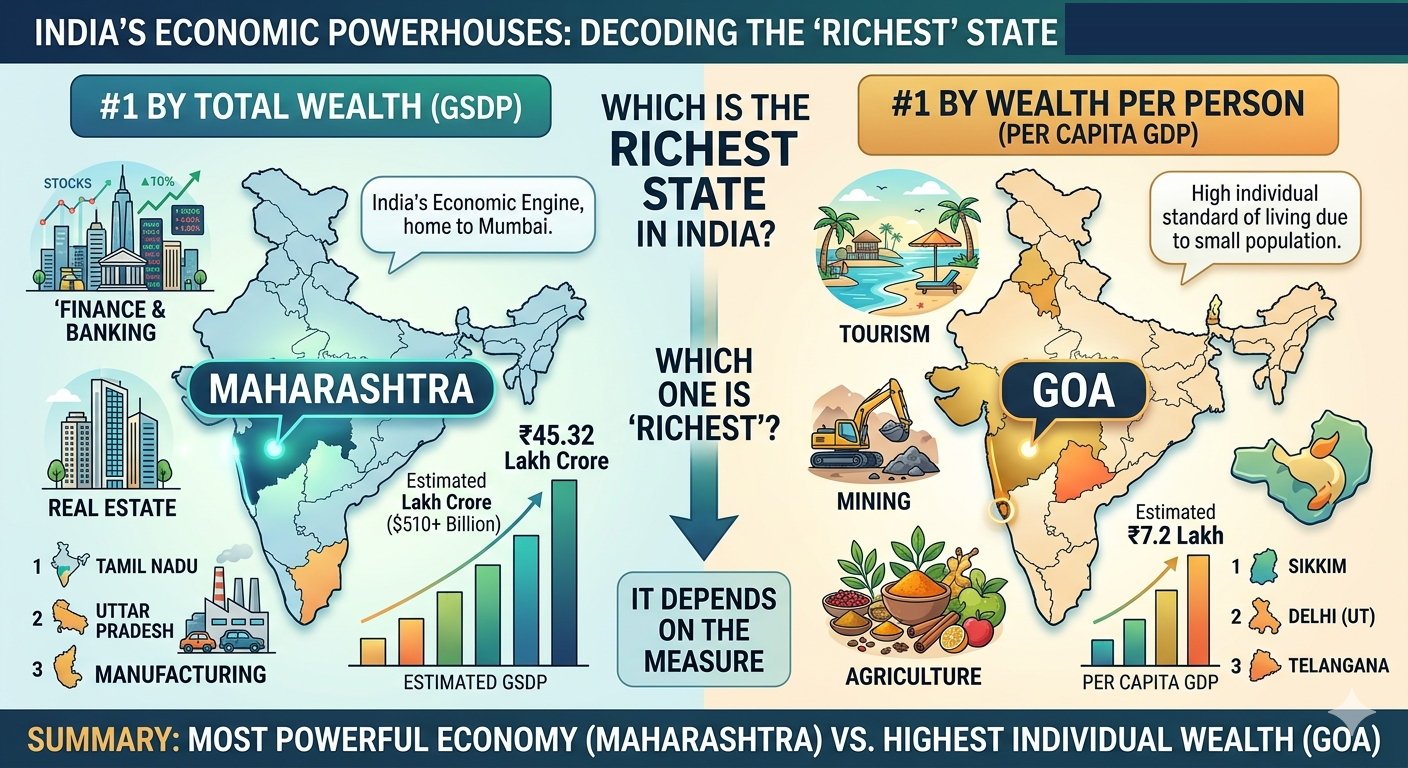
Which is the Richest state in India / Top 5 richest state in India: The richest state in India is usually calculated in two forms: the size of the economy (GSDP) or the wealth per capita (GDP Per Capita). As of 2026, the ranking is as follows:
1. Richest by Total Economy (GSDP) Maharashtra is the wealthiest state in India by a wide margin. It is the economic powerhouse of the country, the financial capital, Mumbai. GSDP: ~ 45.32 Lakh Crore ($510+ Billion)
1. Tamil Nadu (₹31.19 Lakh Crore)
2. Uttar Pradesh (₹29.78 Lakh Crore)
3. Karnataka (₹28.84 Lakh Crore)
2. Richest by Wealth per Person (GDP Per Capita)
When you consider the amount of wealth created per resident, smaller states and Union Territories lead.
Goa: Ranks 1st among states. Its low population and high-revenue tourism and mining make it the highest-income per person in the country (approx. ₹7.2 Lakh).
Sikkim: As a Union Territory, it often leads the list of urban prosperity (approx. ₹5.6 Lakh).
Summary: Maharashtra is the strongest economy, in case you mean that. Goa, in case you refer to the highest individual standard of living.
By total GSDP, Maharashtra is estimated to be the wealthiest state in India in 2026, continuing to lead with an estimated GDP of more than ₹45 lakh crore. Maharashtra is the largest economy in the country due to its robust finance, manufacturing, and services industries. The next largest state economies are Tamil Nadu and Uttar Pradesh.
Leading Richest States (Total GSDP – 2026):
Maharashtra: Estimated to be the top with more than 45 lakh crore (Approx. 540+ billion).
Tamil Nadu: It is second with a robust manufacturing industry.
Uttar Pradesh: Overtook Karnataka to become the third.
Karnataka: It is a strong state with an IT sector.
Gujarat: Economic activity and industrial output are high.
Best Performing States (Fiscal Health – 2026):
The Fiscal Health Index (FHI) 2026 indicates that Odisha is the leader in financial management and fiscal performance.
Comparison Table: Top 5 Economic Leaders (2026 Projections)
| Rank | State | GSDP (Total Wealth) | Wealth Focus |
| 1 | Maharashtra | ₹45.32 Lakh Cr | Banking & Industry |
| 2 | Tamil Nadu | ₹31.19 Lakh Cr | Automobiles & Textiles |
| 3 | Uttar Pradesh | ₹29.78 Lakh Cr | Agriculture & Services |
| 4 | Karnataka | ₹28.84 Lakh Cr | IT & Startups |
| 5 | Gujarat | ₹27.99 Lakh Cr | Refineries & Manufacturing |
Goa and Jharkhand were also identified as the best in fiscal sustainability.
Key Factors: Maharashtra is strengthened by the fact that it is the financial capital of India, Mumbai. But in terms of per capita GDP (wealth per person), smaller states such as Goa tend to be ranked higher.
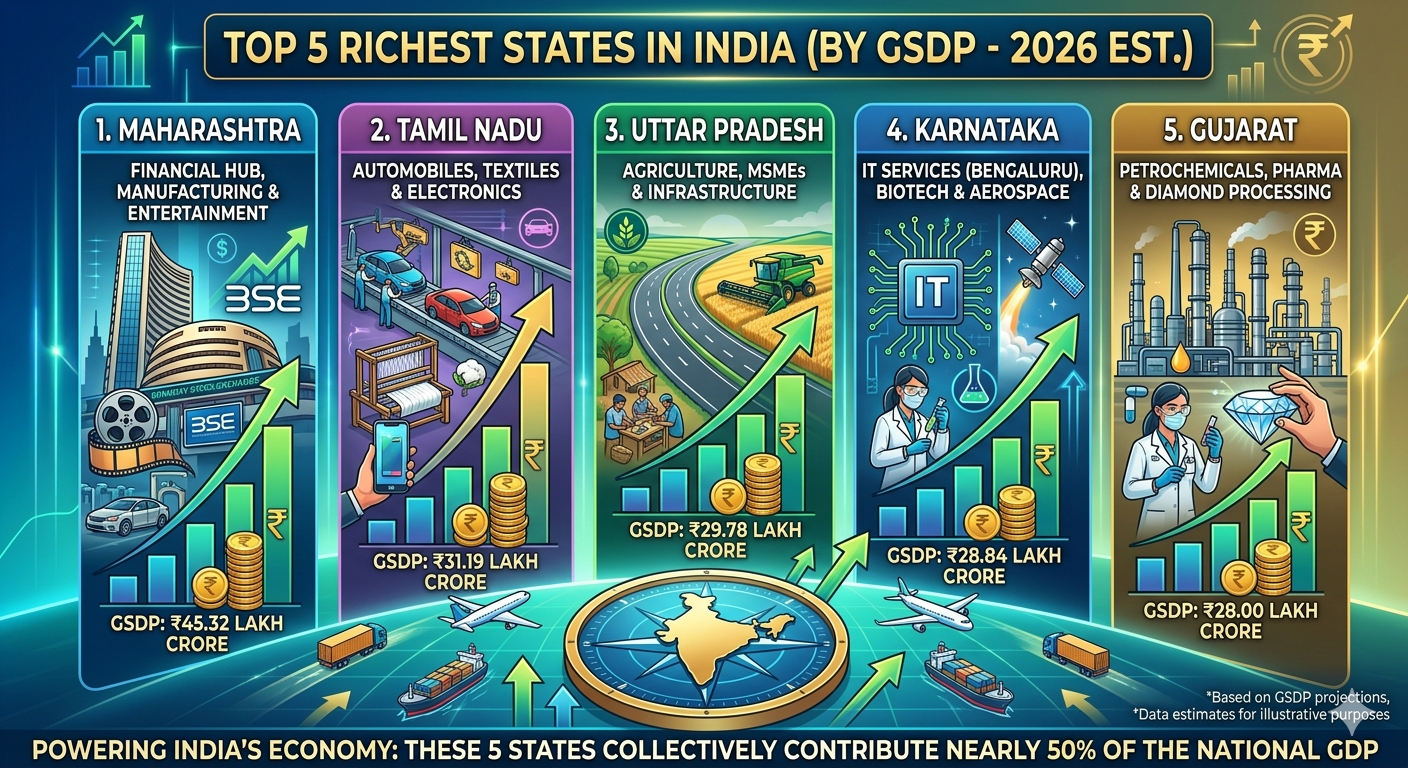
Top 5 States by GSDP (Total Economy Size)
These states are the industrial and commercial powerhouses of India, collectively contributing nearly 50% of the national GDP.
| Rank | State | Estimated GSDP (₹ Lakh Crore) | Key Economic Drivers |
| 1 | Maharashtra | ~45.32 | Financial services (Mumbai), manufacturing, and IT. |
| 2 | Tamil Nadu | ~31.19 | Automobiles, textiles, and electronics manufacturing. |
| 3 | Uttar Pradesh | ~29.78 | Agriculture, MSMEs, and rapidly growing infrastructure. |
| 4 | Karnataka | ~28.84 | IT services (Bengaluru), biotechnology, and aerospace. |
| 5 | Gujarat | ~28.00 | Petrochemicals, pharmaceuticals, and diamond processing. |
Interpretation of Rich: GSDP vs. Per Capita.
Although the above states have the largest economies, they also have very high populations. When you use the average wealth of an individual (Per Capita Income) to define the richest, the list looks much different. Smaller states tend to dominate this category since their wealth is shared among a smaller number of individuals.
Goa: Leads in Per Capita Income consistently because of tourism and mining.
Sikkim: High per capita because of low population and robust pharmaceutical/hydroelectric industries.
Delhi (UT): It is very high because it is a huge commercial and political center.
Telangana & Haryana: Are also much higher per person than larger states such as Uttar Pradesh or West Bengal.
Summary of Strengths
Maharashtra is the unchallenged leader, with a goal of a state economy of 1 trillion by 2028.
Uttar Pradesh has been the most rapidly improving state, surpassing Karnataka to become the 3rd largest in overall GSDP.
High-end services and technology exports remain dominated by Southern States (Tamil Nadu, Karnataka, Telangana).