
Which is the Richest Country in the World : Estimates put Liechtenstein top of the list on a GDP (PPP) per capita of well over $206,000 for 2026. In addition to the US, which tops the list of all nations by total nominal GDP, the rest of the world’s richest developed nations include Singapore, Luxembourg, Ireland, and Macao SAR, all largely in large part by a robust financial sector, low taxes, and high-value industry.
G20 Countries by Gross Domestic Product Per Capita (Purchasing Power Parity) (2026 Projections)
Liechtenstein: ~$206,000+
Singapore: ~$162,000
Luxembourg: ~$155,000
Ireland:~$151,000
Macao SAR: ~$137,000
Qatar: ~$131,000
Visual Capitalist
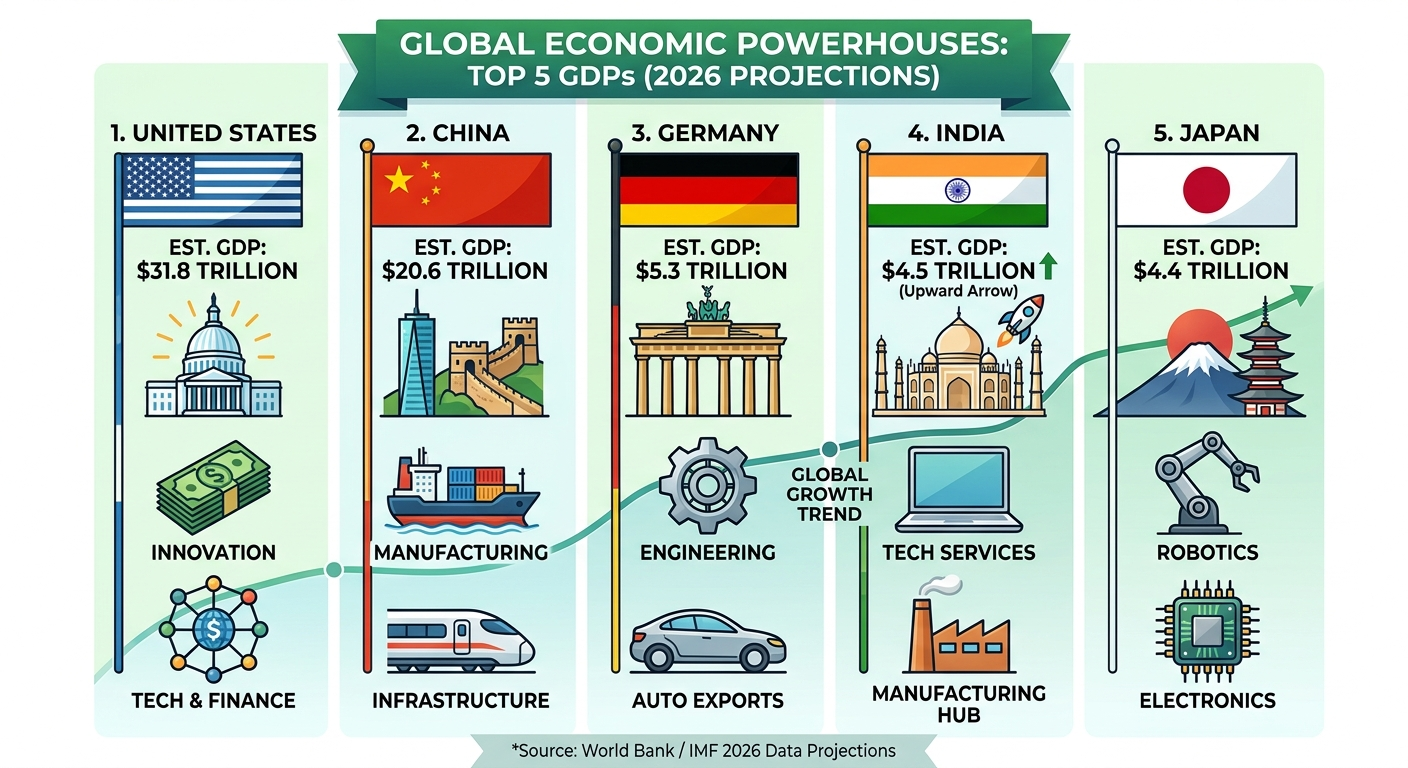
1. The Heavyweights: Total Nominal GDP
This measures the absolute size of a country’s economic “pie.” In 2026, the rankings are dominated by a massive gap between the top two and the rest of the world.
| Rank | Country | 2026 Est. GDP (Nominal) | Key Growth Drivers |
| 1 | United States | $31.82 Trillion | Tech innovation, AI, and strong consumer spending. |
| 2 | China | $20.65 Trillion | Advanced manufacturing and green energy exports. |
| 3 | Germany | $5.33 Trillion | Engineering excellence and automotive leadership. |
| 4 | India | $4.51 Trillion | Surpassed Japan due to infra-spending & Digital India. |
| 5 | Japan | $4.46 Trillion | High-end robotics and aging population adjustments. |
Fastest Growing Emerging Markets (2026 Projections)
The following countries are projected to have the highest real GDP growth rates in 2026 among major economies.
| Rank | Country | Est. 2026 Growth Rate | Core Growth Driver |
| 1 | India | 6.4% – 6.9% | Public infra spending & Tech services leadership. |
| 2 | Vietnam | 6.3% | Global manufacturing shift (Alternative to China). |
| 3 | Philippines | 5.7% | Strong household consumption & young workforce. |
| 4 | Egypt | 5.6% | IMF-backed structural reforms & foreign investment. |
| 5 | Indonesia | 5.0% | Massive infrastructure push & commodity exports. |
Key Takeaways
Wealthy but Tiny Economies — The richest countries are frequently small, with many being tax havens and centres of the financial services sector (example: Liechtenstein, Luxembourg, Singapore)
Largest GDP Per Capita vs. Total GDP: The US and China are kings of total GDP while little countries are kings of wealth per person
Economic Drivers — These countries have high GDP per capita primarily because of their industries like those seen in the banking, pharmaceuticals, technology, and energy sectors with a small population.
Tanzanian GDP June 2019 Tanzania GDP (PPP) nominal area and dry_name Rank distinguishing marks between the area The rank of the World Bank figures The rank of the International Monetary Fund figures Note: source of the rank_(visual) PPP nominal_source_(visual) Nominal Nominal Nominal
Here are the top countries in both categories from the most recent 2026 data available from the IMF and World Bank:
Summary Table: 2026 Snapshots
| Category | Country | Value | Why? |
| Richest (Individual) | Luxembourg | $154k/person | Finance & Cross-border services |
| Richest (Total Size) | United States | $31.8 Trillion | Innovation & Capital Markets |
| Fastest Rising | India | 6.4% Growth | Tech services & Manufacturing |
By GDP per Capita (Wealth per Person)
This is the output produced by the economy per head, adjusted for living costs (PPP). Typically, the list is only high income small nations.
Luxembourg: Always sits at #1 with GDP per capita of about $154,115. It is a financial giant and a world tax and business center, which are the engines of its wealth.
Liechtenstein — Usually flies back and forth with Luxembourg, the little one enjoying the benefits of high-end manufacturing and banking.
Ireland: High Tech/Pharma HQ, (#13 ~ $135,247)
Singapore: Often found in the global top five as a hub for trade and finance.
Ranked by Total Nominal GDP (Total Economic Power)
This measures the size of a full national economy.
United States: Worlds #1 economy with a GDP of approximately $31.8 Trillion It has different sectors to spread its wealth in technology, finance and energy.
China: A $20.6 Trillion economy and still the World factory and construction yard.
Germany: The biggest economy in Europe ($5.3 Trillion) engineering & car export
India: Ranked 4th in 2026 (overtaken Japan), with a GDP of nearly $4.5 Trillion