Rera asks Gurgaon’s developer to pay Rs 78L compensation to buyers for delay
Rera asks Gurgaon’s developer to pay Rs 78L compensation to buyers for delay
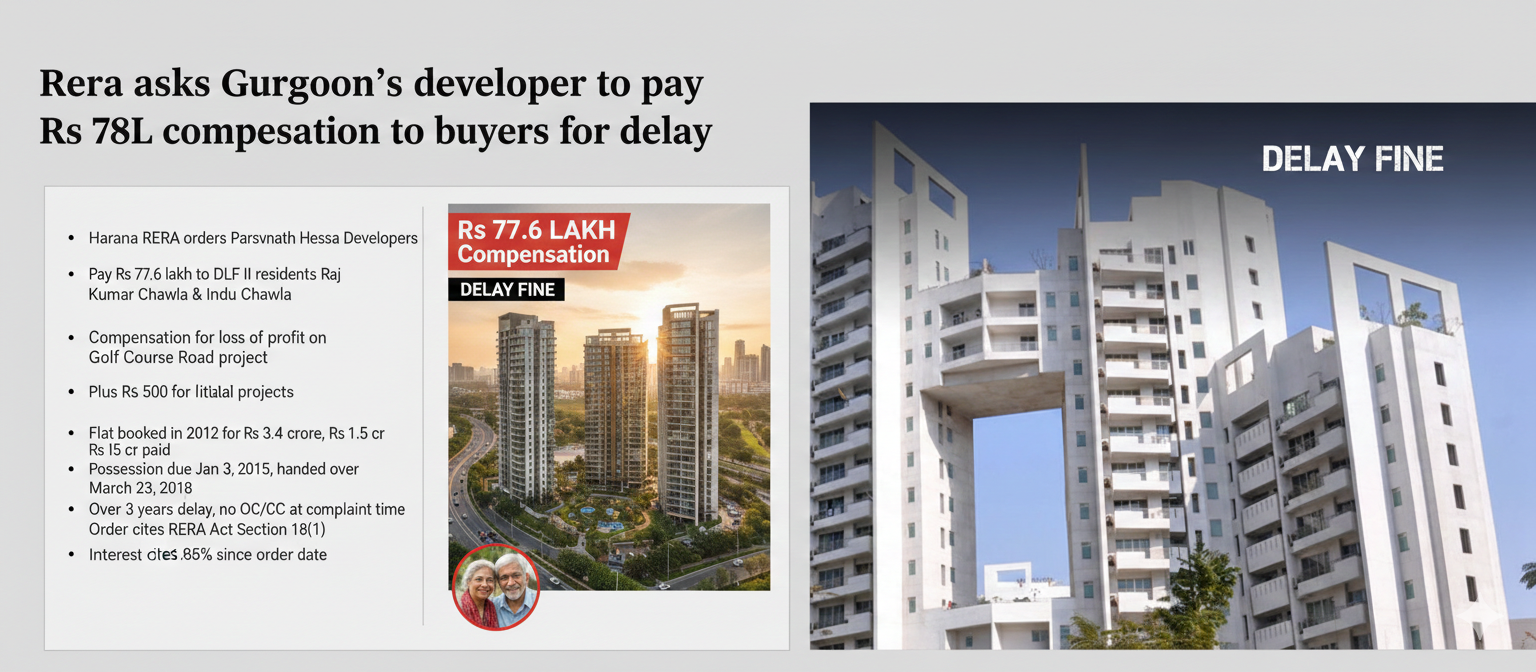
Gurgaon: Fourteen years later, Haryana Real Estate Regulatory Authority (HRera) has asked a developer to pay more than Rs 77 lakh as compensation to a couple in Golf Course Road project.
The developer, despite a delay of over three years in this regard, did not hand over possession of the apartment on time and was found to have abandoned construction for four years after demanding payment in full but without handing over an occupation certificate.
On Tuesday, the order was passed by adjudicating officer Rajender Kumar directing Parsvnath Hessa Developers to pay Rs 77.6 to DLF II residents Raj Kumar Chawla and Indu Chawla for loss of profit as well as Rs 50,000 towards litigation costs.
The possession of the apartment was handed over on March 23, 2018 but a delay “was already over three years and OC/CC had not been obtained” at the time when complaint was filed earlier, Rera had said.
Rera safeguards rights of allottees under Section 18(1) of the Real Estate (Regulation and Development) Act, stating that “after payment is made, a promoter is not permitted to compel upon its allottees an interminable wait”. Payments and 10.85% interest since order date are “due forthwith,” the officer said.
The couple also booked a 3,390 sq ft flat for Rs 3.4 crore on Sept 3,2012. They paid Rs 1.5 crore, after adjustments from a previous MoU for cancelled shops, and were to take possession by Jan 3, 2015.
Pronouncing the order after considering a complaint filed under Section 31 of the Act, Rera observed that there is a court order in another complaint before it and directed refund of Rs 1.5 crore plus 10% interest under Rule 15 of Haryana RERA Rules, 2017 as per Supreme Court observation in case IREO Grace Realtech vs Abhishek Khanna (2021).
The Chawlas claimed 82.5 lakh for loss of profit, Rs 2.15 crore for lost opportunity, interest at 6% on deposits towards mental agony and Rs 2.5 lakh cost against the backdrop of steep appreciation in property prices, “similar units now are fetching upto anywhere between Rs 4.3-8 crore”, from recent sale deeds. Kumar passed the standard Rs 77.6 lakh (50% appreciation on invested sum) for value increase/decrease/profit loss, with earlier interest seen as compensation for time delay. Claims for additional interest (6%) and Rs 1 crore in agony were turned down as egregious but costs of Rs 50,000 were allowed without court fees. Parsvnath contended that all losses had been compensated in prior interest.
news sources Times of India
Frequently Asked Questions
What is mutation and why is it important?
Mutation updates the ownership in municipal and revenue records after a sale. Without it the property tax and records still point to the old owner, so get it done.
What credit score do I need for a home loan?
Lenders prefer a healthy score, usually in the mid-700s and above, for the best rates. A lower score can still get a loan but often at a higher rate.
Can I claim tax benefits on a home loan?
Yes, home-loan principal and interest carry deductions under the income tax rules, subject to limits and conditions. Confirm the current rules or ask a tax adviser.
What is the difference between freehold and leasehold?
Freehold gives you full, permanent ownership of the property and land; leasehold runs for a fixed term from an authority. Freehold is generally simpler to resell.
How do I check a builder's track record?
Look at delivered projects, delivery delays, the RERA record and buyer reviews. A builder with a clean, on-time record lowers your risk sharply.
What red flags should I watch for when buying?
Unclear title, missing approvals or RERA, pending dues, a builder with delays, and prices far below the market. If something feels rushed, slow down and verify.
What is the difference between capital appreciation and rental yield?
Appreciation is the rise in the property value over time; rental yield is the annual rent as a share of the price. Most Indian homes give modest yield and rely on appreciation.
How much should I keep as a buffer beyond the price?
Set aside for stamp duty, registration, GST where it applies, interiors, and a contingency. A buffer of a meaningful share above the base price is prudent.
Is a home loan pre-approval useful?
Yes, a pre-approved loan tells you your budget, speeds up booking and strengthens your negotiating position with sellers. Get it before you shortlist seriously.
How do I choose between two similar projects?
Compare the builder record, RERA status, carpet area, real amenities, connectivity and total cost, not just the headline price. Visit both before deciding.
What is the property registration process in India?
You sign a registered sale deed, pay stamp duty and complete the mutation in your name. Our registration guide covers every step.
What is stamp duty and who pays it?
Stamp duty is the state tax on registering a property, usually paid by the buyer. Rates vary by state, with a rebate for women buyers in many states.
Why is a GPA sale risky?
A general power of attorney is not a substitute for a registered sale deed and gives weaker ownership. Insist on a proper registry, not a GPA transfer.
What approvals should a project have?
A valid licence, RERA registration, sanctioned building plans and, for ready homes, an occupancy certificate. Match the actual construction to the approved plan.
What is a completion certificate?
It confirms the building was completed as per the approved plan and local rules. Along with the occupancy certificate, it matters for legal, loan and resale purposes.
How do I check land records online?
Most states publish land records online where you can verify ownership and dues. Our land records guide shows how.