RERA 2.0 in India: 7 Changes That Actually Protect Your Home Buying Money
India's original RERA framework (Real Estate Regulation and Development Act) came into force in 2017. It was a significant shift, for the first time, developers had to register projects, disclose plans publicly, maintain escrow accounts, and face penalties for delays.
Nine years later, RERA 2.0 landed in March 2026. The upgrade isn't a complete overhaul. It's a set of targeted tightening measures that address the gaps and loopholes that exposed buyers in the 2018–2024 period. Some of the changes are technical, but several directly affect what you can expect when you buy a property in 2026 and beyond.
This is what changed, what it means in practice, and what hasn't changed (so you don't have unrealistic expectations).
Key Takeaways
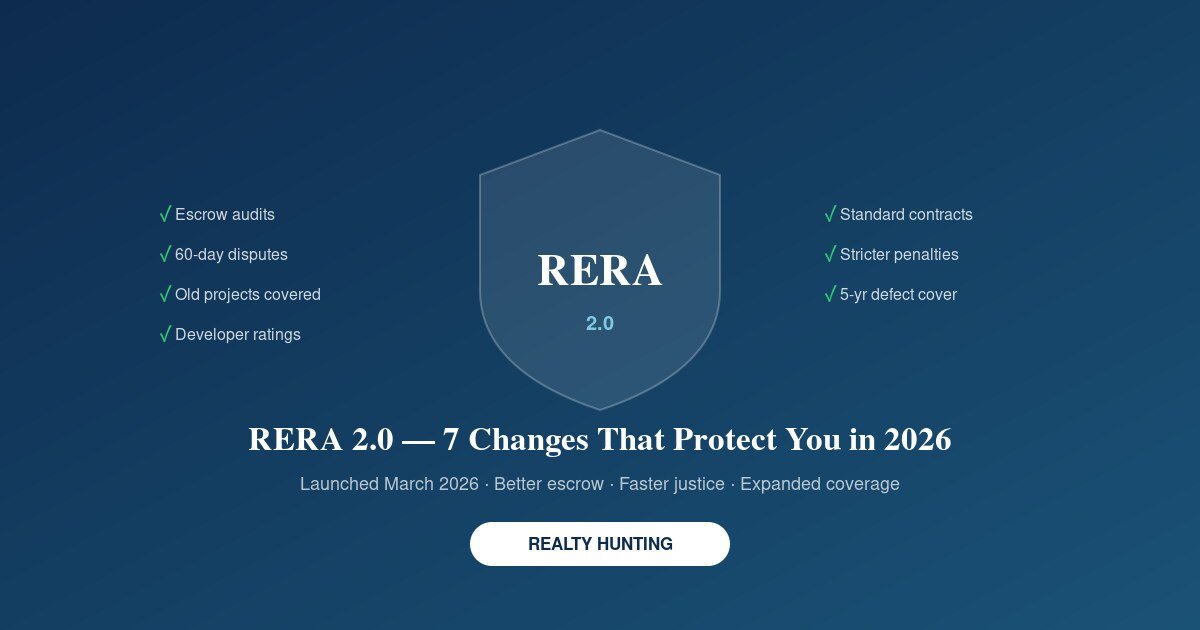
- RERA 2.0 launched March 2026. It upgrades, not replaces, the original 2017 framework.
- The biggest change: mandatory third-party audits of project escrow accounts.
- Dispute resolution now has a 60–90 day mandatory timeline (was open-ended).
- Older unregistered/partially-complete projects are now covered under the revised framework.
- Standardized carpet area definitions and contract templates make comparisons easier.
- Developer transparency improved: ratings, compliance history, and delivery records now public.
- The 5-year structural defect liability clause remains (unchanged but reinforced).
Background: Why RERA 1.0 Wasn't Enough
The original RERA was an improvement. But it had real weaknesses that developers exploited:
- Escrow rule violations: Developers were supposed to park 70% of project funds in escrow and use it only for that project. In practice, auditing was minimal. Money moved around. Projects stalled.
- Slow dispute resolution: RERA tribunals were set up in most states, but timelines were undefined. Complaints filed in 2019 were still pending in 2024.
- Old projects excluded: Projects launched before 2017 were either excluded or loosely brought under RERA, leaving thousands of buyers stuck in pre-2017 projects with no clear legal pathway.
- Non-uniform standards: Carpet area definitions and penalty calculations varied between states, creating confusion and loopholes.
RERA 2.0 targets precisely these gaps.
Change 1: Third-Party Escrow Audits (The Most Important One)
Under RERA 1.0, developers were required to put 70% of project collections into an escrow account. But who checked? State RERA authorities were understaffed, and audits were rare.
RERA 2.0 mandates third-party auditors, independent CA firms, not the developer's own auditors, to verify that: - Money collected from buyers is going into the escrow account. - Withdrawals from escrow are only for that specific project's construction costs. - Quarterly fund utilization reports are filed with the RERA authority and made public.
What this means for you: Before paying any installment to a developer, you can now check if the project's escrow audit is current and clean. If a project is consistently not meeting escrow requirements, that's a red flag the portal now makes visible.
This is the single biggest structural improvement in RERA 2.0. The 2019–2022 wave of stalled projects happened largely because escrow money was diverted. Audits make that harder.
Change 2: Mandatory Dispute Resolution Timelines
RERA 1.0 set up Adjudicating Officers and appellate tribunals, but didn't set timelines for resolution. Cases dragged for years.
RERA 2.0 introduces mandatory 60–90 day timelines for most complaint categories: - Possession delay complaints: 60 days to adjudication. - Refund disputes: 90 days. - Structural defect claims: 90 days.
States have to establish tracking systems that show complaint status publicly. If the adjudicating officer misses the deadline, the case escalates automatically.
Practical impact: This doesn't mean you'll get your money back in 90 days. Execution (actually receiving the refund or possession) can take longer. But the adjudication, the legal decision, should now happen faster. That's meaningful if you're stuck and need a court-backed order to proceed.
Change 3: Expanded Coverage to Older Projects
This is the change that affects the most people in terms of sheer numbers.
Pre-2017 projects, buildings launched before RERA came into effect, were in a legal grey zone. Many of these are partially complete, occupied by some buyers but with other wings still under construction. Thousands of buyers in these projects had no RERA recourse.
RERA 2.0 expands coverage to: - Ongoing projects that were registered under RERA but with outdated compliance filings (many developers stopped updating after 2022). - Partially complete projects originally registered under old-era approvals that meet revised criteria for "ongoing." - Revival schemes for stalled projects: a new framework for RERA authorities to appoint resolution professionals for genuinely stalled projects where the original developer is insolvent or absent.
The revival framework is new and untested, it'll take 2–3 years before we see it meaningfully working. But the legislative intent is clearer now.
Change 4: Standardized Carpet Area and Contract Templates
One of the most common disputes between buyers and developers: the carpet area in the brochure doesn't match what you get.
RERA 2.0 tightens the definition of carpet area:
| Term | RERA 2.0 Definition |
|---|---|
| Carpet Area | Area enclosed by outer walls, excluding balconies and service shafts |
| Super Built-Up Area | Carpet area + proportionate share of common areas (lifts, lobbies, stairs) |
| Built-Up Area | Carpet area + outer walls (not common areas) |
The use of "super built-up area" in sale agreements for pricing purposes is now explicitly regulated, developers cannot use an inflated super-BUA percentage to obscure the actual carpet area you're paying for.
Additionally, RERA 2.0 introduces model agreement templates that states are expected to adopt. These templates: - Spell out exact payment milestones linked to construction stages. - Define penalty rates for developer delays and buyer defaults symmetrically. - Include a specific "force majeure" definition to prevent developers from invoking it for normal delays.
Change 5: Developer Transparency Ratings
RERA 2.0 introduces a developer rating and compliance score system on state RERA portals:
- Past projects: delivery record, RERA complaints, delay history.
- Current projects: compliance status, escrow audit status, construction progress.
- Industry blacklist: developers with unresolved orders of ₹5 crore+ are flagged.
This is similar to credit scores, but for builders. Before you book a flat, you can look up the developer on the RERA portal and see their track record. A developer with 10 projects and 2 blacklist flags is different from one with 10 clean deliveries.
Change 6: Stricter Penalties for Delays
RERA 1.0 required developers to pay buyers interest at a rate linked to SBI's MCLR (typically 8–10%) for delayed possession. In practice, enforcement was weak.
RERA 2.0: - Increases the penalty rate to SBI MCLR + 2% (so approximately 10–12% annualized). - Makes the penalty automatic, you don't have to separately prove damages. - Allows buyers to seek both interest (for delay) AND a refund with interest (if you decide you don't want the flat anymore after a significant delay).
The interest compounding structure is now also clarified, it applies monthly, not annually.
Change 7: The 5-Year Structural Defect Liability (Reinforced)
This existed under RERA 1.0 but was weakly enforced. RERA 2.0 reinforces it:
- The developer is liable for structural defects, poor workmanship, and quality failures for 5 years from the date of possession.
- The buyer can raise a defect claim directly to RERA, they don't have to go to civil court.
- Developers must maintain a construction defect insurance policy and provide the buyer with the policy document at possession.
If your ceiling leaks within 3 years, or the balcony railing is structurally unsound, this is your legal pathway without expensive litigation.
What RERA 2.0 Doesn't Fix
Being honest here is important:
- Execution gap: RERA 2.0 is a central framework. Each state has to adopt and implement it. As of July 2026, Maharashtra, Karnataka, Delhi, and Telangana have begun implementation. Some smaller states are still absorbing the changes. If you're buying in a state with weak RERA infrastructure, the law on paper is better than the reality on the ground.
- Stalled project recovery: The revival mechanism for old stalled projects is new and will be slow. Don't expect quick resolution for pre-2017 stuck projects, the framework exists but the bureaucratic machinery needs time.
- Broker regulation: Real estate agents are still RERA-registered in principle but broker accountability remains loose. RERA 2.0 doesn't meaningfully change this.
How to Use RERA Before Buying
These are the steps every buyer should take, regardless of how strong RERA 2.0 is:
- Go to your state's RERA portal (e.g., RERA UP at up-rera.in, Maharashtra at maharera.mahaonline.gov.in, Karnataka at rera.karnataka.gov.in).
- Search the project by registration number, every developer is required to display it in all marketing material.
- Check the compliance status: Is the escrow audit current? Are quarterly updates being filed?
- Check developer history: Any orders issued against this developer for past projects?
- Read the registered plan: The approved plan on the RERA portal is the legally binding document, compare it to the brochure. Discrepancies are red flags.
Check verified RERA-registered projects at Realty Hunting, every listing includes the RERA number and a direct link to the portal.
FAQ
Q: Can I still lose money if a RERA 2.0 registered project fails? Yes. RERA 2.0 improves protection significantly, but it's not a guarantee. If a developer goes insolvent, recovery through RERA is faster than civil court but not instant. Check developer track records and don't rely on RERA as a substitute for due diligence.
Q: Does RERA 2.0 cover all states? The central framework applies to all states, but implementation timelines vary. As of mid-2026, major states (Maharashtra, Karnataka, UP, Delhi) are implementing. Check your specific state's RERA website for status.
Q: What do I do if a developer misses possession date? Under RERA 2.0, file a complaint on the state RERA portal. The developer owes you interest (SBI MCLR + 2%) from the agreed possession date until actual handover. You can also seek full refund with interest if the delay exceeds a defined threshold.
Q: Can I check whether a broker is RERA registered? Yes, state RERA portals list registered brokers/agents. Only deal with RERA-registered agents, especially for new launches.
Q: Is a resale flat covered by RERA? RERA primarily governs new project sales from developers. Resale transactions (buyer to buyer of an already-completed flat) are generally outside RERA's scope. For resale, title due diligence through a lawyer is your protection.
Explore more real estate guides on our blog, or browse new launches with complete RERA details.
What is the difference between carpet area and super area?
Carpet area is the usable space inside your walls; super area adds a share of common areas. Always confirm the carpet area you actually get before comparing prices.
What extra costs come beyond the price in Gurgaon and NCR?
Budget for stamp duty and registration, GST on under-construction homes, parking, club and maintenance deposits, and loan fees. Ask for a full cost sheet upfront.
How does Realty Hunting help me buy in Gurgaon and NCR?
We share verified listings, honest area advice and the real paperwork picture, and connect you with builders and sellers. Reach out and we will shortlist options that fit your budget.
Should I buy ready-to-move or under-construction in Gurgaon and NCR?
Ready homes have no wait, no GST and no build risk but cost more; under-construction is cheaper with a longer wait. Choose by your timeline and risk appetite.
How do I book a property in Gurgaon and NCR?
Shortlist, visit, check the papers and RERA, then pay the booking amount and sign the agreement. Read the payment plan and cancellation terms before you commit.
Do I need a lawyer to buy property in Gurgaon and NCR?
For anything beyond a simple, clean deal it helps. A lawyer vets the title, the agreement and the approvals, which is cheap insurance against a costly mistake.
What is a builder-buyer agreement?
It is the core contract between you and the developer, setting the price, payment plan, area, specifications and possession date. Read it fully before signing.
What is an occupancy certificate and why does it matter?
It certifies a building is legally fit to occupy. Never take possession of a completed home without it, since it affects loans, utilities and resale.
What is mutation and why is it important?
Mutation updates the ownership in municipal and revenue records after a sale. Without it the property tax and records still point to the old owner, so get it done.
What credit score do I need for a home loan?
Lenders prefer a healthy score, usually in the mid-700s and above, for the best rates. A lower score can still get a loan but often at a higher rate.
Can I claim tax benefits on a home loan?
Yes, home-loan principal and interest carry deductions under the income tax rules, subject to limits and conditions. Confirm the current rules or ask a tax adviser.
What is the difference between freehold and leasehold?
Freehold gives you full, permanent ownership of the property and land; leasehold runs for a fixed term from an authority. Freehold is generally simpler to resell.
How do I check a builder's track record?
Look at delivered projects, delivery delays, the RERA record and buyer reviews. A builder with a clean, on-time record lowers your risk sharply.
What red flags should I watch for when buying?
Unclear title, missing approvals or RERA, pending dues, a builder with delays, and prices far below the market. If something feels rushed, slow down and verify.
What is the difference between capital appreciation and rental yield?
Appreciation is the rise in the property value over time; rental yield is the annual rent as a share of the price. Most Indian homes give modest yield and rely on appreciation.
How much should I keep as a buffer beyond the price?
Set aside for stamp duty, registration, GST where it applies, interiors, and a contingency. A buffer of a meaningful share above the base price is prudent.