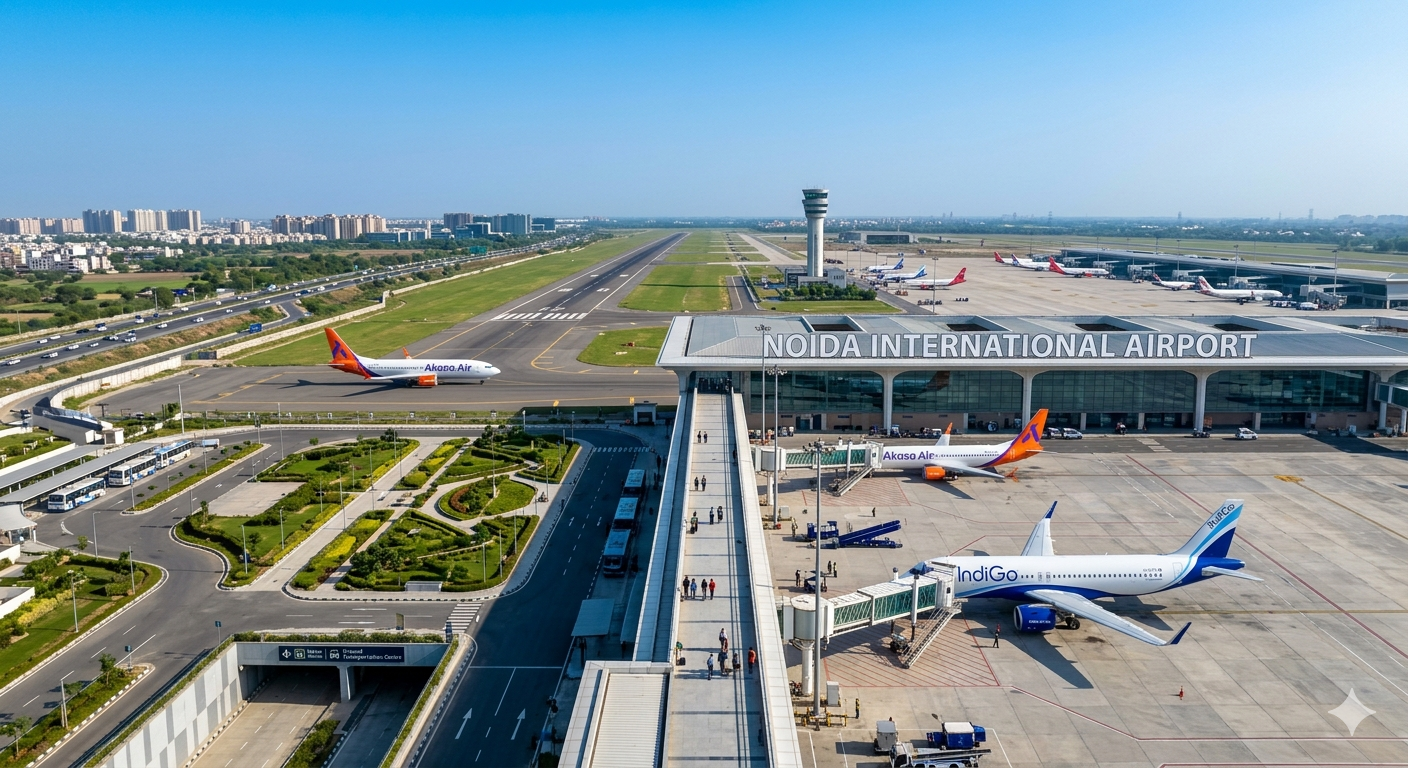
Noida International Airport (NIA), Jewar, Uttar Pradesh will be a greenfield airport which on completion would be developed as one of the most technologically advanced, digitally enabled and sustainable airports in India; NIA is to be constructed under phase 1 for an estimated capacity of 12 million passengers per year. It has several such features — AI-powered security, Digi Yatra forautomated check-ins and smart technology to handle baggage and ops.
Key AI and Technology Features
Security & Ops: Using AI with security and ops.
Digital Experience– Includes features such as touch-free, automated check-in kiosks; baggage drop and biometric-based boarding (DigiYatra).
IT Infrastructure: Kyndryl is deploying AI-based software to manage IT operations, anticipating and preventing problems.
Example Tata Projects used AI in construction for safety, project monitoring and resource optimisation बहुत पंखे हैं।
BIM Technology: Building Information Modelling (BIM) was used to generate a 3D model for construction precision.
Key Airport Details
Location: Jewar, Gautam Buddha Nagar, UP (next to Delhi-NCR)
Capacity: 12 million passengers when its first phase is completed; up to 70 million at full completion.
Airport Information: One 3,900 m x 45 m runway (10/28) equipped with CAT III Instrument Landing System (ILS).
Developer: Yamuna International Airport Private Limited (YIAPL), a unit of Zurich Airport International.
Status: The airport has obtained its aerodrome license and is likely to begin commercial operations in the near future.
The airport is intended to be a net-zero emission facility.
Jewar’s Noida International Airport (NIA) has achieved its key milestones of development.
PROJECT IN OPERATIONAL PHASE, EXPECTED TO BE INAUGURATED SOON (MARCH 2026)
Current Status & Launch Timeline
Last Approved: DGCA Aerodrome License on March 6th, 2026. This was last major regulatory hurdle after security clearance from Bureau of Civil Aviation Security (BCAS).
Inauguration: Officials are working with the Prime Minister’s Office for a proper inauguration likely in late March 2026
Flight Operations: Commercial domestic flights and cargo operations should start about 45 days after the issuance of the license, meaning they would likely take to the air between mid-to-late April 2026.
International flights: International services are scheduled to join domestic routes in the second half of 2026 at earliest — after operations have stabilized.
Phase 1 Key Features
Phase one, constructed by Zurich Airport International AG, was slated to accommodate 12 million passengers yearly.
Infrastructure: One 3,900-meter runway (10/28) suitable for wide-body aircraft such as the Boeing 777.
Digital: “DigiYatra” biometric processing, self-baggage drops and a paperless travel flow
Going Green: NIA aspires to become India’s first net-zero emissions airport through solar energy and extensive rainwater harvesting
Connectivity & Airlines
Airlines Confirmed: IndiGo, Akasa Air and Air India Express have signed agreements to operate from the airport.
Road Connectivity: The terminal is now directly connected to the Yamuna Expressway by a 750-meter long dedicated link road. It is also connected to the Eastern Peripheral Expressway.
Transit Hub– The future phases consist of a Ground Transportation Centre (GTC) which will comprise of a Metro station, Namo Bharat (RRTS) station and bus terminals.
I. Launch & Operational Status
-
When will the airport officially open? The formal inauguration is expected in late March 2026. Following the receipt of the DGCA Aerodrome License on March 6, commercial operations for domestic flights and cargo are slated to begin by late April 2026.
-
Which airlines will fly from Jewar? IndiGo is confirmed as the launch carrier. Other major airlines including Akasa Air and Air India Express have signed agreements to operate from the terminal.
-
When do international flights start? International operations are planned for the second half of 2026 to ensure the domestic systems and 24-hour operations are fully stabilized first.
-
What is the airport code? The IATA code for Noida International Airport is DXN.
II. Connectivity & Logistics
-
How far is it from major NCR hubs?
-
Greater Noida: ~30–40 minutes
-
Noida: ~50–60 minutes
-
New Delhi (IGI Airport): ~72 km (~2 hours via Yamuna Expressway)
-
-
Is there a direct link to the Delhi-Mumbai Expressway? Yes. A 31 km greenfield link connecting the airport to the Delhi-Faridabad-Ballabhgarh-Sohna spur is under rapid construction, providing direct access for travelers from Gurugram and South Delhi.
-
What about Metro or Rail? A Metro expansion from Greater Noida (Knowledge Park II) to the airport is planned. Additionally, the airport will eventually be a stop on the Delhi-Varanasi High-Speed Rail (Bullet Train) corridor.
III. Real Estate & Investment
-
Which sectors are seeing the most growth? The most active investment zones are YEIDA Sectors 15C, 18, 20, and 22D. These areas are part of the latest authority plot schemes and are located closest to the airport boundary.
-
What are the current property rates? As of early 2026, YEIDA residential plot rates are trending around ₹35,000 per sqm. Private residential land in nearby micro-markets (Jewar, Tappal) has seen values appreciate by over 1.6x since 2020.
-
Is it a good time for commercial investment? Yes. The area is transitioning into an “Aerotropolis.” Significant demand is emerging for warehousing, logistics hubs, and service apartments to support the projected 12 million annual passengers.
-
What is the “Film City” impact? The upcoming Noida International Film City (Sector 21) is located just 6 km from the airport, creating a dual-catalyst effect that is driving premium residential and hospitality demand along the Yamuna Expressway.
I. Specialized Infrastructure & Connectivity
-
What is the status of the “Pod Taxi” (PRT) project?
The Personal Rapid Transit (PRT) system, intended to connect Sector 21 (Film City) directly to the airport, is currently in the procurement and tender finalization stage. It is designed to be a driverless, high-frequency transit solution specifically for the “Aerotropolis” zone.
-
Will there be a direct rail link to the New Delhi Railway Station?
Yes. The Regional Rapid Transit System (RRTS), also known as Namo Bharat, has been finalized to connect Ghaziabad to Jewar. This 72.44 km corridor will allow passengers from the existing Delhi-Meerut RRTS line to reach NIA with minimal interchanges, effectively linking Central Delhi to the new airport in under 60–70 minutes.
-
How does the airport handle cargo differently?
NIA is being built with a “Multi-Modal Cargo Hub” philosophy. It includes a dedicated Integrated Cargo Terminal (ICT) and an MRO (Maintenance, Repair, and Overhaul) facility, positioning it as the primary logistics gateway for North India’s manufacturing clusters (mobile phones, apparel, and medical devices).
II. Industrial & Corporate Ecosystem
-
What are the “Japan City” and “Singapore City” projects?
These are specialized township proposals along the Yamuna Expressway. Singapore City is envisioned as a world-class smart city hub, while the Japanese and Korean industrial clusters (Sectors 10 and 11) are attracting semiconductor and electronics giants, creating a massive local employment base.
-
Are there Data Centers near the airport?
Yes, Sector 28 has been designated as a Data Centre Park. Major tech firms have already taken allotments to set up hyper-scale data centers, capitalizing on the 24/7 power supply and high-speed fiber connectivity planned for the airport zone.
-
What is the status of the Medical Device Park?
Located in Sector 28, the 350-acre Medical Device Park is now operational in its first phase. It is a key industrial anchor that will utilize the airport’s cargo capabilities for exporting high-value medical equipment.
III. Investment & Buyer Psychology (2026 Trends)
-
Should I buy a Plot or an Apartment in 2026?
-
Apartments: Currently seeing higher demand from “end-users” and professionals working in the nearby electronics and mobile manufacturing units (Sectors 24 and 22D). They offer immediate rental yield.
-
Plots: Best for long-term “land banking” (8–10 years). While appreciation has been high, plots in peripheral sectors may take longer to show “liveability” compared to established group housing societies.
-
-
Is the “Yamuna Expressway Authority (YEIDA)” plot scheme still open?
YEIDA regularly launches scheme cycles for residential and industrial plots. The most recent 2026 Scheme Cycle for the Medical Device Park and residential plots in Sectors 18 and 20 saw record-breaking applications, often oversubscribed by 20–30 times.
-
What is the “Singapore City” impact on property?
The announcement of international collaborations for urban planning has shifted investor interest toward Sector 22D and Sector 25, which are expected to host premium mixed-use developments and hospitality hubs.
I. Regulatory & Operational Updates
-
What is the significance of the DGCA Aerodrome License issued on March 6, 2026?
This was the final “green signal” from the regulator. It certifies that the airport, its single runway, and the terminal are fully compliant with international safety and security standards (ICAO). It effectively transitions the site from a “construction project” to an “operational airport.”
-
What happened during the “Calibration Flights”?
Before the license was issued, specialized aircraft tested the Instrument Landing System (ILS) and ground navigation aids. This ensures that planes can land safely even in low-visibility conditions (like NCR fog) using precision radio signals.
-
Is the air traffic control (ATC) managed from Jewar?
While the airport has its own high-tech ATC tower, it will operate in close coordination with the Delhi Air Traffic Management to ensure there is no congestion or conflict with flights coming into IGI Airport.
II. Specialized Connectivity Projects
-
What is the “Faridabad-Jewar Greenfield Expressway”?
This is a critical 31 km link that connects the airport directly to the Delhi-Mumbai Expressway at Ballabhgarh. Once finished (expected by late 2026), it will allow travelers from Faridabad, Sohna, and Gurugram to reach the airport in roughly 45–60 minutes, bypassing the traffic of Delhi.
-
Are Pod Taxis still happening?
Yes. The plan for India’s first Pod Taxi (PRT) system is moving forward to connect the Noida Film City (Sector 21) to the airport terminal. It is designed to carry 4–6 passengers per pod at high frequencies, serving as a futuristic last-mile connector for the “Aerotropolis.”
-
What is the “Namo Bharat” (RRTS) expansion?
A new 72 km RRTS corridor has been confirmed to link the Ghaziabad RRTS station to the Noida International Airport. It will have 22 stations, including stops at Greater Noida West (Noida Extension) and Pari Chowk, making it a primary high-speed transit artery for the region.
III. Regional Development & Economy
-
What is the “MRO Hub” and why does it matter?
NIA is being developed with a massive Maintenance, Repair, and Overhaul (MRO) facility. Currently, most Indian airlines send their planes abroad (to Singapore or Sri Lanka) for major repairs. This hub will save millions in foreign exchange and create thousands of high-skilled engineering jobs locally.
-
What is “Sector 28” being developed for?
Sector 28 is the designated Medical Device Park. It is the first of its kind in North India and is expected to house over 200 manufacturing units for oxygen concentrators, ventilators, and other high-tech medical gear, all leveraging the airport’s cargo terminal for exports.
-
Is there a “Cargo Village”?
Yes, the airport features an integrated Multi-Modal Cargo Hub (MMCH). It includes a dedicated terminal for perishable goods (like fruits and flowers from Western UP) and a “transshipment” center to handle cargo moving between trucks and planes seamlessly.
IV. Smart City & Sustainable Features
-
How is it a “Net Zero” airport?
The airport uses a “passive” architectural design to reduce heat, features a massive on-site solar power plant, and has a zero-liquid discharge system. All ground support equipment (like baggage tugs and shuttle buses) will be electric.
-
Will there be a “Forest” inside the terminal?
The terminal design includes an internal courtyard inspired by a traditional Indian haveli, featuring natural ventilation and dense greenery, creating a “breathable” environment for passengers.