Mumbai's ₹1.5 Trillion Redevelopment Wave: Nearly 59,000 New Homes Coming by 2031
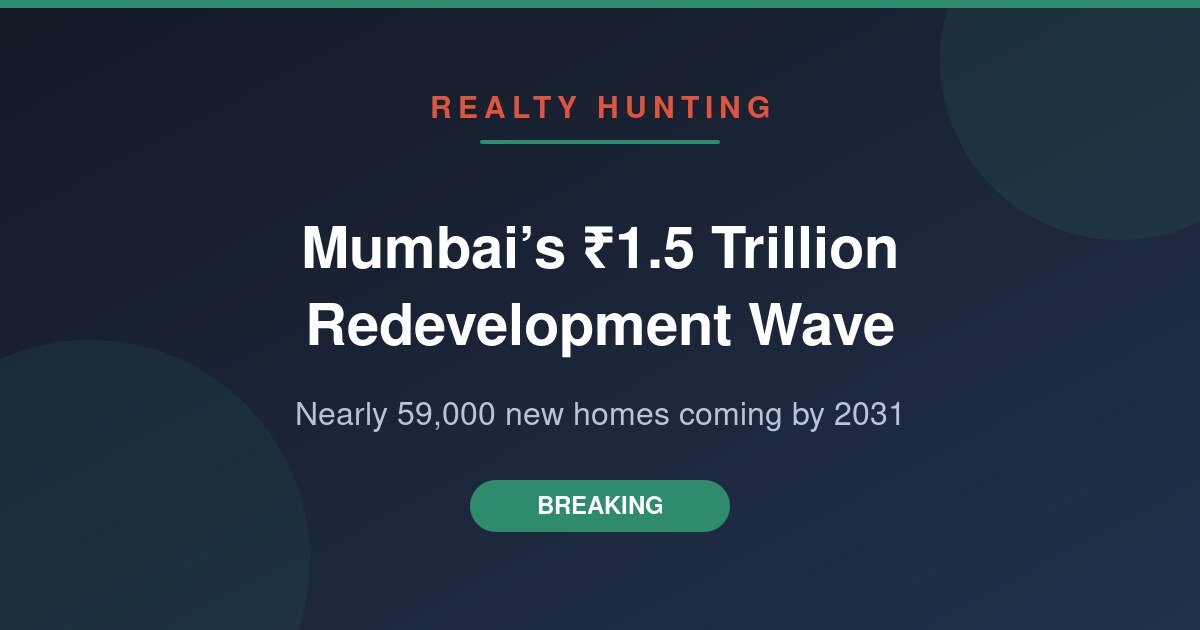
Mumbai's biggest housing story isn't a new township or a reclaimed seafront, it's the city rebuilding itself, society by society. Knight Frank India's latest analysis puts numbers on the phenomenon: the redevelopment pipeline could deliver nearly 59,000 new homes worth about ₹1.5 trillion (₹1.5 lakh crore) by 2031. Developer agreements with housing societies have crossed the 1,050 mark for the first time since 2020, with 1,094 societies currently under redevelopment, collectively opening up roughly 432 acres of land in a city where vacant plots essentially don't exist. This is what's driving the surge, where it's happening, and what it means whether you live in an ageing society, want to buy into a redeveloped tower, or invest around the trend.
Quick summary
- Nearly 59,000 new homes worth ~₹1.5 trillion could come from Mumbai redevelopment by 2031 (Knight Frank).
- 1,094 societies are currently under redevelopment, freeing up about 432 acres across the city.
- 2026 started hot: the first ten weeks produced over 30% of the developer-agreement volumes seen in each of 2024 and 2025 as full years.
- Borivali, Andheri, Bandra and Ghatkopar lead activity. The western suburbs dominate.
- Redevelopment projects are expected to generate over ₹9,115 crore in stamp duty for the state across their lifecycle.
- Typical lag from development agreement to launch is 2–2.5 years, factor that into any possession promise.
The numbers at a glance
| Metric | Figure |
|---|---|
| Projected new homes by 2031 | ~59,000 |
| Estimated value | ~₹1.5 trillion |
| Societies under redevelopment | 1,094 |
| Land being unlocked | ~432 acres |
| Expected stamp duty generation | ₹9,115+ crore |
| Agreement-to-launch timeline | 2–2.5 years |
| Hotspots | Borivali, Andheri, Bandra, Ghatkopar |
Why redevelopment is exploding now
Three forces converged. First, Mumbai ran out of land decades ago, the only meaningful supply in the island city and inner suburbs comes from rebuilding what's already there. Thousands of societies built in the 1960s–80s are structurally tired, lift-less and sitting on unused development rights.
Second, the incentive math improved. Higher FSI allowances, premium rationalisations and Maharashtra's policy support (including self-redevelopment options for societies) mean a developer can offer existing members larger flats, corpus funds and rent for the transition, and still make the project work by selling the free-sale component at Mumbai prices.
Third, the housing cycle rewards it. With end-user demand strong in the ₹1.5–3 crore band, now the dominant new-launch segment nationally, redeveloped towers in established suburbs hit exactly the price point and location buyers want. That's why the first two and a half months of 2026 alone produced more than 30% of the agreement volumes of each of the previous two full years.
Where the action is concentrated
Knight Frank's earlier tracking already showed the western suburbs leading Mumbai's redevelopment boom, and the current wave confirms it: Borivali, Andheri, Bandra and Ghatkopar are the most active clusters. The logic is straightforward, these are established residential ecosystems with schools, stations and offices in place, where a new tower sells itself. Borivali and Andheri offer developers volume (large society plots), Bandra offers price (₹60,000–1,00,000+ per sq ft for free-sale flats), and Ghatkopar anchors the eastern corridor's metro-linked demand.
For buyers, this geography matters: redevelopment supply will keep these micro-markets liquid and competitive, while areas with little redevelopment potential (newer planned nodes) will depend on conventional launches.
If you own a flat in an ageing society
This wave is your leverage, use it carefully.
- Competition among developers is real again. Societies in good pockets are fielding multiple offers. Compare not only the extra area promised. But the corpus, rent, bank guarantee and, most importantly, the developer's balance sheet and delivery record. An extra 50 sq ft from a shaky developer is worth less than nothing.
- Timeline honesty: 2–2.5 years from agreement to launch means 4–6 years to possession in practice. Members voting on offers should stress-test the rent commitment for that full duration, with escalation.
- Insist on stage-wise bank guarantees and RERA registration of the rehab component. The failed-redevelopment stories of the 2010s almost all trace back to skipping this.
If you're buying into a redeveloped project
The free-sale wings of redevelopment projects are often excellent buys, established location, new construction, existing infrastructure. The specific checks: confirm the development agreement and society consent are litigation-free (member disputes are the classic stall risk), verify the project's RERA page for the rehab-plus-sale structure, and prefer projects where the rehab tower is completing alongside or before the sale tower, it aligns the developer's incentives with existing members and signals financial discipline.
The real caveats
Not all 1,094 projects will deliver on schedule, or at all. Redevelopment is the most execution-sensitive format in Indian real estate: one member litigation, one funding gap or one approval snag can stall a site for years, with existing members stuck on rent. The 59,000-home, ₹1.5 trillion figure is a pipeline estimate, not a promise; Mumbai's own history says a meaningful fraction will slip past 2031. And concentrated new supply in Borivali–Andheri could cap near-term price growth in exactly the pockets where buying looks most attractive today. Treat that as a feature if you're an end-user, more choice, better negotiation, and a caution if you're underwriting quick appreciation.
What it means beyond Mumbai
The redevelopment model, vertical re-use of tired housing stock in job-rich locations, is Indian real estate's next decade in miniature. Delhi's DDA flats, Bengaluru's older layouts and Pune's inner wards all have versions of the same maths waiting. Investors watching NCR should note the parallel: value migrates to wherever new supply can be created inside established urban fabric. For more market analysis like this, see our Mumbai market study and the full news archive on the blog; NCR buyers can browse verified new launches and projects.
FAQs
How many homes will Mumbai redevelopment create by 2031?
Knight Frank estimates nearly 59,000 new homes worth about ₹1.5 trillion by 2031, from 1,094 societies currently under redevelopment across roughly 432 acres.
Which Mumbai areas lead redevelopment activity?
Borivali, Andheri, Bandra and Ghatkopar, established suburbs with strong resident demand, with the western suburbs leading overall.
How long does society redevelopment take?
About 2–2.5 years from development agreement to project launch, and typically 4–6 years to possession, assuming no litigation or funding delays.
Is buying a flat in a redeveloped building safe?
Generally yes, if the project is RERA-registered, the society consent is undisputed, and the developer has redevelopment-specific delivery history. The location advantages are usually superior to fresh peripheral launches.
Why is redevelopment so big in Mumbai specifically?
No vacant land, thousands of ageing societies, improved FSI incentives, and strong demand at the price points redeveloped towers hit. It's now the city's primary source of new housing supply.
Tracking how big-city supply trends play out in NCR? Realty Hunting publishes daily market coverage, and if you're weighing a purchase anywhere in Delhi NCR, we're happy to help you shortlist.
What documents do I need to buy property in Gurgaon and NCR?
Identity and address proof, PAN, income papers for a loan, and the property title chain, approvals and latest tax receipts. Keep both sides KYC ready for registration.
How do I check if a project is RERA-registered?
Search the state RERA portal by project or builder name for the registration number and approved plan. Our RERA check guide explains it.
Can NRIs buy property in Gurgaon and NCR?
Yes, NRIs can buy residential and commercial property in India, though not farm land. Payments must come through banking channels, and a trusted power of attorney helps if you are abroad.
What taxes apply when I sell property in Gurgaon and NCR?
You pay capital gains tax on the profit, lower if you hold beyond the long-term period, with reliefs if you reinvest in another home. Take advice before you sell.
Is it a good time to buy in Gurgaon and NCR?
Timing matters less than buying the right property at a fair price with clean papers. If a home fits your budget and needs, waiting for a perfect market rarely pays.
How do I verify a property title in Gurgaon and NCR?
Check the chain of ownership, the latest record, any loan or lien and pending dues, and match the seller identity to the title. A local lawyer can vet the deed.
What should I check during a site visit in Gurgaon and NCR?
Construction quality, water and power backup, the neighbourhood, road access, and how the actual unit compares to the brochure. Visit at different times of day if you can.
Can I negotiate the price in Gurgaon and NCR?
Resale and ready inventory are usually negotiable, while fresh launches have fixed rates but may waive some charges. Compare recent deals nearby to judge a fair price.
What is the difference between carpet area and super area?
Carpet area is the usable space inside your walls; super area adds a share of common areas. Always confirm the carpet area you actually get before comparing prices.
What extra costs come beyond the price in Gurgaon and NCR?
Budget for stamp duty and registration, GST on under-construction homes, parking, club and maintenance deposits, and loan fees. Ask for a full cost sheet upfront.
How does Realty Hunting help me buy in Gurgaon and NCR?
We share verified listings, honest area advice and the real paperwork picture, and connect you with builders and sellers. Reach out and we will shortlist options that fit your budget.