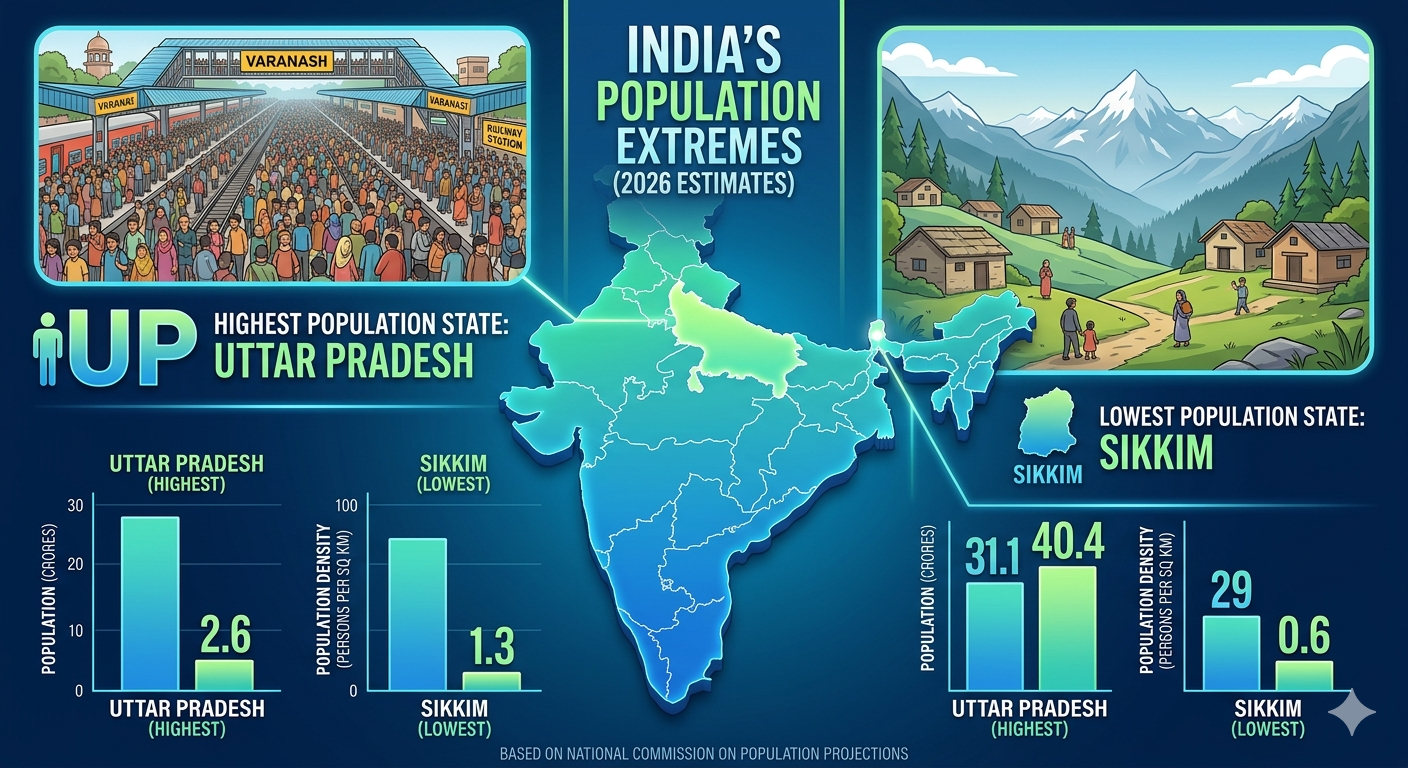
Highest population state in india – Lowest Population state in india : As of 2024–2026, Uttar Pradesh being the highest populated state with over 200 million people and Sikkim being the lowest populated state in India with around 700000 inhabitants. Uttar Pradesh has over 17% of the population in India, while Sikkim’s topography is a factor for its lower population density.
The Most & Least Populous States (Estimates 2025-2026)
Most Populous State: Uttar Pradesh (241 million)
State with the least number of population: Sikkim (703,000 to 705,000)
Key Population Data:
Most Populous: Uttar Pradesh’s population is about equal to that of Nigeria.
Least Populous: Sikkim is the least populous state, followed by Mizoram and Arunachal Pradesh.
The smallest population for a Union Territory: Lakshadweep (64000–69000)
Key Bihari and Mahrashtra: After Uttar Pradesh, the next two most populated states are Bihar and Maharashtra.
The population gap between India’s most populous state, Uttar Pradesh, and least populous state, Sikkim, is still enormous, with some 239 million more people in Uttar Pradesh than in tiny Sikkim as of 2026. Uttar Pradesh ranks high as the largest population state, and Sikkim exhibits a low population among Indian states.
Here is how that looks with the latest 2026 projections from the National Commission on Population.
| Category |
State |
Estimated Population (2026) |
Quick Fact |
| Highest Population |
Uttar Pradesh |
24.35 Crore |
Roughly the size of Brazil’s entire population. |
| Lowest Population |
Sikkim |
7.09 Lakh |
Less than the population of many individual Indian cities (like Gurgaon). |
A Closer Look: Top 3 vs. Bottom 3 States
The demographic spread can help provide context to these numbers. The top three states alone host more than 50 crore people, while the last three don’t even reach a total of 50 lakh.
Highest Population States
Uttar Pradesh: 243.5 million (17% of India’s total)
Bihar: 13.28 Crore (Recently surpassed Maharashtra for the No. 2 spot)
Maharashtra: 12.96 Crore
Lowest Population States
Sikkim: 7.09 Lakh
Mizoram: 12.75 Lakh
Goa: 16.01 Lakh
Union Territory (UT) Comparison
If you factor in Union Territories, the diversity is even starker:
UT with Highest Population: Delhi (22.6 million)
Least Populated UT: Lakshadweep (70,000)
Key Takeaway for 2026
The 2026-27 India Census officially commenced its Phase 1 (House Listing) in April, 2026. Representing the first official headcount since 2011, this massive exercise will reveal whether current estimates of dramatic northern migration hold true, as well as rapid growth in Bihar and Uttar Pradesh, stabilization in Kerala and Tamil Nadu.
Frequently Asked Questions
What is a builder-buyer agreement?
It is the core contract between you and the developer, setting the price, payment plan, area, specifications and possession date. Read it fully before signing.
What is an occupancy certificate and why does it matter?
It certifies a building is legally fit to occupy. Never take possession of a completed home without it, since it affects loans, utilities and resale.
What is mutation and why is it important?
Mutation updates the ownership in municipal and revenue records after a sale. Without it the property tax and records still point to the old owner, so get it done.
What credit score do I need for a home loan?
Lenders prefer a healthy score, usually in the mid-700s and above, for the best rates. A lower score can still get a loan but often at a higher rate.
Can I claim tax benefits on a home loan?
Yes, home-loan principal and interest carry deductions under the income tax rules, subject to limits and conditions. Confirm the current rules or ask a tax adviser.
What is the difference between freehold and leasehold?
Freehold gives you full, permanent ownership of the property and land; leasehold runs for a fixed term from an authority. Freehold is generally simpler to resell.
How do I check a builder's track record?
Look at delivered projects, delivery delays, the RERA record and buyer reviews. A builder with a clean, on-time record lowers your risk sharply.
What red flags should I watch for when buying?
Unclear title, missing approvals or RERA, pending dues, a builder with delays, and prices far below the market. If something feels rushed, slow down and verify.
What is the difference between capital appreciation and rental yield?
Appreciation is the rise in the property value over time; rental yield is the annual rent as a share of the price. Most Indian homes give modest yield and rely on appreciation.
How much should I keep as a buffer beyond the price?
Set aside for stamp duty, registration, GST where it applies, interiors, and a contingency. A buffer of a meaningful share above the base price is prudent.
Is a home loan pre-approval useful?
Yes, a pre-approved loan tells you your budget, speeds up booking and strengthens your negotiating position with sellers. Get it before you shortlist seriously.
How do I choose between two similar projects?
Compare the builder record, RERA status, carpet area, real amenities, connectivity and total cost, not just the headline price. Visit both before deciding.
What stamp duty and registration charges apply in Gurgaon and NCR?
Stamp duty and registration vary by state and are usually a few percent of the property value, with a small rebate for women buyers in many states. Confirm the current Gurgaon and NCR rate before you budget.
How much home loan can I get to buy in Gurgaon and NCR?
Most buyers get a loan for 75-90% of the value, tied to income and credit score. Our home loan by salary guide shows the ranges.
What documents do I need to buy property in Gurgaon and NCR?
Identity and address proof, PAN, income papers for a loan, and the property title chain, approvals and latest tax receipts. Keep both sides KYC ready for registration.
How do I check if a project is RERA-registered?
Search the state RERA portal by project or builder name for the registration number and approved plan. Our RERA check guide explains it.