GST on Property Purchase in India: What You Actually Pay, Explained
Ask ten people what tax they'll pay on a new flat and most will say "stamp duty", and stop there. That's only half the picture if the flat is under construction. GST applies too, on top of stamp duty, and the two are calculated completely differently, by different governments, for different reasons. Mixing them up is one of the most common budgeting mistakes first-time buyers make, and it can throw your total cost off by 5% or more of the property value.
This is exactly what you owe, when, and how to tell in advance whether a specific flat will cost you 1% extra or 5% extra in GST.
Key Takeaways
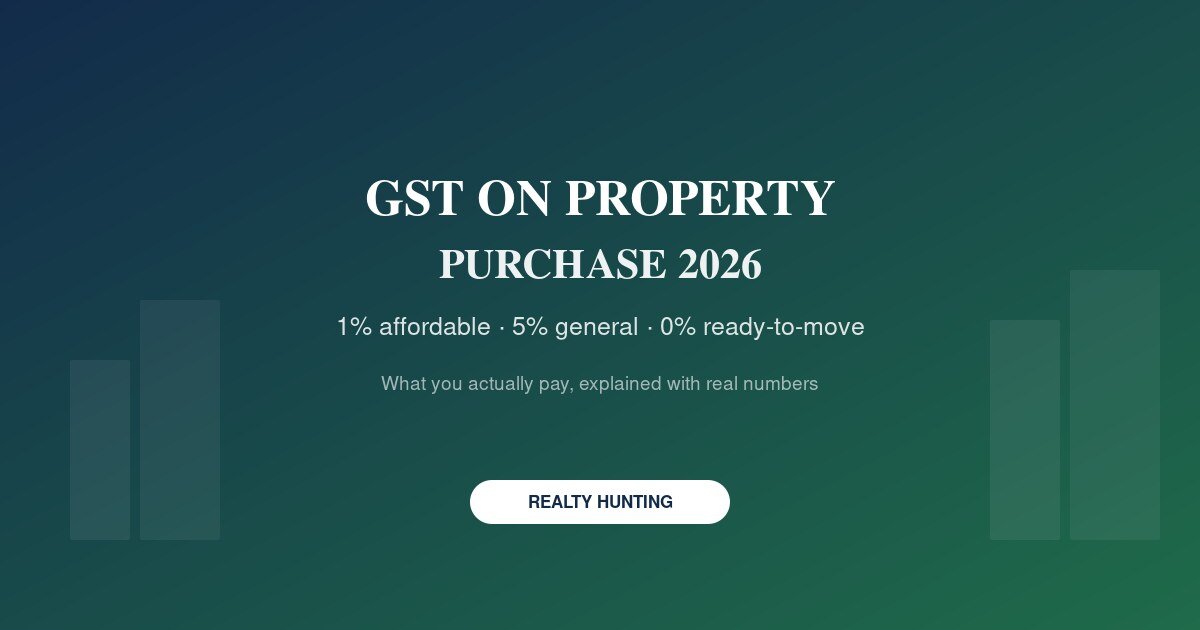
- Under-construction affordable housing: 1% GST, no input tax credit for the builder.
- Under-construction non-affordable housing: 5% GST, no input tax credit for the builder.
- Ready-to-move property with a Completion/Occupancy Certificate: 0% GST.
- Stamp duty (5–8%, state-specific) applies regardless of construction status, GST doesn't replace it.
- Under-construction commercial property (shops, offices): 12% GST, with input tax credit available to GST-registered business buyers.
GST vs Stamp Duty: Two Different Taxes
This is the single most important thing to get right. GST is a central tax charged as a service, you're essentially being taxed on the construction service the builder provides while the flat isn't finished yet. Stamp duty is a state tax charged on the transfer of property ownership itself, and it applies whether the flat is ready or under construction.
They don't substitute for each other. If you buy an under-construction flat, you pay both. If you buy a ready-to-move flat with a completion certificate, you pay only stamp duty and registration, GST doesn't apply at all.
GST Rates at a Glance
| Property Type | GST Rate | Input Tax Credit |
|---|---|---|
| Affordable housing (under construction) | 1% | None for builder |
| Non-affordable housing (under construction) | 5% | None for builder |
| Ready-to-move (with Completion/Occupancy Certificate) | 0% | Not applicable |
| Commercial property (under construction) | 12% | Available to registered business buyers |
What Counts as "Affordable Housing"
The 1% rate isn't about price alone, it's a combination of carpet area and price. A flat qualifies as affordable housing if the carpet area is up to 60 sq. metres (about 645 sq ft) in metro cities or up to 90 sq. metres (about 968 sq ft) in non-metro cities, AND the sale price is ₹45 lakh or less. Miss either condition, say, a 700 sq ft flat in Gurgaon priced at ₹42 lakh, and it falls into the 5% bracket instead, because the carpet area exceeds the metro limit even though the price qualifies.
This distinction matters more than most buyers realize. A ₹44 lakh, 55 sq metre flat and a ₹44 lakh, 65 sq metre flat can carry a ₹1.76 lakh difference in GST alone, purely because of a 10 sq metre carpet area gap.
A Real Cost Comparison
Take a ₹75 lakh under-construction 2BHK in a non-metro city, non-affordable category, in a state with 6% stamp duty:
- Base price: ₹75,00,000
- GST at 5%: ₹3,75,000
- Stamp duty at 6%: ₹4,50,000
- Registration charges (~1%): ₹75,000
- Total cost: ₹83,00,000, roughly 10.7% above the quoted flat price
Now take the same ₹75 lakh flat, but ready-to-move with a completion certificate:
- Base price: ₹75,00,000
- GST: ₹0
- Stamp duty at 6%: ₹4,50,000
- Registration charges (~1%): ₹75,000
- Total cost: ₹80,25,000, about 7% above the quoted price
That's a ₹2.75 lakh difference purely from the GST-vs-ready-to-move choice, on identical flats at identical quoted prices. This is exactly why "same price, different possession status" listings aren't actually the same deal.
Commercial Property: A Different Bracket Entirely
If you're buying office space, retail or a warehouse unit under construction, GST jumps to 12%. But if you're a GST-registered business buying it for business use, you can claim input tax credit against your own GST output liability, which materially softens the real cost. Residential buyers get no such offset regardless of the rate they pay. This is one reason pre-leased commercial and office space deals often quote returns net of GST considerations, always ask specifically how the seller has structured this before comparing yield numbers across properties.
GST on Plots and Land
A question that trips up a lot of buyers: does GST apply to a plot purchase? Sale of land itself, without any construction, is outside the scope of GST entirely, you only pay stamp duty and registration on a plot. GST enters the picture only once a developer starts constructing something on your behalf against payment, such as a builder-developed plotted layout with infrastructure works billed separately, or a bespoke construction contract. If you're comparing a plain plot against a plotted development with roads, drainage and boundary walls built by the developer, ask specifically whether the developer is billing construction/development charges separately with GST, many plotted developments do, even though the underlying land sale itself doesn't attract it.
State-Wise Stamp Duty Adds Another Layer
Because stamp duty is a state subject, the total cost on an identical flat price varies meaningfully by state even before GST is factored in. Maharashtra and Karnataka typically run 5–6% (plus a 1% metro cess in some Mumbai transactions), Haryana around 6–7% depending on gender of the buyer and urban/rural classification, Uttar Pradesh around 7% before rebates, and Delhi 4–6% depending on the buyer's gender. Many states offer a 1–2% stamp duty rebate for property registered solely in a woman's name, a detail worth checking before you decide whose name goes on the sale deed, since it's a straightforward way to reduce the non-GST portion of your total cost.
TDS on Property Purchase: A Separate Obligation Entirely
Beyond GST and stamp duty, tthis is a third deduction buyers routinely forget: TDS under Section 194-IA of the Income Tax Act. If you're buying any property (resale or new, under-construction or ready) worth ₹50 lakh or more, you as the buyer are legally required to deduct 1% TDS on the sale value and deposit it with the government before paying the balance to the seller, this applies regardless of whether GST is also charged. Miss this and you, the buyer, are liable for the shortfall plus interest and penalty, not the seller. If the seller is an NRI, the TDS obligation jumps to a flat rate under Section 195 (typically higher, often 20%+ depending on the capital gains classification and any lower-deduction certificate obtained), and this needs a separate TAN-based process rather than the simpler Form 26QB used for resident sellers. This is a genuinely common oversight, buyers budget for GST and stamp duty, then get an unpleasant surprise notice for unpaid TDS months after possession.
GST Registration Status: Why It Affects Your Price
An under-construction project's GST treatment can also depend on when the builder obtained its RERA registration and the specific rate regime it opted into. Builders can choose between the standard 5%/1% rates without input tax credit, or in specific legacy cases (older ongoing projects that began before the current GST rate structure), a different rate with ITC available to the builder, theoretically passed through as a lower price to the buyer under anti-profiteering rules, though this is now largely a legacy scenario for most 2026 launches. Practically, for any new launch you're evaluating today, assume the standard no-ITC rates (1% or 5%) apply, and ask your builder directly to confirm which regime the specific project falls under before you finalize a budget, a written confirmation in the allotment letter protects you if tthis is a dispute later.
Common Mistakes Buyers Make
Buyers frequently compare an under-construction flat's quoted price directly against a ready-to-move flat's quoted price without adding GST to the first one, which makes the under-construction option look cheaper than it actually is once all costs land. Others assume affordable housing status based on price alone, missing the carpet area condition, and get an unpleasant surprise at the time of the final demand notice. And some assume GST applies to resale (secondhand) property, it doesn't; GST only applies to a first sale by a builder/developer, not resale transactions between individuals.
FAQ
Do I pay GST on a resale flat? No. GST applies only to new construction sold directly by a builder/developer. Resale between individuals attracts stamp duty and registration only, no GST.
What GST rate applies to a ₹40 lakh flat with 50 sq metre carpet area in Mumbai? That qualifies as affordable housing (metro, under 60 sq metre, under ₹45 lakh), so 1% GST applies.
Is GST charged on the full property price or just the construction cost? It's charged on the total sale value of the under-construction unit (excluding the value of land, which is deemed to be one-third of the total and excluded by rule), effectively landing at the 1% or 5% headline rate on the agreement value.
Does a completion certificate really make that much difference? Yes, it's the single biggest lever you control. A flat with an Occupancy/Completion Certificate at possession is entirely GST-exempt. The same flat sold a few months earlier, still under construction, is not.
Can I negotiate who pays the GST, buyer or builder? GST is legally the buyer's cost, built into the price the builder quotes for an under-construction unit. It's not something builders can absorb or waive. It's a statutory levy.
Is TDS the same as GST? No, they're completely separate. TDS under Section 194-IA is a 1% income-tax deduction the buyer withholds from the seller's proceeds on any property worth ₹50 lakh+, deposited with the Income Tax Department. GST is a central tax on the builder's construction service, paid on top.
What happens if I forget to deduct TDS on a property purchase? The buyer becomes liable for the unpaid TDS amount plus interest and penalty, not the seller. This applies even on resale properties with no GST involved, so it's easy to overlook if you're focused only on stamp duty and GST.
Before you finalize any under-construction booking, ask the builder for the exact carpet area, price, and completion certificate status in writing, it changes your real cost by lakhs. Browse new-launch and residential listings on Realty Hunting, or talk to us and we'll help you work out the true landed cost before you sign anything.
Is a home loan pre-approval useful?
Yes, a pre-approved loan tells you your budget, speeds up booking and strengthens your negotiating position with sellers. Get it before you shortlist seriously.
How do I choose between two similar projects?
Compare the builder record, RERA status, carpet area, real amenities, connectivity and total cost, not just the headline price. Visit both before deciding.
What stamp duty and registration charges apply in Gurgaon and NCR?
Stamp duty and registration vary by state and are usually a few percent of the property value, with a small rebate for women buyers in many states. Confirm the current Gurgaon and NCR rate before you budget.
How much home loan can I get to buy in Gurgaon and NCR?
Most buyers get a loan for 75-90% of the value, tied to income and credit score. Our home loan by salary guide shows the ranges.
What documents do I need to buy property in Gurgaon and NCR?
Identity and address proof, PAN, income papers for a loan, and the property title chain, approvals and latest tax receipts. Keep both sides KYC ready for registration.
How do I check if a project is RERA-registered?
Search the state RERA portal by project or builder name for the registration number and approved plan. Our RERA check guide explains it.
Can NRIs buy property in Gurgaon and NCR?
Yes, NRIs can buy residential and commercial property in India, though not farm land. Payments must come through banking channels, and a trusted power of attorney helps if you are abroad.
What taxes apply when I sell property in Gurgaon and NCR?
You pay capital gains tax on the profit, lower if you hold beyond the long-term period, with reliefs if you reinvest in another home. Take advice before you sell.
Is it a good time to buy in Gurgaon and NCR?
Timing matters less than buying the right property at a fair price with clean papers. If a home fits your budget and needs, waiting for a perfect market rarely pays.
How do I verify a property title in Gurgaon and NCR?
Check the chain of ownership, the latest record, any loan or lien and pending dues, and match the seller identity to the title. A local lawyer can vet the deed.
What should I check during a site visit in Gurgaon and NCR?
Construction quality, water and power backup, the neighbourhood, road access, and how the actual unit compares to the brochure. Visit at different times of day if you can.
Can I negotiate the price in Gurgaon and NCR?
Resale and ready inventory are usually negotiable, while fresh launches have fixed rates but may waive some charges. Compare recent deals nearby to judge a fair price.
What is the difference between carpet area and super area?
Carpet area is the usable space inside your walls; super area adds a share of common areas. Always confirm the carpet area you actually get before comparing prices.
What extra costs come beyond the price in Gurgaon and NCR?
Budget for stamp duty and registration, GST on under-construction homes, parking, club and maintenance deposits, and loan fees. Ask for a full cost sheet upfront.
How does Realty Hunting help me buy in Gurgaon and NCR?
We share verified listings, honest area advice and the real paperwork picture, and connect you with builders and sellers. Reach out and we will shortlist options that fit your budget.
Should I buy ready-to-move or under-construction in Gurgaon and NCR?
Ready homes have no wait, no GST and no build risk but cost more; under-construction is cheaper with a longer wait. Choose by your timeline and risk appetite.