Delhi Metro expansion Plans 7 New Corridors, 65 Stations
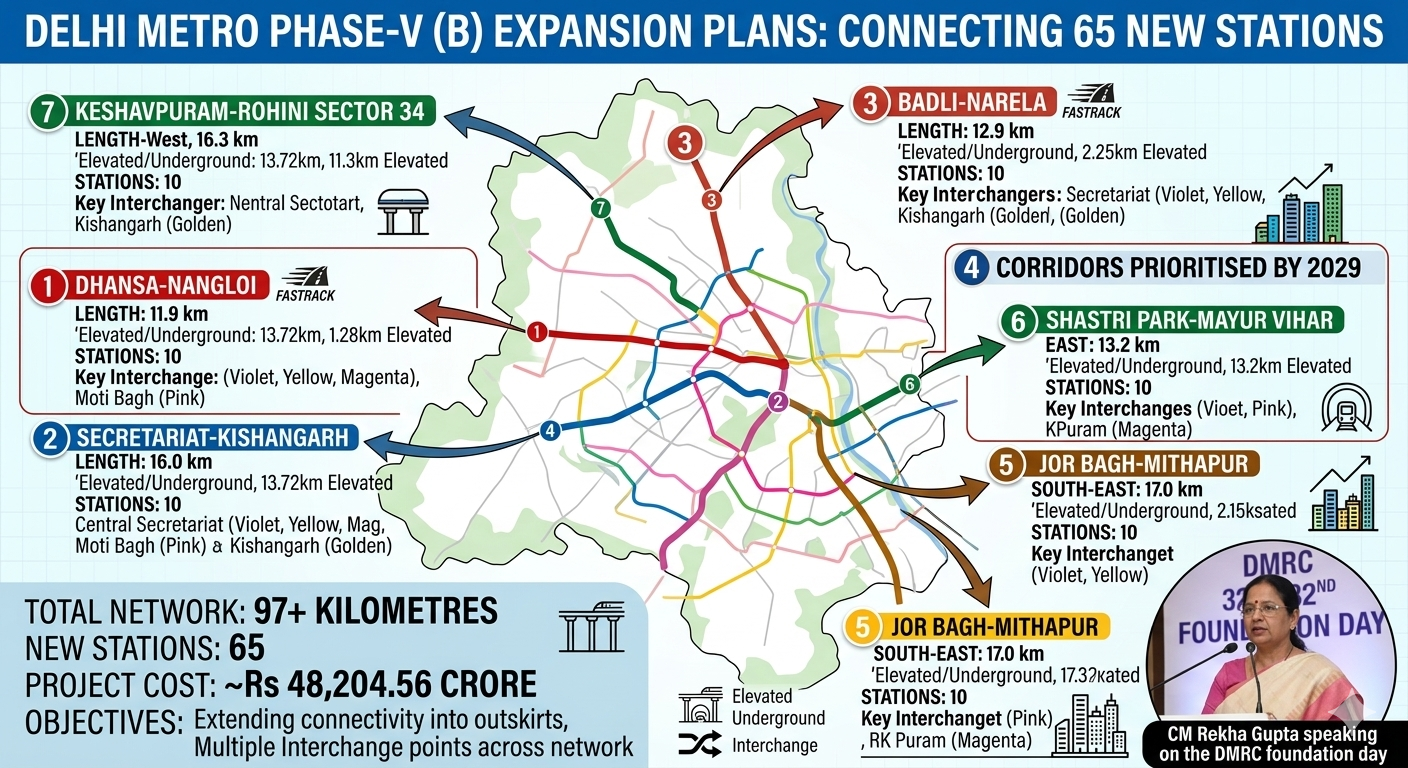
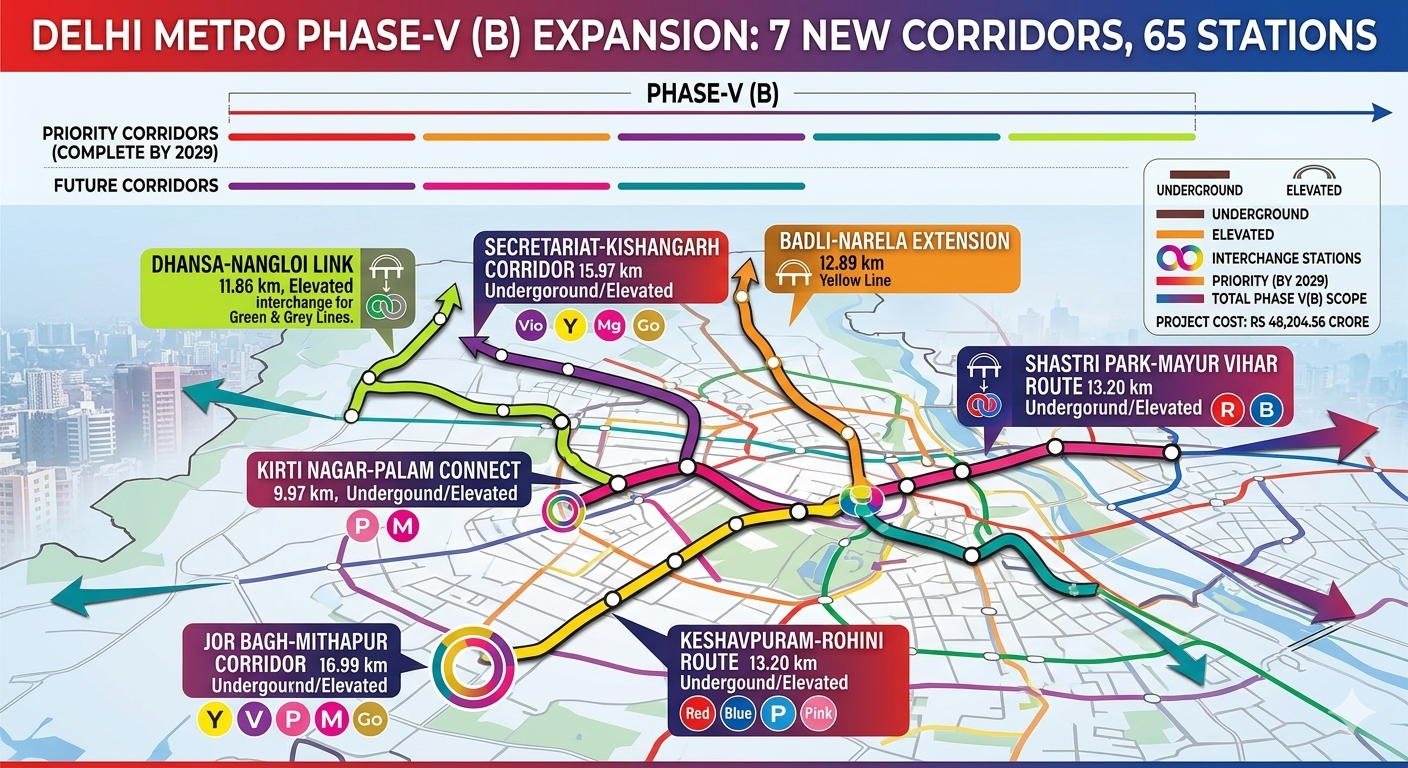
Delhi Metro expansion Plans 7 New Corridors, 65 Stations : 7 new corridors of Total length 97 Km with 65 stations planned under phase-V (B) in Delhi ↓ DELHI: Major expansion plan for metro network in Delhi. These corridors have been identified for completion by 2029 and priority has been given to four of these, officials said on Sunday.
The state government is open for new development projects: Delhi Chief Minister Talking about the decision at the 32nd foundation day of the Delhi Metro Rail Corporation at Maulana Azad stadium, the CM Rekha Gupta said that other three corridors would be developed in next phases. The project is estimated to cost a total of Rs 48,204.56 crore.
The expansion will take the metro deeper into peripheral and fast-developing areas of the city, while also including a number of interchange points throughout the network.
Southwest Delhi Link: Dhansa-Nangloi Corridor
The 11.859 km fully-elevated corridor will extend from Dhansa Bus Stand in Najafgarh to Nangloi with nine stations on the stretch. From there it will go through Ranhola, Baprola, Dichaon Kalan and Najafgarh Extension. An interchange will be available at both Nangloi (Green Line) and Dhansa Bus Stand (Grey Line).
Central Delhi Access: Secretariat-Kishangarh Corridor
The corridor will mostly be subterranean (13.721 km) with a 2.248 km section elevated It will include 10 stations, linking RK Puram, New Moti Bagh, Jawaharlal Nehru University and local institutional and residential pockets. The interchange points will be at Central Secretariat (Violet, Yellow and Magenta lines), Moti Bagh (Pink Line), RK Puram (Magenta Line) and Kishangarh (Golden Line).
North Delhi Extension: Badli-Narela Corridor
To run a total length of 12.89 Km spanning Siraspur, Khera Kalan, Holambi Kalan, Alipur and Narela DSIIDC area, the extension will be fully elevated with eight stations for the Yellow Line. Siraspur (Yellow Line) interchange facility and Narela DDA Sports Complex (Red Line) will have interchange facilities.
Extent: WestDelhi Connectivity: Kirti Nagar-Palam Corridor
Comprising 8.397 kilometres of underground and 1.57 kilometres of elevated sections, the 9.967-kilometre corridor will be made up of six stations. Saraswati Garden, Mayapuri Industrial Area Phase III, IITM Janakpuri and Sagarpur. Also, interchange at Mayapuri (Pink Line) and Palam (Magenta Line).
South-East Link: Jor Bagh-Mithapur Corridor
Twelve stations, seven underground and five elevated, will be built along this 16.991-kilometre standalone corridor. It will link Lodhi Colony, Old Ishwar Nagar, Ali Village, Jaitpur, Moladband and Mithapur. Interchange locations will also be at: Lajpat Nagar (Violet and Pink lines), Jasola Apollo(Metrorail Violet Line) and Madanpur Khadar (Golden Line extension).
East Delhi Route : Mayur Vihar Corridor, Shastri Park
The corridor of 13.197 kilometres will consist of underground (8.99 km) and elevated (4.207 km) stretches, featuring eight stations in total. Passing through Geeta Colony, Gandhi Nagar market, Kailash Nagar, Patparganj (Mother Dairy), New Kondli and Mayur Vihar Phase III. You will also get interchanges at Shastri Park (Red Line), Nirman Vihar (Blue Line) and Trilokpuri (Pink Line).
North-West Corridor: Keshavpuram-Rohini Sector 34
The corridor, which will be fully elevated and is a little over 16.285 kilometres long, will have 12 stations connecting Pitampura, Rohini etc with Delhi Technological University and Rohini Sector 29 amongst others. There will be interchange facilities at North Pitampura (Pink Line) and Rohini Sector 34 (Red Line) alongside Keshavpuram (Red Line).
Four Corridors Nurtured For Quick Execution
Officials have said that of the seven corridors identified, four had to be taken up on a fast track basis and completed by 2029. The other three will be dealt with in later schedules.
The Delhi Metro Rail Corporation has been asked to formulate additional Detailed Project Reports in two packages, distinguished between priority and non-priority corridors.