Budget 2026: Real Estate : Memoirs of the Union Budget 2026, which was presented by Finance Minister Nirmala Sitharaman on February 1, 2026 will not just be about unanticipated changes (or lack thereof) in tax demands or reliefs but is also indicative economic policy aspirations towards infrastructure-led growth and perhaps institutional stability over immediate aggressive tax breaks for individual buyers.
And while it didn’t directly meet the industry’s big “asks” – such as lifting the cap on home loan interest deduction – the budget sets a long-term agenda that could advance both urban development and asset recycling.
🏗️ Key Highlights for the Real Estate Sector
1. Infrastructure & Connectivity Push
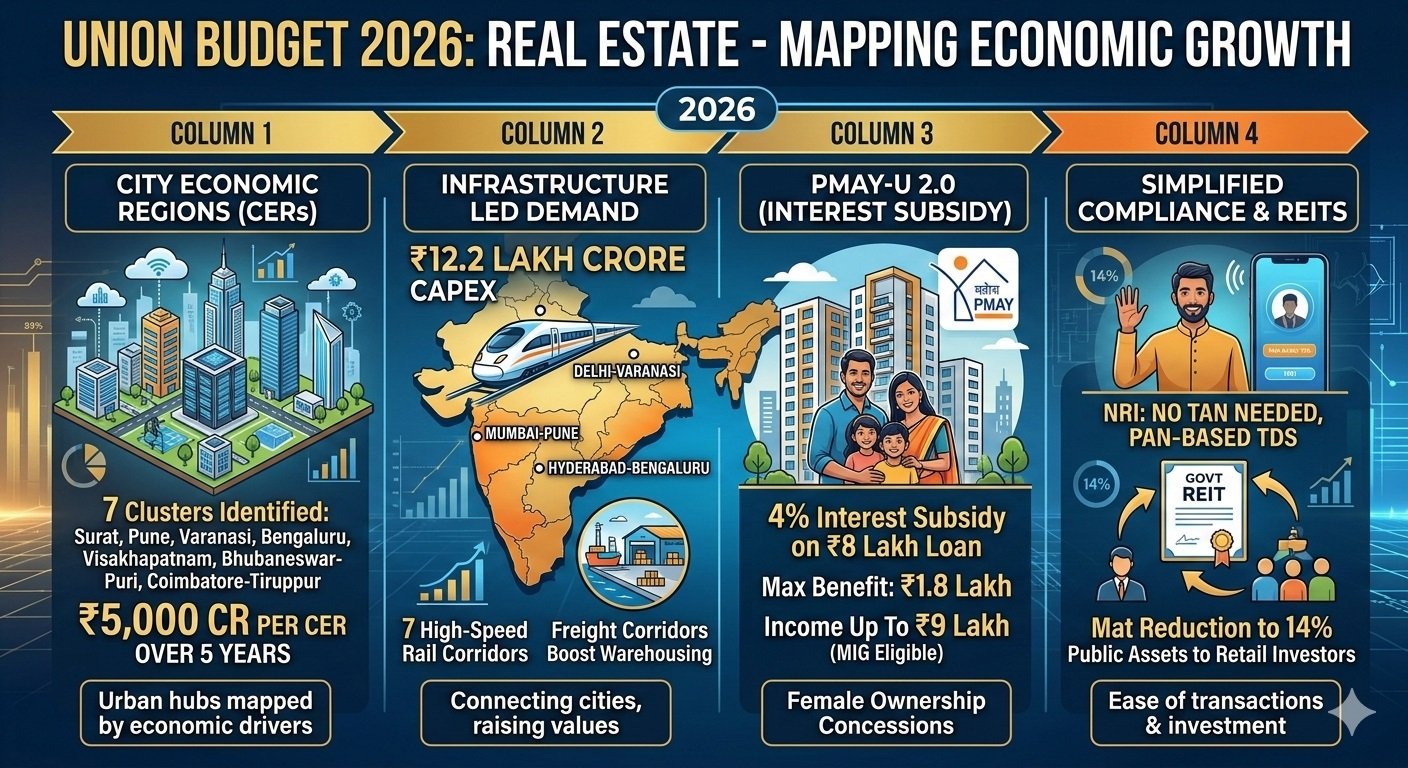
The government increased the Capital Expenditure (CAPEX) outlay to ₹12.2 lakh crore.
-
Impact: A massive portion is dedicated to urban transport, high-speed rail corridors, and highways.
-
Real Estate Angle: Improved connectivity directly boosts land values and project feasibility in emerging micro-markets, particularly along transit corridors.
2. Focus on Tier-2 and Tier-3 Cities
The introduction of City Economic Regions (CERs) is a game-changer for smaller cities.
-
The Plan: Each CER (cities with 5 lakh+ population) is slated to receive ₹5,000 crore over five years.
-
Goal: To create self-sustaining urban hubs with integrated residential and commercial zones, easing the pressure on saturated metros.
3. Monetization via REITs
The budget proposes a major push to recycle real estate assets held by Central Public Sector Enterprises (CPSEs) through dedicated Real Estate Investment Trusts (REITs).
-
For Investors: This opens up high-quality, government-backed commercial assets (offices, warehouses) to retail investors.
-
For the Market: It increases liquidity and transparency in the commercial sector.
4. Relief for NRIs
The compliance burden for Non-Resident Indians (NRIs) has been simplified.
-
TDS Ease: Starting October 2026, buyers of NRI property will no longer need a TAN (Tax Deduction Account Number) for TDS. A PAN-based challan will suffice, reducing procedural delays in transactions.
🏠 Impact on Homebuyers & Developers
| Feature | Status in Budget 2026 |
| Home Loan Interest (Sec 24b) | Remains capped at ₹2 lakh (no increase). |
| Affordable Housing Cap | No change to the ₹45 lakh price cap (a major industry disappointment). |
| MAT for Developers | Reduced from 15% to 14%, providing slight relief to corporate developers. |
| PAN Requirement | Draft rules suggest raising the PAN-quoting threshold for property deals to ₹20 lakh (from ₹10 lakh). |
📉 What was Missed?
Despite strong lobbying from bodies like CREDAI and NAREDCO:
-
No “Industry Status”: The real estate sector still lacks formal “Industry” status, which would have allowed for cheaper credit.
-
Affordable Housing Slump: There were no fresh interest subvention schemes or tax holidays for developers building low-cost homes, despite a falling market share for affordable housing.
Note: While the New Tax Regime is being heavily promoted for its simplicity, most housing-related deductions (like Section 24b and 80C) still yield the best results under the Old Tax Regime.
The budget for 2026-27 is a “macro”-level budget for the real estate sector. It avoids direct subsidies, preferring to gamble on infrastructure-driven demand. The government’s thinking is that if you build the metro, the highway and the tech hub, housing demand will come naturally.
Here are the granular details by the four primary pillars of the sector:
TEL US TECO (The Eco-lighthouse Expansion in Form of UTC System) Urban Development & The — “CER” Model
This is the turning point from Smart Cities to City Economic Regions (CERs).
The Investment – For cities with a population of more than 5 lakh, ₹5,000 crore per region is being invested by the government in five years.
The Target — These areas shall be mapped in accordance with their relevant flourishing boosters (Say: A location will get mapped for “Manufacturing” vs. “Tourism”).
Real Estate Impact: This paves the way for “planned urban clusters”, where residential and commercial hubs are integrated from day one, resulting in organized township projects to come up in Tier-2 cities such as Indore, Coimbatore or Lucknow.
PMAY (Pradhan Mantri Awas Yojana) News
The fund allocation for the flagship housing scheme drew mixed reactions over utilization issues.
PMAY-Urban 2.0: ₹18,625 crore allocated (a marginal dip of ~6% over previous budget estimates) But the government signaled that money can be ramped up if execution accelerates.
PMAY-Gramin: Boosted by ₹54,917 crore (from ₹15,000 crore 10 years ago) — target of another 2 crore houses.
The “Gap”: The industry was expecting the hike in affordable housing price cap, from ₹45 lakh to ₹75 lakh. It didn’t happen. This is still a significant pain point for developers in metros.
Financial & Tax Reforms
There were no changes to income tax slabs for home-buys, but two “procedural” changes will affect how you buy and sell:
Increase Property Deal PAN Quoting Limit: As per the Draft Income Tax Rules 2026, the limit for mandatory quoting of Permanent Account Number (PAN) is proposed to be increased from ₹10 lakh to ₹20 lakh in property deals. This is a huge administrative relief for small-ticket buyers in rural and semi-urban areas.
Infrastructure Risk Guarantee Fund: A new fund will be established to provide credit guarantees for large projects. This is intended to reduce developers’ borrowing costs, possibly (in theory) stabilizing property prices.
MAT Reduction: The MAT [Minimum Alternate Tax] was reduced from 15% to 14%, a modest but welcome margin booster for corporate real estate companies.
The Commercial & Investment Landscape
The government is trying to divest its own real estate holdings to pay for new projects.
CPSE Asset Monetization: “Recycling” of public sector land and buildings, through dedicated Government-backed REITs.
Retail Opportunity: Allows retail investors to purchase “units” of prime government-owned commercial assets which serves as safer, liquid alternative to buying actual shops or offices
Logistics & Warehousing: The government has recently announced 7 new high-speed rail corridors along with the Surat-Dankuni freight corridor announcement, which could cause a spike in demand for warehouses at intersections along these routes.
Summary Table: Winners vs. Losers
| Winners 🏆 | Losers 📉 |
| Tier-2/3 City Developers (Benefit from CERs) | Affordable Housing Buyers (No new tax breaks) |
| REIT Investors (More high-quality asset options) | Luxury Segment (No change in high stamp duties) |
| NRIs (Simplified PAN-based TDS process) | First-time Buyers (₹2 lakh interest cap remains) |
| Logistics/Industrial Parks (Huge infra spend) | Metro Urban Centers (Saturation issues not addressed) |
Beyond those sweeping strokes, the “fine print” of Budget 2026 offers up several practical adjustments that affect both your wallet and your property decisions. Most common FAQs on the latest 2026-27 provisions.
💰 Taxes & Home Loans
Q: Is home loan interest deduction available in the New Tax Regime?
A: No. Industries had lobbied heavily for the Section 24(b) deduction (₹2 lakh + one-time payment as high as possible) and also for Section 80C (₹1.5 lakh principal), but these remain exclusive to the Old Tax Regime till October 2023. If your mortgage is significant, the Old Regime generally still will be less tax-inefficient for you.
Q: Is there additional benefit for first-time homebuyers?
A: Not in this budget. The highest deduction of ₹1.5 lakh under Section 80EEA was not reintroduced. It currently covers only loans sanctioned between April 1, 2019 and March 31, 2022.
Q: What does the new “PAN-only” rule mean in terms of NRIs?
A: Earlier, when you bought property from an NRI, that TDS would need to be deposited using a TAN (Tax Deduction Account Number). This is eliminated as of October 1, 2026. This is a visible simplification and paperwork reduction for buyers as TDS can be paid using PAN now.
🏢 Investment & REITs
Q: What is this all about new “Government REITs” thing now?
Q: What is the government planning for its land and assets?
The Good: You, as a retail investor, can purchase units of these REITs. It’s like owning a “share” of an office building leased by the government and collecting regular dividends from its rent.
Q: What happened to Capital Gains tax for property?
A: There were no large jumps in the base rate for property. But the budget also brought tighter timeframes for reinvesting gains. If you sell a house and want to deduct the tax on buying another (Section 54), make sure that your new property is completed within this stipulated s3 years window because the 2026 rules are far more stringent with respect to “actual possession” vis-a-vis just allotment, than section 54.
📍 PMAY-U 2.0 (Pradhan Mantri Awas Yojana)
Q: In 2026, who qualifies for the Interest Subsidy Scheme (ISS)?
A: Families earning up to ₹9 lakh a year (MIG category) are eligible under PMAY-U 2.0.
The Subsidy: There is a 4% interest subsidy available on the first ₹8 lakh of your loan.
Max Benefit: Bow low — about ₹1.8 lakh, which will directly refund your loan account to bring down your EMI
Q: Is there any Carpet Area limit for the subsidy?
A: Yes. The house should not be more than 120 square meters (approx. 1,290 sq. ft.) in carpet area.
📈 Market Outlook
Q: Will the price of property increase due to Budget 2026?
A: Not directly because of taxes, but indirectly because of infrastructure. 2026-27 ₹12.2 lakh crore CAPEX is very metro centric on 7 new high-speed rail corridors The regions within a 2–3 km-jurisdiction of these new transit spots would witness maximum capital appreciation in the next 18-24 months.
Q: What are City Economic Regions (CERs)?
A: How do you envision them, exactly? The government has already earmarked ₹5,000 crore each to clusters of Tier-2 cities for internal roads, waste management and business hubs. Currently, long-term investment (5+ years) in these zones are the “hot zones” for land and residential plots.
Various technical and procedural changes were introduced as part of the 2026 Union Budget which will not have made headlines but will impact how you plan your property journey.
Here is some of the key “deep-dive” FAQs relevant to the 2026-27 provisions.
🏛️ Regulatory & Transactional FAQs
Q: What are the updated rules regarding property purchase from NRI?
A: This is a huge amount of administrative relief. Earlier, when a buyer was also an NRI seller then the buyers were required to obtain TAN (Tax Deduction Account Number) in order to deposit TDS.
The Change: From 1st October,2026 onwards a PAN based challan can be used in place of TAN. This eliminates a big layer of paperwork and potential delay in the registration process.
Q: Has property deal PAN threshold been revised?
A: Yes, according to the amended 2026 Income Tax Rules, the limit of quoting a PAN for property transactions will be raised from ₹10 lakh to ₹20 lakh. This largely aids small buyers from semi-urban cities in decreasing their compliance burden.
Q: What do you mean by “5-Year Construction Rule” for tax deductions?
A: To avail full ₹2 lakh interest deduction under Section 24(b) for self-occupied property, the construction of property should have been completed within five years from end of financial year in which loan was availed.
Budget 2026 Clarification: The budget also clarified that “pre-construction interest” (interest paid before you got possession) is also capped at the same ₹2 lakh annual limit after you move in.
🏗️ City & Regional Development Questions
Q: What are the new “City Economic Regions” (CER)?
A: Which initial clusters have been identified by the government that will get ₹5,000 crore each over next five years? So here are some of the best places for long-term real estate investment:
Surat (Gujarat)
Varanasi (Uttar Pradesh)
Visakhapatnam (Andhra Pradesh)
Bengaluru (Karnataka)
Bhubaneswar-Puri-Cuttack (Odisha Tricity)
Coimbatore-Erode-Tiruppur (Tamil Nadu cluster)
Pune (Maharashtra)
Q: What are “University Townships”?
A: Budget 2026 states that 5 University Townships will be established near major industrial and logistics corridors. These will be integrated campuses with colleges, research centers as well as residential complexes, which has created a new segment for investments in Student Housing.
🏠 PMAY-U 2.0 (Subsidy) FAQs
Q: What is the maximum subsidy I can avail myself under PMAY-U 2.0 in 2026?
A: The Interest Subsidy Scheme (ISS) provides a 4% interest subsidy on loan amount up to ₹8 lakh.
Total Benefit: Approximately ₹1.8 lakh.
Payment Mode: This is 06 credited to your account in 05 (five) equal installments of ₹36,000 each annually (if the Loan account is active and regular).
Q: What are the property value and size limits of PMAY-U 2.0?
A: The property must also satisfy these criteria to qualify:
Max House Value: ₹35 lakh.
Max Loan Amount: ₹25 lakh.
Max carpet area: 120 sq m (approx. 1,290 sq. ft.).
Evidence: Most, if not all, countries require mandatory female (co)ownership.
📉 Capital Gains & REITs
Q: Can I save tax by reinvesting, even after selling my property?
Q: Yes, Sections 54 and 54F (reinvestment into a new house) is still intact. But the budget stressed adherence to timelines. You need to purchase the new home within 1 year preceding sale and 2 years following the sale or construct it in three. The tax department has now leveraged automated systems to track these ‘completion certificates’.
Q: Should I invest in physical property or the new CPSEs REITs?
A: * Physical Property: High leverage (loans) and “usage” value with low liquidity and high entry.
CPSE REITs: These were introduced in Budget 2026 to monetise government land. In general they present regular dividends (approx 90% of rental income), and high liquidity (they can be sold just like stocks). This is again great if you are looking for exposure to real estate with as less as ₹15,000–₹20,000.
As we advance further into the 2026-27 fiscal year, the “fine print” of the budget has removed a few doubts for homebuyers and investors. FAQs on Capital Gains, GST and PMAY-U 2.0 specifics – Part 3
📈 Capital Gains and Selling Property
Q: What’s the last word on LTCG (Long-Term Capital Gains) for property in 2026?
A: The 2026 Budget retains a simplified structure first introduced last year.
Rate: 12.5% flat rate with no indexation benefits for assets held more than 24 months
The Grandfathering Option – If you purchased your property before July 23, 2024, they have a choice of taxation (12.5% gaining no indexation or 20 % with indexation) whichever benefits the buyer financially.
Exemption Limit: The overall exemption under Sections 54 to 54F (by reinvesting in a new house) will continue to be subject to a cap of ₹10 crore.
Q: Can I still save tax through purchase of 54EC Bonds?
A: Yes. You may buy specified bonds (NHAI, REC, etc.) (₹50 lakh) within 6 months of sale to be exempted from such Capital Gains. These bonds come with a mandatory lock-in period of 5 years.
🛒 GST on Flat Purchases
Q: Will I have to pay GST for ‘Ready-to-Move’ flat in 2026?
A: No. Zero GST if the building gets a CC/OC before you sign the sale agreement This means that in terms of tax, ready-to-move properties are about 5% cheaper than under-construction ones.
Q: What is the applicable GST on under-construction homes currently?
A: The rates stay uniform under the “GST 2.0” model:
Affordable Housing: 1% (No ITC)
Criteria: Value $\le$ ₹45 Lakh AND Carpet Area $\le$ 60 sqm (Metros) or 90 ¬sqm (Non-Metros).
General/Luxury Housing: 5% (No ITC)
Commercial Property: 12% (Available input tax credit to the owner).
🏘️ PMAY-U 2.0 (The New Housing Subsidy)
Q: Is the income limit for the subsidy really ₹9 lakh?
A: Yes, under the ISS (Interest Subsidy Scheme) vertical of PMAY-U 2.0:
EWS: Income of ₹3 lakh or below annually
LIG: ₹3 lakh to ₹6 lakh.
MIG: ₹6 lakh to ₹9 lakh.
Note: All three categories are entitled to the same 4% interest benefit on a loan amount of up to ₹8 lakh.
Q: Is the “Female Ownership” rule still in effect?
A: To avail the benefits for EWS and LIG categories, it is mandatory that the title of the house be either in the name of a female member or jointly. In the MIG category, female ownership is strongly encouraged but not mandatory for them to obtain a subsidy (though they are still better off financially taking advantage of local stamp duty concessions).
🏢 Rental & Commercial Real Estate
Q: Do I have to pay GST on rent if it is a residential property?
A: Only if you are GST-registered (typically, a business) and use the property for commercial purposes. So if you are a person renting a flat for personal stay, GST is not applicable to the rent paid by you — whether you pay ₹ 500 or ₹ 5 crores.
Q: What is the 2026 “RCM” rule that developers must know?
A: Builders are now required to pay GST on inputs (such as cement or sand) under the Reverse Charge Mechanism (RCM) if they purchase from unregistered local vendors. This will force some order on the supply chain, but will also add a small (1-2%) premium to base prices as developers pass through these compliance costs.
🏗️ The “New Urban” Strategy
Q: What on earth is a “City Economic Region” (CER) and why should I care?
A: Unlike the previous “Smart Cities”, a CER is a high-investment zone (₹5,000 crore budget each), which is instituted to create an economic core.
The Opportunity: As you purchase property in the 7 planned clusters, be it Surat, Varanasi, Visakhapatnam, Bengaluru, Pune, Bhubaneswar-Puri-Cuttack or Coimbatore-Erode-Tiruppur you are actually investing into promising cities with guaranteed road drainage and medical hub funding.
The Strategy: Government is “mapping” these by growth engines (e.g., Pune for Tech/Auto, Varanasi for Tourism)
Q: What are the “University Townships” in the budget?
A: The govt is creating 5 new University Townships along industrial corridors.
Investment Angle: This breaks for investors looking ahead, Student Housing and Co-living units within these circle when built will have a captive rental market filled with students and research persons from outside of the state.
🧓 Special Segments: Senior Living
Q: Is there relief for Senior Citizen housing?
A: The sector did not get an all-important “Infrastructure Status,” but the budget offered to derive Senior Living support from pension schemes.
The plan: New rules are being prepared that will allow retirees to spend up to “Assisted Living” expenses out of their pension corpus.
Developer Push: Building incentives are being sounded out for any builder who commits at least 20 percent of a project to senior-friendly designs (ramps, emergency buttons, medical centers).
⚖️ Builder Accountability & RERA
Q: What if my builder puts me behind schedule in 2026?
A: Homebuyer bodies (including FPCE) lobbied for a “penalty parity” rule.
The Proposal: In the scenario where a promoter misses a timeline, the budget proposes that total EMIs received by the promoter during that year should be added back to their profit calculations for tax purposes.
Impact: It makes such “hoarding” of homebuyer money and delaying of projects a very costly tax liability to developers.
Q: Has the RERA budget increased?
A: Yes. The budget for the Ministry of Housing and Urban Affairs is also increased to expedite Single-Window Clearances. The aim is to fully digitise the sign-off process so that “no permissions” is no longer an acceptable reason for builder hold-ups.
📊 Summary Comparison: Budget 2025 vs. 2026
| Feature | Budget 2025 | Budget 2026 |
| Urban Focus | General Infrastructure | City Economic Regions (CERs) |
| PMAY Goal | Closing PMAY 1.0 | PMAY-U 2.0 (1 Crore houses) |
| NRI Compliance | TAN mandatory | PAN-based (No TAN needed) |
| CAPEX Outlay | ₹11.1 Lakh Cr | ₹12.2 Lakh Cr |
| High-Speed Rail | Planning Stage | 7 New Corridors Approved |
The Union Budget 2026-27, delivered on February 1, 2026, focuses on “Mapping City Economic Regions” and simplifying compliance for investors. Here is the latest round of FAQs reflecting the finalized provisions.
🏛️ Regulatory & Transactional FAQs
Q: What is the new “PAN-only” rule for buying property from an NRI?
A: This is a major relief for individual buyers. Effective October 1, 2026, the requirement for a TAN (Tax Deduction and Collection Account Number) to deposit TDS on property bought from an NRI has been removed. You can now use a PAN-based challan for reporting and payment, significantly reducing procedural friction.
Q: Has the threshold for mandatory PAN in property deals changed?
A: Yes. Under the revised 2026 Income Tax Rules, the threshold for quoting a PAN in property transactions has increased from ₹10 lakh to ₹20 lakh. This primarily helps small-scale buyers in semi-urban areas and rural markets by reducing their compliance burden.
💰 Taxes & Home Loans
Q: What is the final word on LTCG (Long-Term Capital Gains) for property?
A: The 2026 Budget maintains the simplified structure from 2024:
-
Rate: Flat 12.5% without indexation benefits for properties held over 24 months.
-
The “Grandfather” Option: If you bought your property before July 23, 2024, you can still choose between 12.5% (no indexation) or 20% (with indexation), whichever results in lower tax.
-
Reinvestment: The exemption cap under Sections 54 to 54F remains at ₹10 crore.
Q: Can I claim home loan deductions in the New Tax Regime?
A: Generally, no. Interest (Section 24b) and Principal (Section 80C) deductions are only available in the Old Tax Regime. However, if you have a let-out (rented) property, you can still claim the interest deduction under the New Tax Regime to set it off against rental income.
🏗️ City & Regional Development FAQs
Q: Which cities are being developed as “City Economic Regions” (CER)?
A: The government has allocated ₹5,000 crore per CER over five years to transform Tier-2 and Tier-3 cities into self-sustaining hubs. The initially identified clusters focus on regional strengths:
-
Industrial/Tech: Bengaluru, Pune, and Coimbatore-Erode-Tiruppur.
-
Heritage/Tourism: Varanasi and Bhubaneswar-Puri-Cuttack.
-
Logistics/Trade: Surat and Visakhapatnam.
Q: What are the “7 High-Speed Rail Corridors”?
A: These corridors are expected to become the new “growth veins” for real estate. Key segments include Mumbai-Pune, Pune-Hyderabad, Hyderabad-Bengaluru, Delhi-Varanasi, and Varanasi-Siliguri. Land prices along these proposed routes are already seeing speculative interest.
🏠 PMAY-U 2.0 (Housing Subsidy)
Q: How much is the actual subsidy in 2026?
A: Under PMAY-U 2.0, the Interest Subsidy Scheme (ISS) provides a 4% interest subsidy on a loan amount up to ₹8 lakh.
-
Maximum Benefit: ₹1.8 lakh, credited to the borrower’s account in five annual installments.
-
Eligibility: Families with annual income up to ₹9 lakh (MIG), provided they do not own a pucca house anywhere in India.
Q: Are there size limits for the house?
A: Yes. To qualify for the PMAY-U 2.0 subsidy, the maximum carpet area allowed is 120 square meters (approx. 1,290 sq. ft.).