Real Estate Payment Plans: Down Payment vs CLP vs PLP
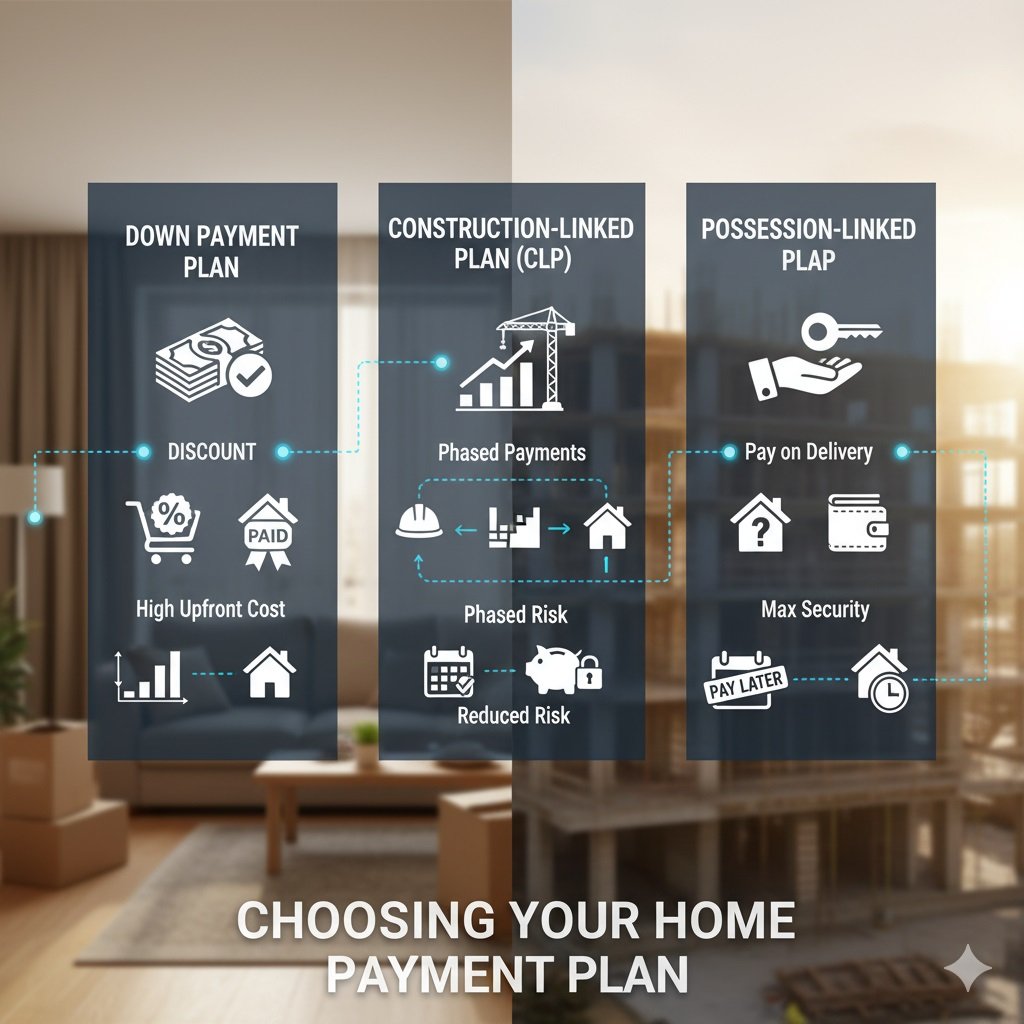
When you buy a flat that is still being built, the builder gives you a schedule for paying the price. Most schedules are one of three kinds: a down payment plan, a construction-linked plan (CLP) or a possession-linked plan (PLP). The flat can be the same in all three. What changes is how much of your money is with the builder before the flat exists, and how much loan interest you pay while you wait.
A correction. An earlier version of this page had been run through a word-swapping tool, so many of its sentences did not read properly, and it gave no source for its rules. This version is new. The rules below come from the RERA Act and the orders and reports named at the end.
The three plans side by side
| Plan | What you pay early | When the rest is due | Your money at risk if work stops |
|---|---|---|---|
| Down payment plan | Most of the price, soon after the agreement for sale is signed | A small balance at possession | High: nearly all of it |
| Construction-linked plan (CLP) | Up to 10% before the registered agreement, then a share at each stage of work | Stage by stage: foundation, floor slabs, brickwork, finishing, possession | Medium: what you have paid for the stages already built |
| Possession-linked plan (PLP) | A first payment, sometimes one or two more | Most of the price at possession | Low, but a large sum falls due at once |
The exact percentages differ from project to project. The schedule that binds the builder is the one in your agreement for sale, not the one in the brochure.
What the law allows
No more than 10% before a registered agreement. Section 13(1) of the Real Estate (Regulation and Development) Act, 2016 says a builder cannot take more than 10% of the cost of a flat, plot or building as an advance or application fee before signing a written agreement for sale with you and registering it. This applies to every plan. Regulators enforce it: Haryana RERA has reminded developers of the limit, and Goa RERA fined a builder ₹5 lakh for taking more.
Your money goes into a separate account. Under Section 4(2)(l)(D) of the Act, 70% of what buyers pay for a registered project must be kept in a separate bank account for that project. The builder can withdraw from it only in proportion to the work done, and each withdrawal needs a certificate from an engineer, an architect and a chartered accountant.
The project page shows the progress. Section 11 makes the builder update the project's page on the RERA website every quarter: flats booked, approvals and the status of the work. Before you pay a stage demand, you can compare it with what the builder has filed.
Interest is the same both ways. The Act defines interest so that the rate a builder charges you for a late payment is the rate it must pay you for a late possession. In Haryana, Rule 15 of the state's RERA rules sets that rate at the State Bank of India's highest marginal cost of lending rate plus 2%. HRERA's orders work the rate out as on the date of each order, so it moves with the bank's rate.
Down payment plan
You pay most of the price at the start, usually soon after the agreement is signed. In return the builder often offers a lower price. The size of that discount is not fixed by any rule, so ask for it in writing and check that the agreement shows the lower price.
The risk is plain: almost all of your money is with the builder before the building is up. If the project is delayed, you can claim interest or a refund under Section 18 of the Act, but getting the money back can take years. This plan suits a project that is close to completion, or a builder whose past projects you have checked on the RERA website and found finished on time.
Construction-linked plan
You pay as the building rises. Each stage, such as the foundation, a floor slab or the brickwork, has a share of the price, and the builder sends a demand letter when the stage is reached. If work slows down, the demands slow down too.
With a home loan, the bank pays the builder stage by stage. Until possession you pay only the interest on what the bank has paid out so far. This is called pre-EMI. The full EMI, which also repays the loan, starts after possession.
Here is an example with round numbers. You take a loan of ₹80 lakh at 8.5% a year. When the bank has paid ₹40 lakh to the builder, your pre-EMI is ₹40,00,000 × 8.5% ÷ 12 = about ₹28,333 a month. When it has paid the full ₹80 lakh, the pre-EMI is about ₹56,667 a month, and none of it reduces the loan. The longer construction takes, the more of this interest you pay. Use your bank's actual rate for your own sums.
Possession-linked plan
You pay a smaller share before possession and most of the price when the flat is handed over. Less of your money is at risk during construction. The price is often higher than under the other two plans, and you must arrange a large sum at the end.
Read any "no EMI till possession" offer with care. In many of these, called subvention schemes, the bank pays the builder up front and the builder agrees to pay your pre-EMI until possession. The loan is still in your name. When builders stopped paying, banks asked the buyers for the EMIs. On 29 April 2025 the Supreme Court ordered the CBI to investigate the links between builders and banks in such schemes, after petitions from more than 1,200 buyers in Noida, Greater Noida and Gurugram, and later allowed the CBI to register 22 cases. Before you sign, read the three-party agreement between you, the bank and the builder.
Taxes on each payment
- GST. A flat bought before the completion certificate is issued attracts GST of 5% of the amount charged, or 1% for an affordable flat (carpet area up to 60 sq m in metro cities or 90 sq m elsewhere, and a price up to ₹45 lakh). These rates come without input tax credit. The builder charges it on each instalment. No GST is due on a flat when the whole price is paid after the completion certificate is issued.
- TDS. If the flat costs ₹50 lakh or more, you deduct 1% from each payment to the builder and deposit it with the income tax department using Form 26QB. This was section 194-IA of the old Income-tax Act; from 1 April 2026 it sits in section 393 of the Income-tax Act, 2025.
Which plan for whom
- Down payment plan: buyers with the money in hand, for a project that is close to completion or a builder with a record of finishing on time.
- Construction-linked plan: most buyers who need a home loan. Your payments follow the work, and the RERA filings let you check that they do.
- Possession-linked plan: buyers who want to keep money in hand until the flat is ready, and who can arrange a large payment at the end.
Checks before you sign
- Find the project's RERA registration number and open its page on the state RERA website. Read the approvals, the completion date and the latest quarterly update.
- Check that the payment schedule in the agreement for sale is the one you were offered.
- Do not pay more than 10% of the price before the agreement for sale is registered.
- For each stage demand, check that the stage has been reached. The quarterly update on the RERA website is a good place to start.
- For a discount on a down payment plan, get the lower price written into the agreement.
- For a subvention or "no EMI till possession" offer, read the three-party agreement. The loan is yours, whoever pays the pre-EMI.
- Add GST and, if the price is ₹50 lakh or more, the 1% TDS to your sums for each instalment.
Questions people ask
Is a construction-linked plan better than a down payment plan?
It is safer for most buyers, because you pay only for work that is done. A down payment plan can cost less, but almost all of your money is with the builder before the flat exists.
Can a builder ask for 20% at booking?
Not before the agreement for sale is signed and registered. Section 13(1) of the RERA Act caps the advance at 10% of the cost until then.
What is pre-EMI?
It is the interest on the part of your home loan that the bank has already paid to the builder. You pay it every month until possession. It does not reduce the loan.
Do I pay GST on a ready-to-move flat?
No, if you pay the whole price after the completion certificate is issued. GST applies to payments made while the flat is under construction.